New England Cuisine

By: Simon
September 10, 2025 | Updated: February 17, 2026
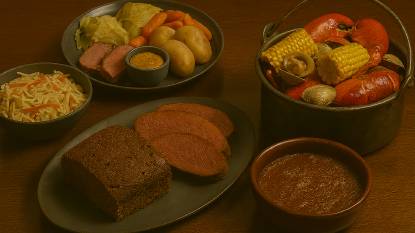


A plain Puritan people with a plain Puritan ethic brought a plain Puritan aesthetic to the shores of New England. Their culinary legacy, shaped by restraint and necessity, gave rise to a regional cuisine that values frugality and simplicity—even in the face of the New World’s unending abundance. Like much American cooking, New England’s foodways are a hybrid: English traditions of boiled meats, casseroles, and puddings meet Native American ingredients and techniques, resulting in a cuisine that is both austere and resourceful.
🐟 Cooking in New England
For better or worse, English cooking was the model—heavy, filling foods that combat the cold and don’t offend God by being too fussy or decadent. Yet Native Americans introduced corn, beans, and maple sugar, along with preservation and cooking methods that transformed colonial kitchens. Maple syrup, used as frequently then as salt is now, may explain the enduring American preference for sweetness: yams, honey-roasted ham, and sweet relishes with roasted meats all echo this early influence.
Despite its meager, rocky soil, New England proffered a bounty of raw ingredients. Fish of all kinds—especially cod, which was salted for winter—and shellfish were abundant. One colonial diarist famously lamented his endless meals of lobster: “lobster lobster lobster!” Game filled the forests and fields: venison, goose, turkey, and pheasant. Berries and nuts—cranberries, blueberries, strawberries, and hickory—blanketed the hills. Pigs, hardy and adaptable, thrived in nearly every condition, and salt pork became the backbone of countless recipes.
New England’s culinary influence extended far beyond its borders. As a launching site for westward migrations, its tastes traveled with settlers, reaching as far as the Pacific Northwest—where blueberry cobbler made from old Maine recipes still appears on menus. One-pot stews remain a hallmark of the region’s cooking, prized for their practicality and depth. Succotash, a blend of lima beans, hominy (called “samp” when made from white corn and “hulled corn” when made from yellow corn), and salt pork, was stewed in endless variations and became a dietary staple.
Baked beans, too, combine beans and salt pork, and debates over their ideal proportions persist. Traditionally, the mix was placed in a cast iron pot and buried in a coal-filled fire pit, Native American-style—or baked slowly in a brick oven. Boiled puddings merged English dessert traditions with indigenous ingredients: corn flour and molasses were favored, and Indian pudding and steamed brown bread remain enduring favorites. These dishes carry the spice signatures of colonial kitchens—mace, cinnamon, cloves, and ginger—used not lavishly, but with intention.
Chowder, with its characteristic Puritan blandness (which is not to say it is not delicious), or fish cakes might introduce a New England boiled dinner, whose only zap of flavoring comes from a dollop of mustard or a splash of vinegar. While simple, New England cooking at its best creates that full-bodied honesty that comes from the combination of bounty and basics—a cuisine shaped by restraint, sustained by abundance, and remembered for its quiet depth.
🐚 Some New England Favorites: Coastal Tradition and Colonial Heirlooms
New England’s culinary canon is built on restraint, resourcefulness, and reverence for the land and sea. These dishes, passed down through generations of settlers and shaped by the region’s rocky soil and bracing climate, reflect a cuisine that values depth over decoration. From shoreline rituals to pantry-born puddings, each preparation carries the imprint of both necessity and pride.
🌊 Clambake
An authentic clambake begins with a deep pit in which a fire has burned down to coals. On top of these coals, layer seaweed still full of the sea. Between seaweed layers, put clams, lobsters, corn on the cob, even fish. The food is steamed by the moisture in the kelp, so the meal is saturated with brisk air and black ocean. Of course, a deep pot can accomplish a pale but flavorful imitation. A mountain of corn bread is never too far away.
This is not just a meal—it’s a coastal rite, a communal feast that captures the Atlantic’s essence in every bite.
🍮 Indian Pudding
Much like steamed brown bread, Indian pudding begins with corn meal and molasses, to which are added milk, butter, and spices. The whole is baked until it becomes a rich, brown pudding.
Its texture is dense, its flavor dark and spiced—a colonial dessert that endures not for its elegance, but for its honest warmth.
🥩 New England Boiled Dinner
A fatty corned beef brisket is boiled in water with cabbage, potatoes, and any number of vegetables—perhaps corn or beans, carrots or celery. The liquid is drained, and the meal is served on a great platter in unadorned glory. A little sharp mustard or vinegar may be offered as a condiment.
This is a dish of substance, not flair. It speaks to the region’s Puritan roots, where nourishment and simplicity were virtues, not compromises.
🍞 Steamed Brown Bread
This is a soda bread that combines corn and other flours, such as rye or graham, with buttermilk and molasses. The batter is steamed in large cans or loaf pans on the stove-top.
The result is a moist, dark loaf with a subtle sweetness and a dense crumb—often served alongside baked beans, and always with a sense of tradition.
These New England favorites are not just recipes—they are cultural artifacts. They evoke hearths warmed by firewood, tables set with care, and a cuisine that honors the land’s limits while celebrating its quiet abundance.
5 New England Must-eats [Video]
Featured Articles
Explore rich culinary stories, exclusive chef interviews, and expert insights from kitchens around the world. Discover cooking techniques, ingredient spotlights, and behind-the-scenes looks at the tools that shape global cuisine.

Georges Auguste Escoffier: Visionary Chef Who Revolutionized French Cuisine and Modern Cooking
Discover the life and legacy of Georges Auguste Escoffier, the legendary chef who transformed French cuisine and laid the foundation for modern culinary arts. This comprehensive historical profile …
How to Use a Knife, Fork, and Spoon
Master the basics of Western table etiquette with this guide to using a knife, fork, and spoon. Learn practical tips, cultural context, and the subtle rules that shape how we dine.
The History of Chocolate
Trace the fascinating history of chocolate—from its ancient origins with the Olmecs and Maya to its transformation into a global indulgence. Explore how cacao evolved from sacred ceremonial drink to …
Georges Auguste Escoffier: Visionary Chef Who Revolutionized French Cuisine and Modern Cooking
Discover the life and legacy of Georges Auguste Escoffier, the legendary chef who …
How to Use a Knife, Fork, and Spoon
Master the basics of Western table etiquette with this guide to using a knife, fork, and …
The History of Chocolate
Trace the fascinating history of chocolate—from its ancient origins with the Olmecs and …