Southern Italian Cuisine: Poverty, Ingenuity, and the Soul of the Mediterranean

By: Simon
September 2, 2025 | Updated: February 17, 2026
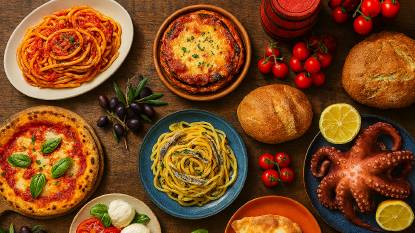


Italian cuisine is often celebrated for its elegance, variety, and regional depth—but nowhere is its soul more vividly expressed than in the kitchens of the south. In contrast to the butter-rich dishes of the north, Southern Italian cooking is shaped by rocky terrain, coastal abundance, and centuries of poverty-driven ingenuity. From the communal pasta-making rituals of Naples to the olive oil-soaked seafood of Calabria, this article explores how Southern Italy forged a cuisine that is bold, resourceful, and foundational—not only to Italy’s culinary identity, but to the Italian-American food culture that followed.
🏔️ Geography and Hardship: The Culinary Landscape
Southern Italy is mountainous, rocky, hot, and poor. These conditions have shaped its cuisine into one of resourcefulness and intensity, where flavor is coaxed from scarcity and tradition thrives in simplicity. Unlike the fertile plains of the north, the south’s soil is often inhospitable to dairy cattle and wheat monoculture. Yet from this rugged terrain emerges a cuisine that is bold, communal, and deeply expressive.
| Feature | Impact on Cuisine |
|---|---|
| Rocky terrain | Limited cattle farming; reliance on pork |
| Hot climate | Emphasis on dried pasta, olive oil, seafood |
| Coastal access | Rich seafood traditions |
| Economic hardship | Frugality, preservation, communal cooking |
🍝 Pasta Twice a Day, Never the Same
Pasta is present at both the midday and evening meal, but even though it’s eaten twice a day, it never tastes the same twice and never gets boring. Southern Italy’s pasta culture is deeply regional, with shapes, sauces, and techniques varying from village to village.
- In Campania, you’ll find paccheri—large tubes often stuffed with ricotta and baked.
- In Puglia, orecchiette (“little ears”) are hand-rolled and served with broccoli rabe and anchovies.
- In Calabria, spicy fileja pasta is twisted around thin rods and paired with fiery ’nduja sausage.
Pasta is not just food—it’s ritual, often made in communal gatherings known as pasta bees, where women roll dough together in courtyards and markets.
🍕 Naples: The Culinary Capital of the South
Naples is the food center—perhaps you’ve heard of pizza? It’s not just the birthplace of the Margherita; it’s the epicenter of Southern Italian culinary identity.
Poor Italians from Naples and Sicily came to the United States by the boatload in the early part of the 20th century. It is their influence, more than any other, which has created the Italian-American food known so well in the States.
🇺🇸 Italian-American Legacy
Neapolitans were the restaurateurs in the new world, and as every food aficionado is quick to point out, the homogenized fare of the classic Italian restaurant is at best Neapolitan, and at worst representative of no place in particular—a hybrid that meets Italian foods from here and there with American tastes.
| Dish Origin | Italian-American Adaptation |
|---|---|
| Pizza Napoletana | New York-style pizza |
| Pasta al forno | Baked ziti with mozzarella |
| Parmigiana | Chicken parm (not found in Italy) |
| Sicilian arancini | Rice balls with marinara and cheese |
🫓 Bread, Dough, and Social Ritual
Southerners are affable and volatile. They love a great feast. Pasta and bread making were—and still are—social rituals, often carried out in open-air settings.
A simple yeasted dough is another starchy staple of southern cooking. Long-proofed Italian bread is light and crusty, baked in wood-fired ovens and shared communally.
🍞 Dough-Based Staples
- Calzone: Folded pizza dough stuffed with cheese, vegetables, or cured meats.
- Pizza: Thin, blistered crust with minimal toppings—anchovies, garlic, and tomato.
- Focaccia: Olive oil-rich flatbread, often topped with herbs or sliced potatoes.
These neutral staples become platforms for flavor, absorbing oils, sauces, and fillings with ease.
🐄 North vs. South: A Tale of Two Italies
Steer and dairy cows thrive in northern Italy, and so its cuisine is marked by a prevalence of beef and rich butter- and cream-based sauces. Southern Italians are not only poorer than their neighbors but also live in a region which, with its rocky soil, is inhospitable to cows.
So, beef, butter, and cream play a much less prominent role. Instead, the south relies on pork, olive oil, and vegetables.
| Ingredient | Northern Italy | Southern Italy |
|---|---|---|
| Fat source | Butter, cream | Olive oil |
| Protein | Beef, veal | Pork, lamb, seafood |
| Cheese | Parmigiano, Taleggio | Pecorino, ricotta, mozzarella |
| Pasta sauces | Cream-based | Tomato, garlic, anchovy |
🐖 Pork, Lamb, and the Southern Hearth
Pigs are a beloved beast in the south. Pork is used for cooking fat, sausages like mortadella, bacon or pancetta, ham, and a hundred other things. Southerners, especially Romans, are also justly famous for their spit-roasted abbacchio, or milk-fed baby lamb that has never tasted grass.
These meats are often slow-cooked, grilled, or cured, forming the backbone of celebratory meals and everyday fare alike.
🌿 Oil, Vegetables, and the Sea
The soil does nourish the olive tree, and so southern cooking is oil-based. Her sauces are filled with the vegetables and seafood that are always nearby and don’t want heavy creams to cover their flavors.
🐟 Frutti di Mare: The Mediterranean’s Bounty
Sardines and anchovies are prominent. Eel, shellfish, and other Mediterranean frutti di mare can be found:
- Cooked in white wine with garlic and parsley
- Grilled over open flames
- Deep-fried in semolina flour
- Tossed on pasta with olive oil and lemon
Southern sauces are bright, briny, and vegetal, often featuring tomatoes, capers, olives, and wild herbs.
🧀 Cheese from the South: Milk Without Cows
Cheeses are made from the milks of all types of livestock—pigs excluded. In the south, where cows are rare, sheep and goats provide the milk for some of Italy’s most iconic cheeses.
| Cheese | Milk Source | Region | Notes |
|---|---|---|---|
| Pecorino | Sheep | Calabria/Sicily | Salty, aged, used for grating |
| Ricotta | Sheep/Cow | Campania | Soft, fresh, used in pasta and desserts |
| Mozzarella | Buffalo | Campania | Mild, elastic, essential for pizza |
| Caciocavallo | Cow | Basilicata | Aged, stretched-curd, often smoked |
These cheeses are versatile and expressive, used in everything from stuffed pasta to street food.
Southern Italian cuisine is not defined by luxury—it’s defined by ingenuity, community, and boldness. It’s a cuisine born of hardship, shaped by geography, and elevated by ritual. From the pasta bees of Naples to the olive groves of Calabria, every dish tells a story of survival and celebration.
Southern Italian Dishes [Video]
Featured Articles
Explore rich culinary stories, exclusive chef interviews, and expert insights from kitchens around the world. Discover cooking techniques, ingredient spotlights, and behind-the-scenes looks at the tools that shape global cuisine.

Georges Auguste Escoffier: Visionary Chef Who Revolutionized French Cuisine and Modern Cooking
Discover the life and legacy of Georges Auguste Escoffier, the legendary chef who transformed French cuisine and laid the foundation for modern culinary arts. This comprehensive historical profile …
How to Use a Knife, Fork, and Spoon
Master the basics of Western table etiquette with this guide to using a knife, fork, and spoon. Learn practical tips, cultural context, and the subtle rules that shape how we dine.
The History of Chocolate
Trace the fascinating history of chocolate—from its ancient origins with the Olmecs and Maya to its transformation into a global indulgence. Explore how cacao evolved from sacred ceremonial drink to …
Georges Auguste Escoffier: Visionary Chef Who Revolutionized French Cuisine and Modern Cooking
Discover the life and legacy of Georges Auguste Escoffier, the legendary chef who …
How to Use a Knife, Fork, and Spoon
Master the basics of Western table etiquette with this guide to using a knife, fork, and …
The History of Chocolate
Trace the fascinating history of chocolate—from its ancient origins with the Olmecs and …