Sicilian Cuisine

By: Simon
July 19, 2026 | Updated: September 12, 2026

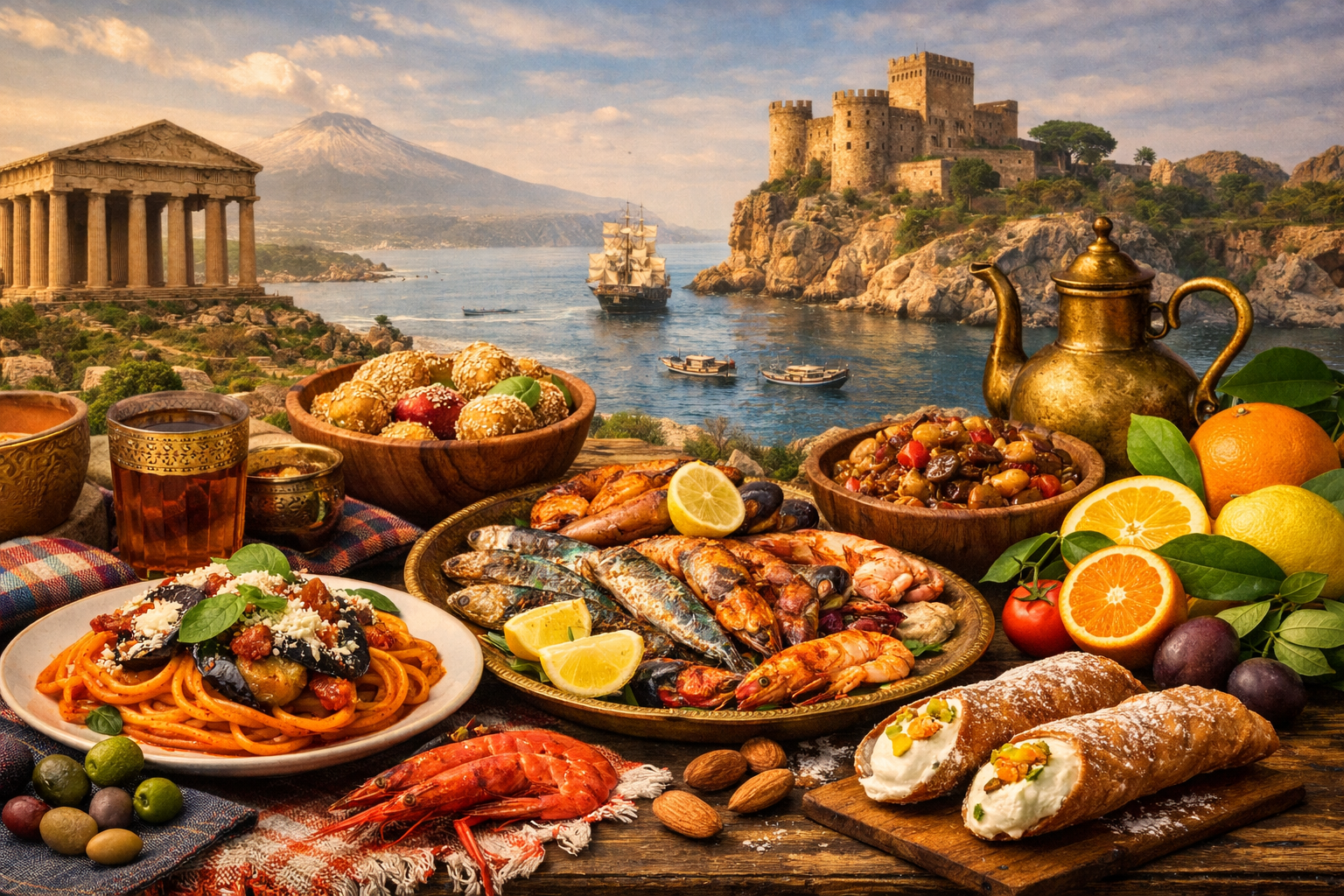
Sicily sits at the crossroads of the Mediterranean, a triangular island that has been conquered, colonized, and coveted by nearly every major power of the last three millennia. It contributes an important piece of the puzzle that is Italian cuisine, distinct from the traditions of both Rome and the mainland.
The Greeks came first in a serious way, planting vineyards and olive groves. The Romans turned the island into a granary. The Byzantines brought sweet and sour flavors. The Arabs transformed the agricultural landscape entirely, introducing citrus, sugar, rice, and the techniques that would give the world dried pasta. The Normans brought a taste for meat. The Spanish shipped in tomatoes, chocolate, and peppers from the New World.
Every single one of these cultures left something behind in the kitchen, making Sicily a cornerstone of Southern Italian cuisine. Sicilian cuisine is not a single tradition. It is a layered archive of human migration, conquest, and exchange. And it is one of the most extraordinary food cultures on earth.
Let me take you through it.
The Island That Belonged to Everyone
To understand Sicilian food, you have to understand that the island was never truly isolated. Sitting at the center of the Mediterranean, it was a natural stopping point for traders, invaders, and settlers from Europe, Africa, and the Middle East. The history of Sicilian cuisine is really a history of the Mediterranean itself.
The earliest Greek colonists arrived around 734 BC and founded cities like Syracuse, Naxos, and Messina. They brought grapes for wine, olives for oil, and wheat for bread. They also brought something less tangible but equally important: a philosophy of dining that elevated food to an art form. The Greek colony of Syracuse became one of the most powerful cities in the ancient world, and its kitchens reflected that wealth.
But the Greeks were just the beginning. The Romans turned Sicily into the breadbasket of the empire, exporting vast quantities of grain. The Byzantines followed, favoring sweet and sour combinations that would later resonate in Arab and Sicilian cooking alike. Then came the Arabs in 827 AD, and everything changed.
The Greek Foundation: Olives, Grapes, and the First Cookbook
Before we get to the Arab influence, we should pause to appreciate what the Greeks gave Sicily. The island’s climate is ideal for olive trees and grapevines, and the Greeks knew exactly what to do with both. Sicily’s olive oil is still among the most prized in Italy, and its wines (think Nero d’Avola and Marsala) have deep roots in this ancient tradition.
The Greeks also gave Sicily something more surprising: the first named cookbook author in Western history. A Sicilian Greek named Mithaecus, who lived during the 5th century BC, wrote a cookbook that is referenced in later Greek texts. Only fragments survive, but they are enough to confirm that Sicilian gastronomy was already being taken seriously more than 2,400 years ago. Mithaecus is credited with bringing Sicilian culinary knowledge to Greece proper, which means the influence flowed both ways.
The Greek love of fish, legumes, fresh vegetables, and wheat set a foundation that later cultures would build upon. The Greeks introduced broad beans, chickpeas, lentils, almonds, and pistachios. These ingredients remain central to Sicilian cooking today, from the fava bean soup called maccu to the pistachio-studded desserts of Bronte.
The Arab Transformation: Sugar, Citrus, and the Soul of Sicilian Food
If the Greeks laid the foundation, the Arabs built the house. The Arab domination of Sicily lasted from 827 to 1091 AD, and it permanently reshaped what Sicilians eat and how they eat it.
The Arabs brought something Sicily had never seen in quantity: sugar. Before the Arab conquest, sugar was a rare luxury in Europe. The Arabs established sugar cane plantations in Sicily, and with sugar came an entire culture of sweets that the island has never abandoned. Sicilian desserts are not an afterthought. They are a central expression of the culture, and they trace directly back to Arab confectionery traditions.
The Arabs also brought citrus fruits: oranges, lemons, and limes. They brought rice, spinach, and saffron. They introduced eggplants (aubergines), which would become one of the most iconic ingredients in Sicilian cooking. They brought advanced irrigation techniques that allowed dry, semiarid land to support orange groves and artichoke fields. The word for artichoke in Sicilian, cacocciuli, comes directly from the Arabic kharshuf.
Perhaps most importantly, the Arabs introduced the sweet and sour flavor profile known as agrodolce. This balance of sugar and vinegar shows up in dish after dish: caponata, sweet and sour swordfish, and many pasta sauces that combine raisins, pine nuts, and tangy tomatoes. The Arab love of combining sweet and savory elements in a single dish became a defining characteristic of Sicilian cuisine.
The Birth of Pasta in the West
This is the claim that surprises most people. Did pasta really come to Italy through Arab Sicily? The evidence is strong.
In 1154, an Arab geographer named Muhammad al-Idrisi was working at the court of the Norman King Roger II in Palermo. He wrote a description of a small Sicilian town called Trabia, noting that its people made large quantities of a stringlike dried food called itriya and shipped it by the boatload to markets across the Mediterranean. This is the earliest clear written evidence of industrial pasta production in what would become Italy.
The word itriya derives from the Arabic itriyya, meaning a thin, dried strand of dough. It appears in medieval Arabic cookbooks and in Jewish rabbinic texts from the same period. In Sicilian dialect, the word trija survived for centuries.
The key innovation was drying. Fresh pasta was common in many ancient cultures. But the Arabs perfected the technique of drying durum wheat pasta so it could be stored for months and transported without spoiling. This turned pasta from a local food into a trade commodity. And it happened in Sicily.
Today, Sicilian pasta dishes are legendary: pasta alla Norma (with eggplant, tomatoes, and salted ricotta), pasta con le sarde (with sardines, wild fennel, raisins, and pine nuts), and spaghetti ai ricci di mare (with sea urchin). Each dish tells a story of the island’s layered history.
From the Sea: Tuna, Swordfish, and the Sicilian Coast
Sicily is an island, and the sea has always been central to its food culture. The waters around Sicily are rich with tuna, swordfish, sardines, anchovies, sea bass, and sea urchin. Fishing has been a way of life here since ancient times.
The Sicilian approach to seafood is distinctive. It is rarely complicated. A swordfish steak might be grilled with nothing more than olive oil, lemon, and oregano. Or it might be prepared alla ghiotta, simmered with tomatoes, olives, capers, and garlic in a sauce that captures the bright, briny flavors of the Mediterranean.
Tuna fishing has a particularly long history in Sicily. The tonnara (tuna fishery) system dates back to Arab times, with huge nets strung between boats to trap bluefin tuna during their migration. The town of Favignana, off the western coast, was famous for its tuna fishery. The belly meat, or ventresca, is considered a delicacy.
Sardines feature prominently in Sicilian cooking, most famously in pasta con le sarde, a dish that combines sardines with wild fennel, raisins, pine nuts, and saffron. This is the Arab influence in a single bowl: the sardines are local, but the combination of sweet and savory, the use of dried fruit and nuts, and the warm spice of saffron all point to North Africa.
In Trapani, on the western coast, the North African influence is even more direct. The city is famous for its couscous alla trapanese, a fish couscous that is essentially identical to the couscous dishes of Tunisia. It is made by hand-rolling durum wheat semolina into tiny grains, steaming them, and serving them with a rich fish broth. The annual Couscous Festival in San Vito Lo Capo celebrates this shared heritage.
The Vegetable Garden: Eggplants, Artichokes, and Caponata
If you had to choose one dish that captures the essence of Sicilian cooking, it might be caponata. This sweet and sour vegetable stew typically features eggplants, tomatoes, celery, olives, capers, and pine nuts, all cooked down into a rich, tangy medley. It is served at room temperature as a starter or side dish, and it improves with time.
Caponata’s history reflects the island’s Arab and Spanish influences. The sweet and sour agrodolce balance is pure Arab. Some versions also include raisins, which were introduced by Arab traders. The Spanish later contributed tomatoes and peppers from the New World. The dish has been made on the island since at least the 18th century.
Eggplants are a true Sicilian staple. They are the star of pasta alla Norma, which originated in Catania and is named after Vincenzo Bellini’s opera Norma. The dish combines fried eggplant with tomatoes, basil, and salted ricotta. It is simple, satisfying, and deeply Sicilian.
Artichokes are another defining ingredient. The fertile plains around Ramacca produce some of the best artichokes in Italy. Farmers there still grow varieties whose DNA can be traced back to North Africa. In spring, artichokes appear in everything from salads to pasta sauces to frittatas.
A Dessert for Every Occasion: Cannoli, Cassata, and Granita
Sicilians take their sweets seriously. There is a dessert for every holiday, every saint’s day, and every family celebration. And almost all of them trace back to Arab confectionery traditions.
Cannoli are the most famous. These crispy, fried pastry tubes are filled with sweet ricotta cream, often studded with chocolate chips or pistachios. They are said to have originated during Arab rule, possibly as a Carnival treat. The name cannolo means “little tube,” and the best ones are fried to order and filled just before serving so the shell stays crisp.
Cassata is the Queen of Sicilian desserts. A sponge cake soaked in fruit juice or liqueur, layered with sweet ricotta, and covered in marzipan and colorful candied fruits, it is a visual and culinary spectacle. The word cassata may derive from the Arabic qas’at, meaning “bowl,” a reference to the round mold used to shape the cake. The sponge cake itself, with its light, airy texture, was refined in Sicilian convents during the Spanish period.
Granita is something else entirely. A semi-frozen dessert made from sugar, water, and flavorings, it is neither a snow cone nor a sorbet. In Sicily, granita has a coarse, crystalline texture that varies from city to city. In Palermo, it is chunkier. In Catania, it is smoother, almost like gelato. The food writer Jeffrey Steingarten noted that the desired texture seems to vary from town to town. Granita is traditionally eaten for breakfast, served with a soft brioche bun for dipping.
Marzipan, called pasta di mandorle in Italian and frutta martorana in Sicily, is another Arab legacy. The almond paste is shaped and painted to look like real fruits and vegetables, an art form that originated in the Convent of the Martorana in Palermo during the 14th century. Convent sweets remain a Sicilian specialty, with nuns still producing traditional pastries in monasteries across the island.
The Mediterranean Melting Pot on a Plate
Sicilian cuisine does not fit neatly into categories. It is Italian, yes, but it is also Arab, Greek, Spanish, and Norman. It is Mediterranean in the truest sense: a cuisine shaped by trade winds and invasion routes, by the movement of people and the exchange of ideas.
The ingredients are simple. Eggplants, tomatoes, sardines, olives, almonds, lemons, and ricotta. But the combinations are sophisticated, balancing sweet and sour, salty and rich, crunchy and creamy. This is not accidental. It is the result of centuries of culinary cross-pollination.
Every time you eat a cannolo, you are tasting the Arab love of sugar and almonds. Every time you enjoy pasta alla Norma, you are eating a dish that could only exist in a place where eggplants, tomatoes, and ricotta all came together under one sun. Every time you sprinkle lemon on grilled fish, you are using a fruit that Arab farmers first cultivated on this island a thousand years ago.
Sicily is often called a melting pot. But that phrase suggests that different elements lose their identity and blend into one. Sicilian food is more like a mosaic. The Greek, Arab, Norman, Spanish, and Italian influences are all still visible, distinct, and identifiable. They sit side by side on the same plate, each contributing something essential to the whole.
That is what makes Sicilian cuisine so special. It does not hide its history. It serves it on a plate.
Sicilian Cuisine Video
To see the flavors and landscapes of Sicily come to life, watch this beautiful documentary featuring art historian Andrew Graham-Dixon and Michelin-starred chef Giorgio Locatelli as they explore the island’s food and culture.
Featured articles
Explore rich culinary stories, exclusive chef interviews, and expert insights from kitchens around the world. Discover cooking techniques, ingredient spotlights, and behind-the-scenes looks at the tools that shape global cuisine.

Georges Auguste Escoffier: Visionary Chef Who Revolutionized French Cuisine and Modern Cooking
Discover the life and legacy of Georges Auguste Escoffier, the legendary chef who transformed French cuisine and laid the foundation for modern culinary arts. This comprehensive historical profile …
How to Use a Knife, Fork, and Spoon
Master the basics of Western table etiquette with this guide to using a knife, fork, and spoon. Learn practical tips, cultural context, and the subtle rules that shape how we dine.

The History of Chocolate
Trace the fascinating history of chocolate, from its ancient origins with the Olmecs and Maya to its transformation into a global indulgence. Explore how cacao evolved from sacred ceremonial drink to …
Georges Auguste Escoffier: Visionary Chef Who Revolutionized French Cuisine and Modern Cooking
Discover the life and legacy of Georges Auguste Escoffier, the legendary chef who …
How to Use a Knife, Fork, and Spoon
Master the basics of Western table etiquette with this guide to using a knife, fork, and …
The History of Chocolate
Trace the fascinating history of chocolate, from its ancient origins with the Olmecs and …