Roman Cooking: The Ancient Roots and Enduring Flavors of Italy's Capital

By: Simon
July 19, 2026 | Updated: September 12, 2026

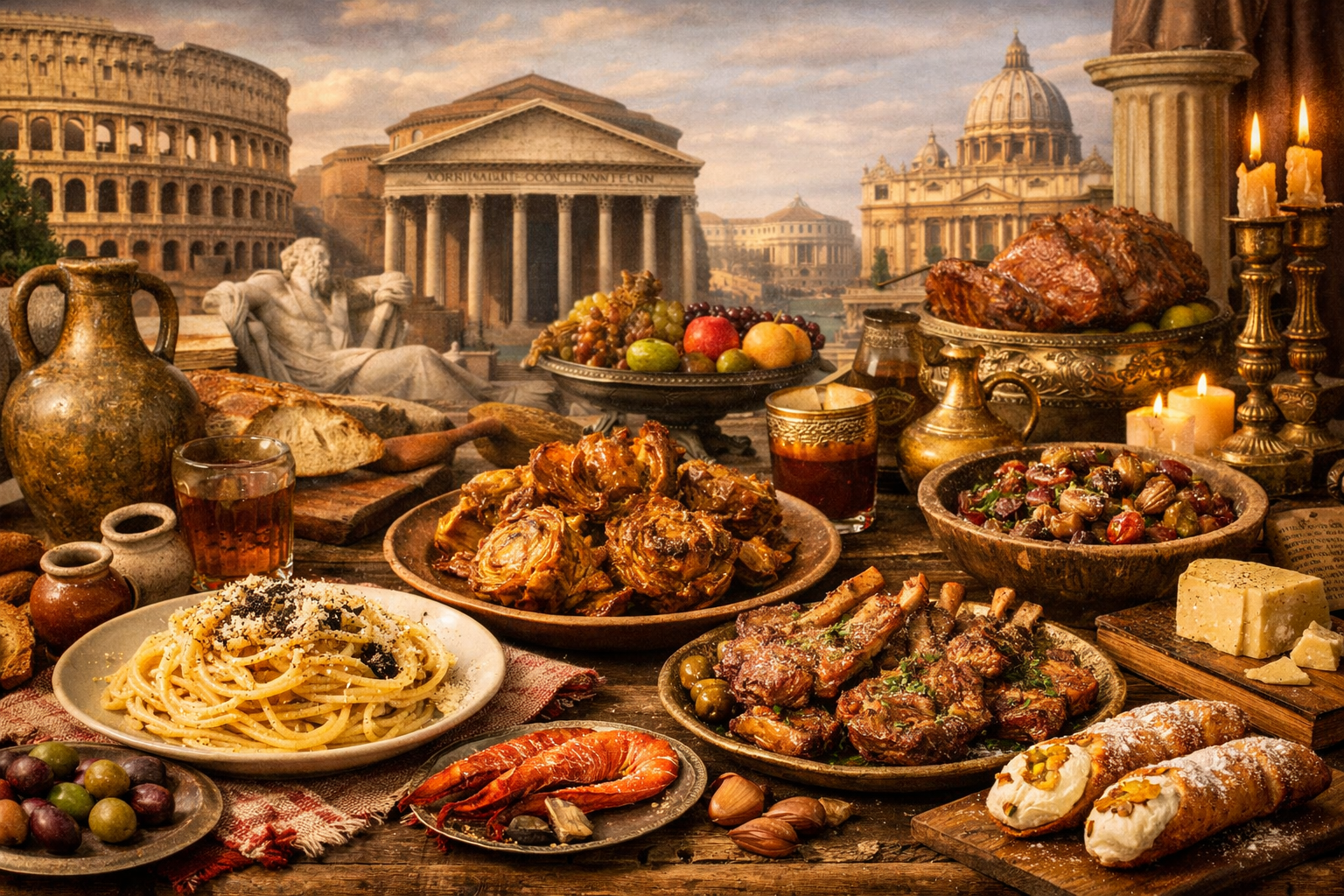
Rome has never been a city of half measures. For more than two thousand years, the Eternal City has fed its people, its emperors, its popes, and its pilgrims with a cuisine that swings between extremes: lavish banquets that would make a pharaoh blush and humble pasta dishes made from just three ingredients. There is no single Roman haute cuisine in the way Paris has haute couture. But Rome has something better. It has a food story that stretches from the vomitorium to the trattoria, from fermented fish guts to fried artichokes, and from imperial excess to the disciplined simplicity of a perfect plate of cacio e pepe. To understand Rome’s place in the broader picture of Italian cuisine, you have to look at how the city’s cooking reflects both its history and its geography, and how it differs from the butter-rich dishes of Northern Italy.
Let us start at the beginning, when Roman cooking was anything but simple, before the Arab and Norman influences that would later shape Sicilian cuisine.
When Dinner Was a Display of Power
Ancient Roman banquets were not really about food. They were about theater. They were about power. They were about showing every guest in the room that you had more money than they did, and you were not afraid to prove it by serving roasted flamingo.
The wealthy Romans of the late Republic and early Empire threw dinner parties that would make modern food influencers weep with envy. Hosts competed to serve the rarest, most expensive, and most shocking dishes they could procure. Fish was a particular favorite, especially if it could be presented to guests still alive. Some hosts served fish in glass jars so diners could watch the creature slowly die before their eyes. Roe deer, suckling pig, partridges, flamingoes, and parrots all found their way onto banquet tables. The more exotic the animal, the greater the host’s prestige.
These feasts became so extravagant that the Roman government repeatedly tried to rein them in through a series of sumptuary laws. In 215 BCE, the Lex Oppia restricted what women could wear and how much gold they could display. In 161 BCE, the Lex Fannia capped the amount of money that elites could spend on banquets. But these laws were about as effective as asking a tiger to stop eating meat. Wealthy Romans found loopholes, ignored the rules, and kept right on feasting. The laws were passed repeatedly because they were violated repeatedly.
The Roman cookbook De Re Coquinaria, attributed to the legendary gourmand Apicius, gives us a window into this world of extreme dining. Apicius was not just a cook. He was a figure of almost mythical extravagance. He reportedly traveled to North Africa to sample a particularly fine variety of shrimp, found it disappointing, and sailed home without buying any. The cookbook that bears his name contains hundreds of recipes, many of which call for garum, the fermented fish sauce that was the ketchup of the ancient world.
Garum: The Secret Weapon of Roman Kitchens
If there is one ingredient that defined ancient Roman cooking, it was garum. Today, we might call it liquid umami. The Romans called it liquid gold.
Garum was made by layering fish intestines, small fish, and salt in a vat and leaving it to ferment in the sun for months. The result was a pungent, deeply savory sauce that the Romans used on everything. Roasted meats, stewed vegetables, sauces, and even some desserts all got a splash of garum. The recipe collection of Apicius calls for garum in nearly every dish.
The Romans did not stop at plain garum. They created compounded versions by adding herbs and spices: dill, anise, hyssop, thyme, rue, cumin, poppy seeds, garlic, and many more. Each combination produced a different flavor profile for a different dish. There was a garum for every occasion, much the way a modern kitchen might have soy sauce, fish sauce, Worcestershire sauce, and Maggi seasoning all in the same pantry.
Garum was produced across the Roman Empire, from Spain to North Africa to the Black Sea. Archaeological sites like Baelo Claudia in Spain still show the ruins of garum factories with their fermentation vats carved into stone. The sauce was traded in amphorae across the Mediterranean, and it remained a staple of Byzantine and medieval Arab cuisine long after the Western Roman Empire fell.
But for all its ubiquity, garum disappeared from European kitchens after the Middle Ages. It was not until the modern revival of ancient Roman cooking that chefs began to rediscover this lost ingredient. Today, artisanal producers in Italy, Spain, and Portugal are making garum again, and you can find it on the shelves of specialty food shops. It tastes remarkably similar to the fish sauces used in Southeast Asian cooking. In a way, garum never really went away. It just changed its name and moved east.
The Medici Influence on Roman Tables
After the fall of the Roman Empire, Rome’s culinary identity went through a long transformation. The city was no longer the center of a vast empire. It became the seat of the papacy, and its food reflected that shift.
At the beginning of the 16th century, a Florentine named Giovanni de’ Medici became Pope Leo X in 1513. Leo was the second son of Lorenzo the Magnificent, and he had grown up surrounded by the artistic and culinary sophistication of Florence. When he moved to Rome, he brought the theatrical Florentine feast tradition with him.
The Medici popes were famous for their lavish banquets, but there was a difference between these Renaissance feasts and the ancient Roman excesses that had come before. Medici feasts were more refined. They emphasized artistry and presentation over sheer gluttony. The food was still abundant, but it was also beautiful. Sculpted sugar centerpieces, gilded meats, and elaborate pasta sculptures were the order of the day.
Pope Leo X was a generous host who spent enormous sums on entertaining. His banquets featured peacock, sturgeon, and elaborate pastries. But the Medici influence also brought something more lasting to Roman cooking: a respect for ingredients and a preference for simplicity where complexity was not needed. This Florentine sensibility would slowly merge with the robust, earthy cooking of Rome to create the foundations of modern Roman cuisine.
The Birth of Modern Roman Simplicity
Here is the paradox of Roman cooking. The ancient Romans feasted with wild abandon. But modern Romans cook with resolute simplicity. How did we get from garum-drenched flamingo to a plate of pasta with nothing but cheese and pepper?
The answer lies in the gap between the wealthy and everyone else. The extravagant banquets of ancient Rome were for the elite. Most Romans ate far more modestly. Bread, olives, wine, and a bit of cheese or fish made up the daily diet of the common person. This tradition of simple eating never went away. It just got better over time.
Modern Roman cooking is grounded in what Italians call cucina povera, or the cooking of the poor. This is not a style of deprivation. It is a style of ingenuity. When you have very little, you learn to make the most of every ingredient. You develop techniques that transform humble staples into memorable meals.
The classic Roman pastas are the perfect example. Cacio e pepe uses just three ingredients: pasta, Pecorino Romano cheese, and black pepper. That is it. But the technique of emulsifying the cheese with starchy pasta water creates a creamy, velvety sauce that feels luxurious. The same principle applies to carbonara (eggs, guanciale, cheese, pepper), amatriciana (guanciale, tomato, cheese), and gricia (guanciale, cheese, pepper). These are not complicated dishes. But they demand precision and respect for ingredients.
The Romans have a particular fondness for organ meats, a legacy of cucina povera in which no part of the animal went to waste. You name it, they love it. Tripe, kidney, liver, sweetbreads, and oxtail all feature prominently in traditional Roman cooking. The famous dish coda alla vaccinara is a slow-braised oxtail stew that cooks for hours until the meat is falling apart. Pajata is the intestine of a milk-fed calf, cleaned and cooked whole. These dishes may sound challenging to the uninitiated, but they are deeply flavorful and deeply Roman.
Abbacchio: The Soul of Roman Lamb
No discussion of Roman meat dishes would be complete without abbacchio. This is the word Romans use for milk-fed lambs that have never eaten grass. The lambs are typically between 30 and 60 days old. They have lost most of their baby fat, but their meat has not yet become tough. The result is a tender, delicately flavored meat that Romans treasure.
Abbacchio appears in several classic preparations. The simplest is abbacchio al forno, a straightforward roast with rosemary, garlic, and white wine. This is the dish Romans traditionally eat on Easter Sunday. Then there is abbacchio alla cacciatora, which translates to “hunter’s style.” The lamb is browned in a wide pan and then braised slowly with garlic, rosemary, white wine vinegar, and anchovy fillets. The anchovies melt into the sauce, adding depth without any fishy taste.
Another preparation is abbacchio brodettato, in which the lamb is stewed with a sauce of lemon and egg. This technique, similar to the Greek avgolemono, produces a rich, tangy sauce that clings to the meat. And then there is abbacchio a scottadito, which means “burn your fingers.” These are thin lamb chops marinated in rosemary, garlic, and lemon, grilled fast over high heat, and eaten hot off the bone with your hands. The name comes from the fact that you simply cannot wait for them to cool down.
The Jewish Ghetto: Rome’s Hidden Culinary Heart
One of the most important influences on Roman cooking came from an unlikely source: the Jewish Ghetto.
Rome’s Jewish community is the oldest continuous Jewish community in Europe, dating back at least to the 2nd century BCE. But in 1555, Pope Paul IV issued the bull Cum Nimis Absurdum, which confined the Jews of Rome to a small, walled area near the Tiber River. This was the Roman Ghetto, and it would remain in place for more than 300 years.
Living conditions in the ghetto were cramped and difficult. The area was prone to flooding from the Tiber. Disease was common. And the Jewish community faced severe restrictions on what professions they could practice and what property they could own. But out of this hardship emerged one of the great cuisines of Italy.
The Jews of the ghetto developed their own variation on Roman cooking, shaped by kosher dietary laws and limited resources. They could not afford expensive cuts of meat, so they became masters of offal and organ meats. They could not use butter or lard with meat dishes, so they turned to olive oil for frying. And because they were confined to the ghetto, they had to make do with whatever ingredients were available in their neighborhood.
The most famous dish to emerge from this tradition is carciofi alla giudia, or Jewish-style fried artichokes. The preparation is deceptively simple. Whole artichokes are trimmed, pressed flat, and fried twice in olive oil. The first fry at a lower temperature cooks the heart through. The second fry at a higher temperature turns the outer leaves into golden, paper-thin crisps. The result is a dish that looks like an open flower, crispy on the outside and buttery soft in the center. It is traditionally served during Yom Kippur to break the fast, but you can find it on menus throughout Rome year-round.
The Jewish ghetto also played a surprising role in changing how Italians thought about a controversial vegetable: the eggplant. Eggplant is a member of the nightshade family, which includes some genuinely poisonous plants. For centuries, Europeans feared it. Some thought it caused leprosy. Others called it the “mad apple” and believed it could drive you insane.
The Jews of the Roman Ghetto, drawing on culinary traditions from their Mediterranean roots, knew better. They had been cooking with eggplant for generations and had learned how to tame its bitterness with salt and transform its spongy texture into something delightful. They demonstrated to Rome, and eventually to all of Italy, that eggplant was not only safe to eat but delicious. Today, eggplant is a staple of Italian cooking, from parmigiana to caponata. But few people remember that it was the Jewish cooks of the ghetto who first made it welcome on Italian tables.
Fritto Misto: A Roman Obsession
The Jewish ghetto’s mastery of frying did not stop at artichokes. Romans, in general, are exceptionally good at fritto misto, the classic mound of mixed fried foods. The name means “mixed fry,” and in Rome, that can mean just about anything.
A Roman fritto misto might include small pieces of veal, chicken, lamb brain, artichoke hearts, zucchini, mozzarella, and potato croquettes, all lightly battered and fried until golden and crisp. The key is the lightness of the batter. Roman frying is not heavy or greasy. The coating is so thin you can see the food through it. The oil must be hot and clean, and the frying must be done in small batches so the temperature never drops.
In the Jewish ghetto, the tradition of frying took on added significance because of Hanukkah, the festival of lights that celebrates the miracle of a small amount of oil burning for eight days. Fried foods are traditionally eaten during Hanukkah, and the Jews of Rome took this obligation as an opportunity to perfect their technique. They fried fish, they fried vegetables, they fried fruits, and they even fried ricotta cheese. Every one of these preparations found its way into the broader Roman culinary repertoire.
Fish Without a Port
One of the more surprising aspects of Roman cooking is the city’s love of seafood. Rome is not a port city. It sits about 15 miles inland from the Tyrrhenian Sea. Yet fish markets in Rome are abundant and excellent.
This tradition goes back to ancient times, when the Tiber River connected Rome to the sea and the port of Ostia brought fresh fish upriver. Today, the markets of Rome are still stocked with everything from tiny sprats to giant tuna. The Romans love baccalà (salt cod), which they fry into golden fritters. They love seppie (cuttlefish), which they braise with peas in a classic spring dish. And they love vongole (clams), which they toss with spaghetti, garlic, white wine, and parsley.
Snails are also popular in Rome, especially in the Testaccio neighborhood. Roman snails are typically prepared alla romana, which means cooked with garlic, anchovies, and white wine, then served in their shells with plenty of bread for soaking up the sauce.
The Flavor of Rome
So what does Roman food actually taste like? If you had to identify the defining flavors of the city, you would start with the classic southern Italian aromatics: garlic, black pepper, rosemary, and parsley. These four ingredients form the backbone of countless Roman dishes.
But Rome has an added fondness for mint, which appears more frequently here than in other Italian cuisines. Roman cooks add mint to lamb dishes, to vegetable soups, to stuffed zucchini flowers, and to fave (fresh fava beans), which are eaten with pecorino cheese in the spring.
Beans are essential to Roman cooking, just as they are in every part of Italy. The Romans love pasta e fagioli, a thick soup of pasta and beans that is more stew than soup. They love fagioli al fiasco, beans cooked slowly in a flask with olive oil, sage, and garlic. And they love lenticchie, lentils, which they eat on New Year’s Eve for good luck.
The herbs in Roman cooking are used with restraint. A sprig of rosemary here, a few leaves of sage there. The goal is not to overwhelm but to enhance. Roman cooks trust their ingredients. If the lamb is good, it needs very little help. If the artichokes are fresh, they need only salt, pepper, and good olive oil.
This philosophy of restraint is what makes Roman cooking so difficult to master. It is easy to hide behind a dozen spices. It is much harder to make a dish of three ingredients sing. But when it is done right, there is nothing quite like it.
Eating Rome Today
To eat in Rome today is to taste all these layers of history at once. You can sit in a trattoria in the Jewish Ghetto, under the arches of the Portico d’Ottavia, and eat carciofi alla giudia that were prepared using techniques perfected four centuries ago. You can walk across the Tiber to Trastevere and order cacio e pepe made with a recipe that shepherds carried with them in their saddlebags. You can go to Testaccio, the old slaughterhouse district, and eat coda alla vaccinara that tastes the way it has tasted for generations.
Rome has not forgotten its past. But it has also not let the past define it. The city’s food culture is alive and evolving. Young Roman chefs are experimenting with ancient grains, reviving forgotten recipes, and finding new ways to express the old flavors of their city.
And somewhere in the background, you can still hear the echo of those ancient Roman banquets. The tables are no longer laden with flamingo and fermented fish sauce. But the spirit of generosity, the love of good ingredients, and the belief that food should be both nourishing and joyful is still very much alive.
Roman cooking has come full circle. From the excess of empire to the constraints of the ghetto, from the refinement of the Medici to the ingenuity of the poor, it has arrived at a place of beautiful balance. It is simple but not simplistic. It is humble but not ordinary. It is, in every sense of the word, eternal.
Roman Cooking Video
Featured articles
Explore rich culinary stories, exclusive chef interviews, and expert insights from kitchens around the world. Discover cooking techniques, ingredient spotlights, and behind-the-scenes looks at the tools that shape global cuisine.

Georges Auguste Escoffier: Visionary Chef Who Revolutionized French Cuisine and Modern Cooking
Discover the life and legacy of Georges Auguste Escoffier, the legendary chef who transformed French cuisine and laid the foundation for modern culinary arts. This comprehensive historical profile …

How to Use a Knife, Fork, and Spoon
Master the basics of Western table etiquette with this guide to using a knife, fork, and spoon. Learn practical tips, cultural context, and the subtle rules that shape how we dine.

The History of Chocolate
Trace the fascinating history of chocolate, from its ancient origins with the Olmecs and Maya to its transformation into a global indulgence. Explore how cacao evolved from sacred ceremonial drink to …
Georges Auguste Escoffier: Visionary Chef Who Revolutionized French Cuisine and Modern Cooking
Discover the life and legacy of Georges Auguste Escoffier, the legendary chef who …
How to Use a Knife, Fork, and Spoon
Master the basics of Western table etiquette with this guide to using a knife, fork, and …
The History of Chocolate
Trace the fascinating history of chocolate, from its ancient origins with the Olmecs and …