Italian Olive Oil

By: Simon
September 2, 2025 | Updated: September 12, 2026

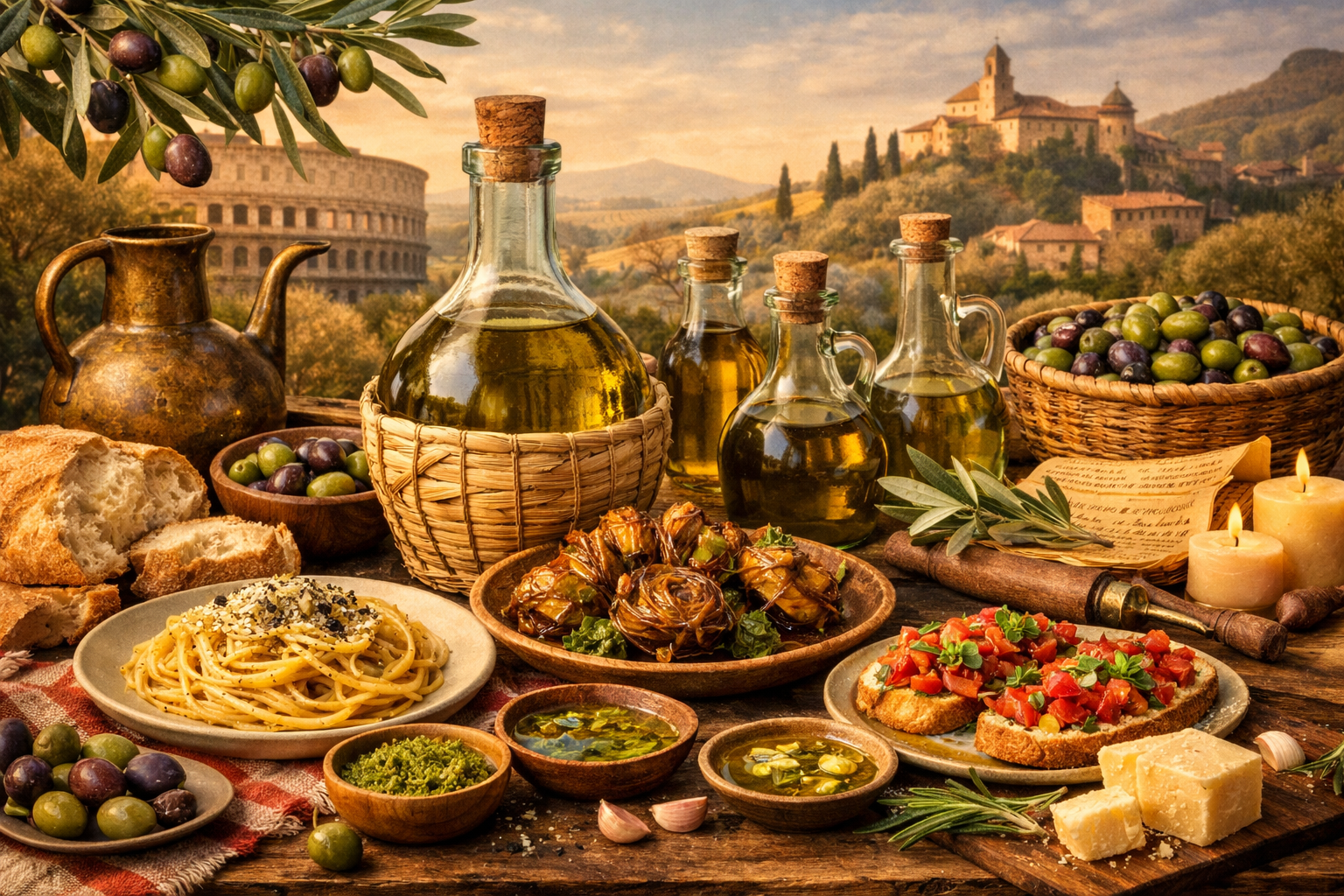
Picture a bottle of Italian olive oil. What comes to mind? A tall green glass bottle with a golden-green liquid inside. A ceramic jug from a Tuscan farmhouse. Or maybe that plastic-wrapped bottle on the supermarket shelf with an Italian flag and the words “Product of Italy” in a font designed to look rustic and old. Olive oil is the cornerstone of Italian cuisine, but the reality behind that bottle is far more complex, rooted in the agricultural abundance of regions like Emilia-Romagna.
The truth is more complicated and far more interesting. Italian olive oil is not one thing. It is hundreds of things. It is the intensely peppery Coratina oil from Puglia that makes you cough on first taste, and it is the soft, buttery Taggiasca oil from Liguria that whispers over delicate fish. It is a 4,000-year story, and it is a story that is still being written in every harvest season from October to December each year, flowing into the sauces that define Italian cooking.
Italy produces roughly 224,000 tonnes of olive oil annually, making it the world’s second largest producer after Spain. But Italy is not just a producer. It is the world’s most diversified olive oil country, with over 500 recorded olive cultivars, 47 DOP (Protected Designation of Origin) olive oil designations, and a per capita consumption of around 7.1 kilograms per person per year. Italians consume more olive oil per person than almost anyone else on the planet.
If you want to understand Italian olive oil, you have to start at the beginning. And the beginning goes back much further than most people realize.
The Ancient History of Olive Oil in Italy
Modern research has pushed the timeline of olive cultivation in Italy far deeper into the past than earlier scholars believed. Evidence from ancient pollen shows that olive trees were present on the Italian peninsula during the Pleistocene era, more than 11,000 years ago. These were wild olives, not cultivated ones. But humans were interacting with them early on.
Olive tree charcoal found in Mesolithic layers from the seventh and sixth millennia BCE in Sicily and Puglia suggests that people were gathering and burning olive wood as fuel. At the Arene Candide cave in Liguria, archaeologists found olive charcoal alongside quern stones and sickle blades, tools that may have been used for rudimentary olive harvesting and processing.
The earliest solid evidence for olive oil production in Italy comes from the Bronze Age. Organic residue analysis has detected plant oils, likely from olives, in a large clay storage jar from Castelluccio, Sicily, dating to around 2000 BCE. This pushes the documented history of Italian olive oil back by at least 700 years compared to what was previously known.
By the time Greek colonies were established in southern Italy around 800 BCE, olive cultivation was already underway. The Greeks brought new knowledge and techniques, but they did not introduce the olive tree to Italy from scratch. That story had been unfolding for thousands of years already.
The Romans, of course, took olive oil production to an industrial scale. During the early Roman Empire, around the first century CE, Rome’s immediate hinterland may have produced an estimated 9.7 million liters of olive oil per year. The Romans used olive oil for cooking, of course, but also for medicine, as a fuel for lamps, in religious rituals, and as a skincare moisturizer. Some oil production facilities from this period had four or more presses, and one facility in Puglia had a cellar with 47 enormous clay jars that could have stored up to 35,000 liters of oil.
The Roman love of olive oil never faded. It passed into the traditions of the Catholic Church, where olive oil is still used to anoint the heads of the baptized. It passed into the daily habits of Italian families, where a bottle of good olive oil sits on the counter like salt and pepper sit on an American table. And it passed into the DNA of Italian cuisine, where olive oil is not just an ingredient but a foundation.
How Italian Olive Oil Is Made
The process of making olive oil has not changed in its essentials for thousands of years. Olives are harvested, pressed, and the oil is separated from the solids and water. But the details matter enormously.
Harvest timing is everything. The moment when an olive has the highest concentration of polyphenols (the antioxidant compounds responsible for both health benefits and that peppery bite) is when the fruit is transitioning from green to purple, typically from mid-October to mid-November. Olives picked early, while still green, produce oils with higher polyphenol content, more intense flavor, and a shorter shelf life. Olives picked later, when fully ripe, produce oils that are mellower, less bitter, and more stable over time.
The pressing itself happens at a frantoio, the Italian word for an olive oil mill. Modern oil extraction uses a centrifuge system that spins the olive paste to separate oil from water and solids. Traditional methods use granite stone mills that crush the olives, followed by hydraulic presses. Both methods can produce excellent oil if done correctly.
The temperature during extraction matters more than most consumers know. Cold extraction, meaning the process stays below 27 degrees Celsius, preserves the volatile aromatic compounds that give high-quality oil its character. Higher temperatures extract more oil per kilogram of olives, but they destroy the delicate compounds that make extra virgin olive oil taste like something worth paying for.
There is another critical factor. Olives must be pressed within 12 to 24 hours of harvest. Olives that sit in heaps before pressing begin to ferment, a process called riscaldo that produces the musty, fermented off-flavors that are the most common defect in low-quality extra virgin olive oil.
Understanding the Grades of Italian Olive Oil
The International Olive Council and the European Union have defined strict categories for olive oil grades. These are not marketing terms. They are legally defined quality standards.
Extra Virgin Olive Oil (EVOO) is the highest grade. It must be produced entirely by mechanical means, with no chemical treatment. It must have a free acidity level below 0.8 percent (measured as oleic acid). And it must pass a sensory panel test, meaning trained tasters can detect no defects in the oil. High-quality fresh extra virgin oil typically has an acidity level between 0.1 and 0.4 percent.
Virgin Olive Oil is the next grade. It also must be mechanically produced, but it can have a free acidity level up to 2.0 percent, and minor flavor defects are allowed.
Refined Olive Oil is made by treating low-quality virgin olive oil with heat and chemicals to remove defects. The result is a neutral, flavorless oil. It is often blended with a small amount of virgin olive oil to create “pure olive oil” or simply “olive oil.” This is the stuff in most supermarket bottles labeled “light” or “mild.”
Lampante Olive Oil is the lowest grade, named for its historical use as lamp fuel. It is not fit for human consumption without refining.
Italy is unusual in that more than two-thirds of the olive oil it produces is extra virgin. Many other producing countries have a higher proportion of lower-grade oils. This reflects the Italian emphasis on quality over quantity, though it also reflects the reality that much of Italy’s lower-grade oil is still produced and sold into the industrial blending market.
Italy’s Great Olive Oil Regions
One of the great pleasures of drinking… sorry, tasting… Italian olive oil is the regional diversity. No two regions produce the same oil, and the differences are not subtle. They are as distinct as the difference between a Chianti and a Barolo.
Puglia: The Powerhouse
Puglia, the heel of Italy’s boot, produces more olive oil than any other Italian region. The dominant cultivar is Coratina, named for the town of Corato in the Bari hinterland. Coratina oils are intensely peppery, with high polyphenol content and a bitterness that some people find challenging and others find addictive. The other major cultivar is Ogliarola, which is gentler and more floral. Coratina oils hold up beautifully to grilled meats, bitter greens, and hearty bean dishes. The Terre di Bari DOP is one of the key protected designations in this region.
Tuscany: The International Benchmark
Tuscan oil is what most people picture when they think of premium Italian olive oil. The classic blend uses Frantoio, Moraiolo, and Leccino cultivars, picked green and early to maximize intensity. The result is grassy, herbaceous, and peppery, with notes of fresh grass and artichoke. Toscano IGP is the protected designation covering olive oil from this region. Tuscan oils are finishing oils. Drizzle them over white beans, ribollita soup, or a grilled steak. The Toscano IGP designation ties a bottle to the region and its production standards.
Liguria: The Delicate Exception
Liguria flips the script. This narrow coastal strip in northwest Italy makes the country’s most delicate olive oil, built almost entirely on the Taggiasca cultivar. The olives are picked later and riper, which softens the bitterness and pepper to almost nothing. The result is buttery, faintly sweet, with notes of pine nut and almond. This is the right oil for delicate fish, for pesto alla Genovese, for any dish where a peppery Tuscan oil would overwhelm the flavors. Riviera Ligure DOP protects this production.
Sicily: Intense and Aromatic
Sicilian oils are the most aromatic of them all. The signature variety is Nocellara del Belice (the same olive you eat as a Castelvetrano table olive), alongside Biancolilla and Cerasuola. These oils are intensely herbaceous, with notes of tomato leaf, artichoke, and green almond. They have a rounder profile than Puglia’s aggressive bitterness, with big aroma and a medium-to-strong finish. Sicilia IGP and Val di Mazara DOP are the key designations here.
Umbria: The Balanced Middle
Umbria sits next to Tuscany and shares much of its cultivar palette, but its oils tend to be more balanced and structured. The bitterness and pepper are present but harmonized. Think of Umbrian oil as the diplomat, the one that works well everywhere without dominating. Umbria DOP covers production across the region, with five sub-zones including the prized Spoleto area.
Calabria and Beyond
Calabria produces some of the highest polyphenol content oils in Italy, primarily from the Carolea cultivar. The Bruzio DOP is the key designation. In the far north, around Lake Garda, you will find delicate, almond-scented oils from the Casaliva cultivar, protected as Lago di Garda DOP. These northern oils are a reminder that Italian olive oil is not just a southern product. It comes from 18 of Italy’s 20 regions.
The Health Benefits of Extra Virgin Olive Oil
The health benefits of olive oil are not a marketing gimmick. They are supported by decades of scientific research. The Mediterranean diet, in which extra virgin olive oil is the primary source of fat, has been consistently associated with lower rates of cardiovascular disease, reduced inflammation, and improved longevity.
The active compounds in extra virgin olive oil are polyphenols, particularly hydroxytyrosol and oleuropein. These compounds are powerful antioxidants that protect blood lipids from oxidative stress. The European Food Safety Authority has authorized a health claim for olive oils that contain at least 250 mg/kg of hydroxytyrosol and its derivatives. Oils that meet this threshold can legally claim that “olive oil polyphenols contribute to the protection of blood lipids from oxidative stress.”
Most commercial extra virgin olive oils do not meet this threshold. The processing and storage conditions that maximize shelf life and economic yield also reduce polyphenol content. The artisan estate oils pressed within 24 hours of harvest from early-picked olives are typically the only category that meets the EFSA threshold. This is one of those cases where the better-tasting oil is also the healthier one.
The compound responsible for that peppery catch at the back of your throat is called oleocanthal. It is a natural anti-inflammatory compound that works in a way similar to ibuprofen, though obviously at much lower concentrations. When an oil makes you cough or feel a burning sensation in your throat, that is not a defect. It is a sign that the oil is fresh and high in polyphenols.
Olive Oil Fraud: How to Spot the Real Thing
The 2010 UC Davis Olive Center study sent shockwaves through the industry. Researchers found that 69 percent of imported extra virgin olive oils sold in California supermarkets failed to meet international sensory standards for the extra virgin grade. Only 10 percent of California-produced oils in the same study failed. The imported oils had defects such as rancidity, mustiness, and fustiness that disqualified them from the extra virgin category under International Olive Council definitions.
The most common fraudulent practice is not what you might think. It is not the dramatic “cutting with hazelnut oil” that makes for good headlines. It is more subtle and more widespread. Producers take refined olive oil (a neutral, flavorless oil produced from low-quality olives through heat and chemical processing) and blend it with a small amount of genuine extra virgin olive oil. The mixture passes chemical tests because the genuine EVOO provides enough of the right compounds, but the sensory quality is far below what the label promises.
A second practice involves blending cheaper oils such as sunflower or canola oil with olive oil and adding green chlorophyll to produce the color associated with quality. This is outright fraud, and it is illegal, but it happens.
How do you protect yourself? Look for four things on the label. First, a harvest date, not just a best-before date. Olive oil is a fresh product with an optimal quality window of 12 to 18 months from harvest. Second, a DOP or IGP designation that names the specific geographic zone. Third, the producer’s address on the label, not just a distributor’s generic corporate address. Fourth, if possible, a monocultivar designation, which indicates a producer willing to invest in variety-specific production rather than blending for consistency.
A bottle that has all four markers is almost certainly genuine quality. A bottle with none of them is almost certainly an industrial blend.
How to Taste Italian Olive Oil
Professional olive oil tasting follows a standardized method. You do not need a laboratory to do it at home. A small glass and a few minutes are enough.
Warm the glass in your hands for three to five minutes. This brings the oil to about 28 degrees Celsius, the temperature at which the volatile aromatic compounds are most accessible. Cover the glass with your palm while you warm it, then remove your palm and inhale immediately.
What do you smell? Fresh positive attributes include grassy notes, artichoke, tomato leaf, green almond, and fresh olive. Defects include musty, rancid, fermented, vinegary, and metallic odors. A high-quality oil should have clear, vibrant fruitiness and no trace of defects.
Take a small sip. Simultaneously draw air through your teeth as you sip. This technique, called strippaggio in Italian, volatilizes the compounds and increases your perception of the aroma. Identify three things: fruitiness (the intensity of olive aroma), bitterness (perceived on the back of the tongue, a positive attribute in fresh high-polyphenol oils), and pungency (the peppery sensation in the throat caused by oleocanthal).
The International Olive Council recognizes only three positive attributes: fruitiness, bitterness, and pungency. It recognizes approximately 15 defects. A high-quality extra virgin olive oil should have no defects and strong expression of all three positive attributes.
Cooking with Italian Olive Oil
There is a persistent myth that you cannot cook with extra virgin olive oil because it has a low smoke point and will become bitter or unhealthy when heated. This is mostly wrong. Extra virgin olive oil has a smoke point between 190 and 207 degrees Celsius, which is higher than the temperature of most home cooking. It is perfectly suitable for sautéing, roasting, and even shallow frying.
Many Italian households keep two bottles. One is an everyday extra virgin olive oil used for cooking. The other is the finest extra virgin olive oil they can afford, used for drizzling, dressing, and finishing dishes.
One thing Italians do not do is add olive oil to pasta water. This common practice does not prevent pasta from sticking together. It only makes the pasta slippery, which prevents sauce from coating it properly. The proper way to prevent sticking is to use enough water (one liter per 100 grams of pasta) and to stir the pasta immediately after adding it and at regular intervals while it cooks.
Another thing Italians generally do not do is dip bread in olive oil and balsamic vinegar as a pre-dinner snack. This practice, common in Italian-American restaurants, is not actually traditional in Italy. Bread is eaten alongside food, not as a separate course dressed with oil and vinegar before the meal.
How to Store Italian Olive Oil
Olive oil has three enemies: heat, light, and oxygen. The correct storage is simple. Keep olive oil in a dark glass bottle or a tin, stored in a cool dark place away from the stove. Do not store it on the windowsill, where sunlight will accelerate oxidation. Do not store it in the refrigerator either. Refrigeration causes the oil to solidify, and the temperature cycling on warming degrades quality.
The optimal consumption window is within 12 to 18 months of the harvest date. After 18 months, even the finest extra virgin olive oil will have lost a significant portion of its polyphenol content and aromatic complexity. It remains safe to eat, but it will not taste like it did when it was fresh.
Buying smaller bottles and consuming them within two to three months of opening produces a better experience than buying large tins that oxidize slowly over six months of use. Olive oil is a fresh juice, not a pantry staple that lasts forever.
The Future of Italian Olive Oil
Italian olive oil faces real challenges. Climate change is pushing olive cultivation northward and causing drought stress in traditional growing areas. Production has declined in recent years, and Italy has fallen in the global ranking of olive oil producing countries. Preliminary estimates for 2024/25 put Italian production at around 224,000 tonnes, placing Italy fifth in the world.
But the same forces that threaten production also create demand. Global appetite for high-quality extra virgin olive oil continues to grow. Italian exports surged by 6.8 percent in volume and 42.6 percent in value in 2024, with total olive oil exports reaching over 3.09 billion euros.
The best Italian olive oil has never been easier to find, if you know what to look for. It is the oil with a harvest date on the bottle, a DOP designation from a specific region, and a producer’s address that you could look up on a map. It is the oil that tastes fresh and alive, with bitterness and pepper that tell you the polyphenols are still present. It is the oil that makes you understand why Italians have been doing this for 4,000 years.
That is the real Italian olive oil. It is not the branded bottle on the supermarket shelf with the Italian flag on the label and no other information. It is the estate-bottled oil from a single harvest, pressed from olives grown on a specific hillside, tasted by the producer who has been making it for generations. It is a product of place, of variety, of tradition, and of care.
And it is worth every penny.
How Oilive Oil is Made in Italy Video
Featured articles
Explore rich culinary stories, exclusive chef interviews, and expert insights from kitchens around the world. Discover cooking techniques, ingredient spotlights, and behind-the-scenes looks at the tools that shape global cuisine.

Georges Auguste Escoffier: Visionary Chef Who Revolutionized French Cuisine and Modern Cooking
Discover the life and legacy of Georges Auguste Escoffier, the legendary chef who transformed French cuisine and laid the foundation for modern culinary arts. This comprehensive historical profile …

How to Use a Knife, Fork, and Spoon
Master the basics of Western table etiquette with this guide to using a knife, fork, and spoon. Learn practical tips, cultural context, and the subtle rules that shape how we dine.
The History of Chocolate
Trace the fascinating history of chocolate, from its ancient origins with the Olmecs and Maya to its transformation into a global indulgence. Explore how cacao evolved from sacred ceremonial drink to …
Georges Auguste Escoffier: Visionary Chef Who Revolutionized French Cuisine and Modern Cooking
Discover the life and legacy of Georges Auguste Escoffier, the legendary chef who …
How to Use a Knife, Fork, and Spoon
Master the basics of Western table etiquette with this guide to using a knife, fork, and …
The History of Chocolate
Trace the fascinating history of chocolate, from its ancient origins with the Olmecs and …