French Cheese

By: Simon
July 25, 2026 | Updated: September 12, 2026

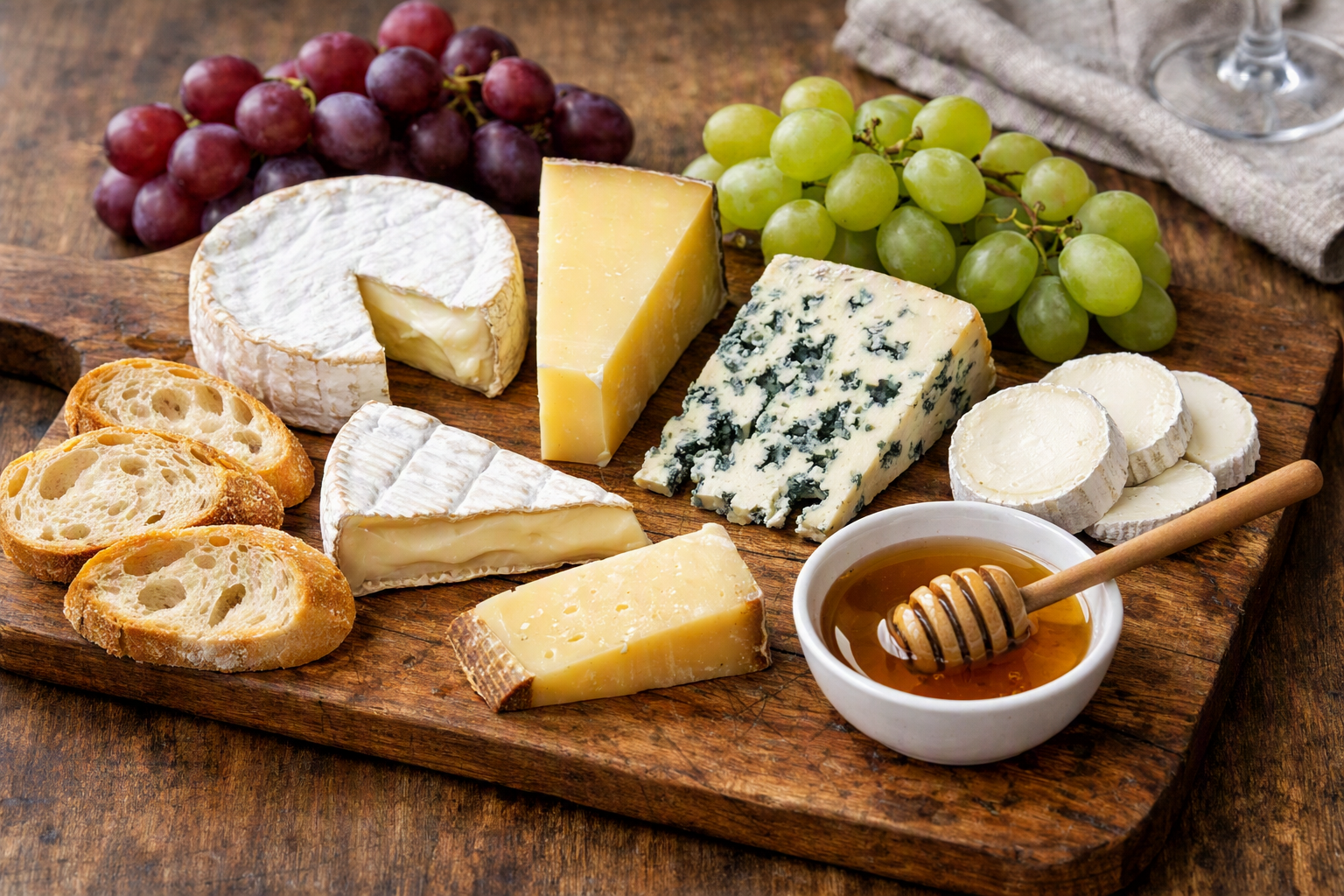
A wedge of Brie, soft and yielding at room temperature, its bloomy white rind striated with faint reddish veins that signal perfect ripeness. A crumbling slice of Roquefort, its blue-green marbling carrying the mineral tang of the Combalou caves. A shard of aged Comté, dense and crystalline, tasting of toasted hazelnut and alpine meadows. This is French cheese in its many forms, and no other country on earth has turned the simple act of coagulating milk into such a profound expression of place, history, and craft.
Terroir, Tradition, and the Eight Families of Fromage
Charles de Gaulle once asked, “How can you govern a country which has two hundred and forty-six varieties of cheese?” The number today is far higher. France produces somewhere between 1,200 and 1,600 distinct types of cheese, depending on how you count them. These are grouped into eight official families and protected by one of the most rigorous systems of geographical indication in the world. With 46 cheeses holding Protected Designation of Origin (AOP) status and 12 more carrying Protected Geographical Indication (PGI) labels, France guards its dairy heritage with the same seriousness it brings to its wines.
The numbers are as impressive as the variety. The AOP and PGI cheese sector alone generated approximately €2.38 billion in revenue in 2024, with more than 201,000 tons sold across 46 protected cheeses. France remains the world’s second-largest cheese exporter, shipping close to €4 billion in cheese annually, behind only Germany. And the French themselves consume about 26.5 kilograms per person each year, among the highest per capita rates on earth.
Terroir: The Geography of Taste
The concept of terroir is central to understanding French cheese. The word, borrowed from wine, describes the complete natural environment in which a food is produced: the soil, the climate, the altitude, the local breeds of animals, and the microbial life that inhabits the aging caves. In France, cheese cannot be separated from the land it comes from.
Normandy’s lush pastures, soaked by Atlantic rains, produce rich cow’s milk perfect for the soft, creamy cheeses the region is famous for. The alpine slopes of the Jura and Savoie, where cows graze on wild herbs and flowers through the short summer, yield large pressed wheels like Comté and Beaufort that can age for years. The arid limestone plateaus of the Auvergne give us Cantal and Bleu d’Auvergne, cheeses with earthy depth and sturdy character. And the windswept Causses region, with its natural caves pierced by fissures called fleurines, creates the unique microclimate that makes Roquefort possible.
This connection between cheese and place is not romantic nostalgia. It is encoded in French law. The AOP system, which evolved from the older AOC (Appellation d’Origine Contrôlée) first applied to Roquefort in 1925, mandates that every protected cheese must be produced in a defined geographic area, from specified milk, using prescribed methods. The flavor must reflect a specific place and a set of skills that cannot be replicated elsewhere.
The Eight Families of French Cheese
French cheeses are classified into eight official families, a system that emerged in the late 19th and early 20th centuries as the cheese industry grew and international trade demanded clear criteria. Understanding these families is the key to navigating the fromagerie.
Soft Cheeses with Bloomy Rind (Pâtes Molles à Croûte Fleurie)
These are often the most approachable French cheeses for newcomers. The white, velvety rind is formed by spraying the cheese with Penicillium candidum or similar fungi, which create a soft, edible crust while the interior ripens from the outside in.
Brie is the most famous member of this family. Brie de Meaux, which holds AOP status, has a distinguished lineage going back to the 15th century. When properly ripe, the rind develops faint reddish tones, a sign that the microorganisms are alive and active. The interior should be creamy and pale, flowing slightly at room temperature but never runny. Brie de Melun, its lesser-known cousin, is saltier and more assertive.
Camembert de Normandie, perfected in its modern form in 1790 by Marie Harel, a farmer’s wife in the village of Camembert, is perhaps France’s most iconic cheese. Authentic Camembert de Normandie AOP must be made from raw cow’s milk, ladled by hand into molds, and aged for a minimum of 21 days. The vast majority of what is sold as Camembert globally is pasteurized, industrial, and lacks the complexity of the real article. A properly aged raw-milk Camembert has an orangy-reddish rind, a dense, fudgy texture, and flavors of mushroom, butter, and earth.
Other notable bloomy-rind cheeses include Coulommiers (a smaller, milder relative of Brie), Chaource (a creamy cylinder from Champagne), and Neufchâtel (the heart-shaped cheese from Normandy that is one of the oldest French cheeses).
Soft Cheeses with Washed Rind (Pâtes Molles à Croûte Lavée)
This is where French cheese challenges the timid. The rind is washed regularly during aging with brine, salt water, cider, or even marc de Bourgogne (a grape pomace spirit). The washing encourages the growth of specific bacteria, particularly Brevibacterium linens, which produce the rusty orange rind and the famously pungent aromas that these cheeses are known for.
Époisses, perhaps the most famous washed-rind cheese, is washed with marc de Bourgogne and aged until it becomes spoonably soft. Its smell is notorious, but the paste is surprisingly mild and savory, with notes of ham and caramelized onions. Munster, from Alsace, is washed with salt water and has a more robust, salty character. Livarot, from Normandy, is bound with five strips of sedge grass (giving it the nickname “the Colonel”) and has a deep barnyard aroma that gives way to a rich, meaty paste. Pont-l’Évêque, another Norman classic, is square-shaped and somewhat milder than its washed-rind cousins.
Among France’s 46 AOP cheeses, eight are soft washed-rind varieties, but bloomy-rind cheeses far outnumber them with 18 references, nearly 40 percent of all French AOP cheeses.
Pressed, Uncooked Cheeses (Pâtes Pressées Non Cuites)
These cheeses are pressed to expel whey but are not heated during production. They tend to be firm yet supple, with nutty and milky flavors that make them widely appealing.
Cantal, from the Auvergne, is one of France’s oldest cheeses, with production records dating to Roman times. It is aged for anywhere from one to six months, developing increasing sharpness and crumbliness as it matures. Cantal is made in three varieties: Cantal Jeune (young, mild, and creamy), Cantal Entre-Deux (medium-aged), and Cantal Vieux (aged, crumbly, and intense).
Saint-Nectaire, also from Auvergne, is a farmhouse cheese with a distinctive orange-brown rind and a supple, ivory paste that tastes of mushrooms and nuts. Tomme de Savoie, from the French Alps, is a leaner cheese made from the skimmed milk left over after cream is removed for butter production. Its gray-brown rind and mild, slightly tangy flavor make it an everyday favorite.
Morbier, from the Jura, is instantly recognizable by the thin horizontal line of vegetable ash running through its center. This tradition dates to the 19th century, when farmers would press the morning’s curds, then top them with ash to protect them before adding the evening’s curds. The practice is now ceremonial, but the visual signature remains.
Pressed, Cooked Cheeses (Pâtes Pressées Cuites)
These are the alpine giants of French cheese, cooked at high temperatures during production and pressed for extended periods. They age for months or even years, developing dense, crystalline textures and extraordinary complexity.
Comté is the most consumed AOP cheese in France. Made in the Franche-Comté region of the Jura mountains, a single wheel requires about 600 liters of milk from Montbéliarde cows. It is aged on wooden planks in cellars for a minimum of four months and often for 12 to 24 months or longer. Each wheel is graded by a jury of experts, and the best are awarded a green band. The flavor profile ranges from fruity and buttery in younger wheels to intensely savory, almost brothy, with notes of roasted nuts, caramel, and tamarind in older ones.
Beaufort, from the Savoie region, is often called “the prince of Gruyères.” It is made exclusively from the milk of Tarentaise cows grazing on alpine pastures. The cheese is dense, smooth, and fruity, with a distinctive concave shape that makes it easier to age in mountain cellars. Emmental de Savoie, the French cousin of Swiss Emmental, is less common but equally distinguished by its large, glossy eyes and nutty, slightly fruity flavor.
These cheeses are the workhorses of French cooking. They melt beautifully, making them essential for fondues, gratins, and croque-monsieurs. Comté, in particular, is the secret ingredient in many a French chef’s repertoire.
Blue Cheeses (Pâtes Persillées)
Blue cheeses are inoculated with Penicillium roqueforti spores, which create the characteristic blue-green veining as the cheese is pierced with needles to allow oxygen to reach the mold. The result is bold, salty, and tangy, with a crumbly or creamy texture depending on the variety.
Roquefort is the king of French blue cheeses. Made exclusively from the milk of Lacaune ewes, it is aged in the natural caves of the Combalou mountain in the village of Roquefort-sur-Soulzon. The caves, riddled with fissures called fleurines, maintain a constant temperature and humidity while allowing fresh air to circulate, creating conditions that cannot be replicated anywhere else. Roquefort was the first cheese to receive AOC status in 1925. Its flavor is powerfully salty, tangy, and mineral, with a creamy, spreadable texture.
Bleu d’Auvergne, made from cow’s milk in the Auvergne region, is creamier and milder than Roquefort, with a buttery texture and a more approachable tang. Fourme d’Ambert, one of France’s oldest cheeses, is cylindrical and made from cow’s milk, with a dense, moist paste and a gentle, fruity blue flavor that is often recommended for those new to blue cheese. Bleu des Causses, aged in similar limestone caves to Roquefort but made from cow’s milk, offers a middle ground between the intensity of Roquefort and the creaminess of Bleu d’Auvergne.
Goat Cheeses (Chèvres)
Goat cheeses occupy their own category in French classification, reflecting their distinct flavor profile and production methods. The bright, citrusy, and herbal notes of goat cheese come from the high concentration of caprylic, capric, and caproic fatty acids in goat’s milk, which are also responsible for the characteristically “goaty” aroma.
Crottin de Chavignol, from the Loire Valley, is perhaps the most famous French goat cheese. Small, cylindrical, and aged until wrinkled and golden, it has a dense, creamy interior that becomes crumbly and nutty as it ages. When baked, it becomes soft and spreadable, perfect on salad.
Valençay is a truncated pyramid-shaped cheese coated in vegetable ash, which preserves the paste and adds a subtle earthy note. Sainte-Maure de Touraine is a log-shaped goat cheese with a straw of rye grass running through its center (a traditional mark of authenticity). Pouligny-Saint-Pierre, shaped like a small pyramid (sometimes called the “Eiffel Tower” cheese), has a distinctive goat-forward flavor with notes of nuts and citrus.
Goat cheeses come in every degree of freshness and age, from the soft, spreadable fromage frais de chèvre to hard, aged varieties that can be grated like Parmesan.
Fresh Cheeses (Fromages Frais)
Fresh cheeses are not aged and are consumed shortly after production. They include fromage blanc (a creamy, spreadable cheese similar to yogurt cheese), faisselle (a mild, moist curd cheese sold in a perforated mold), and brocciu (a Corsican whey cheese made from sheep or goat milk, similar to ricotta). These cheeses are light, refreshing, and often eaten with sugar, fruit, or honey as a dessert.
Processed Cheeses (Fromages Fondus)
Processed cheeses are made by melting one or more cheeses together with emulsifying salts and sometimes adding cream, butter, or spices. This category includes the canonical cheese fondue (a blend of Comté, Beaufort, and Emmental melted with white wine and kirsch), as well as fromage à raclette (a semi-hard cheese melted and scraped onto potatoes and cured meats). While less celebrated than their artisanal cousins, these cheeses play an important role in French convivial dining.
The Regional Cheeses of France
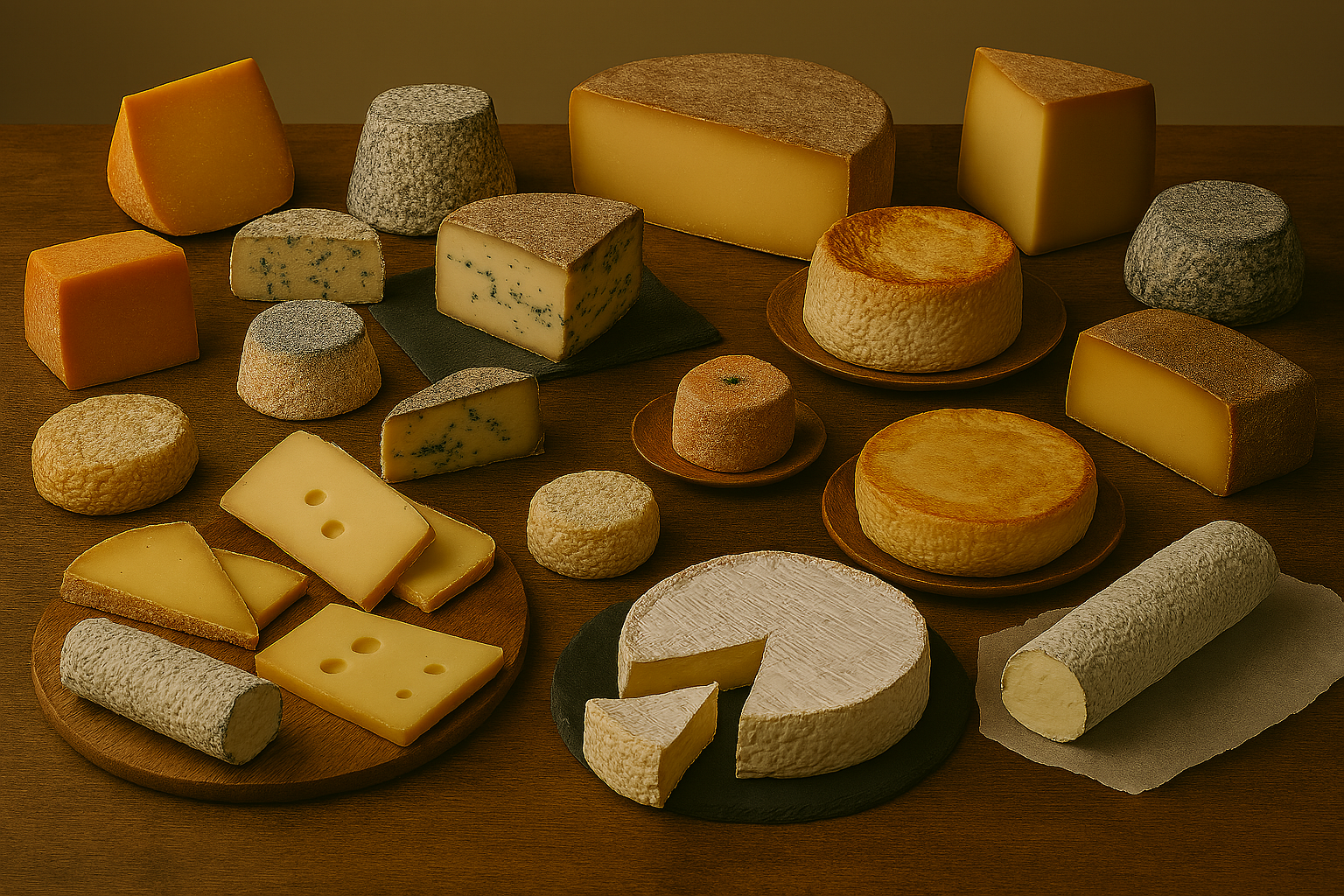
Each region of France produces cheeses that reflect its landscape, climate, and history.
Normandy is the undisputed heartland of French soft cheese. The region’s lush pastures and humid climate produce rich, high-butterfat milk that gives Camembert, Livarot, Pont-l’Évêque, and Neufchâtel their characteristic creaminess. Normandy also produces the famous Isigny butter and cream, which celebrated 40 years of AOP status in June 2026.
Île-de-France, the region around Paris, gave the world Brie. The Brie de Meaux AOP and Brie de Melun AOP are the only two authentic versions, protected from the countless imitations produced worldwide.
The Auvergne, in south-central France, is a mountain region of volcanic soils that support grazing lands producing sturdy, earthy cheeses. Cantal, Saint-Nectaire, Bleu d’Auvergne, and Fourme d’Ambert all originate here, as does Salers, a farmhouse cheese that must be made in summer from the milk of Salers cows grazing on mountain pastures.
The Jura and Savoie regions, in the French Alps, are the domain of cooked pressed cheeses. Comté, Beaufort, Abondance, and Emmental de Savoie are aged in mountain cellars, developing extraordinary complexity over months and years. This region also produces Mont d’Or (also called Vacherin du Haut-Doubs), a seasonal washed-rind cheese made only from August to March, sold in a spruce bark band that imparts a resinous aroma.
Occitanie, in southern France, is the home of Roquefort, as well as the sheep’s milk Ossau-Iraty from the Basque Country, and the goat cheeses of the Pyrenees and the Lot Valley, such as Rocamadour and Cabécou.
The Loire Valley is goat cheese country. The region’s chalky soils and temperate climate produce the bright, mineral-driven flavors that define Crottin de Chavignol, Valençay, Sainte-Maure, and Pouligny-Saint-Pierre.
Raw Milk: The Heart of French Cheese
Raw milk is not a niche preference in France. It is the historical foundation of the country’s AOP cheese system. A large portion of French AOP cheeses rely on raw milk, which is considered essential to their distinct character, microbial biodiversity, and aromatic complexity. Keeping milk below 40°C during cheesemaking preserves the natural microbes that shape flavor, aroma, and texture in ways that cannot be replicated with pasteurized milk.
The debate over raw milk has intensified in recent years. Health crises linked to microbial contamination have heightened scrutiny and led to regulatory pressure, particularly from international markets. The 2026 Cheese and Dairy Products Fair, held at the Paris-Porte de Versailles, featured a major conference on the future of raw-milk cheeses, where industry professionals organized around a raw milk plan to identify solutions in partnership with government agencies.
The stakes are high. Raw milk cheeses face pressures from multiple directions: rising production costs, climate change affecting forage availability, stricter health requirements, and the difficulties of ensuring the next generation of farmers. Late 2025 saw industry professionals organizing to collectively address these challenges. For connoisseurs, the issue is clear: raw milk is the irreplaceable foundation of France’s cheese diversity and the preservation of a culinary heritage that cannot be maintained through pasteurization alone.
The Art of the French Cheese Plate
A French cheese plate is guided by balance, not abundance. The goal is not to overwhelm but to offer a thoughtful selection that invites discovery. Three to five cheeses, chosen for contrast in texture, intensity, and milk type, are ideal.
The traditional order of tasting begins with the mildest and moves toward the strongest. A fresh goat cheese might start the journey, followed by a bloomy-rind Brie or Camembert, then a pressed cheese like Comté, finishing with a blue like Roquefort. The plate is shared, and knives circulate, but separate knives for each cheese prevent flavors from mingling.
Cheese must be served at room temperature. Taking it out of the refrigerator an hour before serving allows the aromas and textures to fully open. Bread is neutral in flavor, a baguette or country loaf meant to accompany, not compete. Small additions like fruit preserves or honey can enhance certain cheeses by adding sweetness or contrast, but they never take center stage.
In France, the cheese course appears after the main course and before dessert. It is never rushed. It is a moment to slow down, share conversation, and savor the flavors that have been months or years in the making. This ritual, as much as any individual cheese, is what makes French fromage a cultural treasure.
French Cheese in 2026
The French cheese industry stands at a crossroads. The 2026 Cheese and Dairy Products Fair convened producers, regulators, and industry leaders to address pressing challenges: rising production costs, climate change, increasing regulatory pressure, and the need to attract young farmers to the profession.
The sector remains a pillar of the French economy. The dairy sector as a whole comprises more than 44,000 farms and generates approximately €47.3 billion in revenue. The AOP and IGP cheese sector alone accounts for more than 15,000 milk producers and nearly 500 processing facilities. These figures demonstrate that quality production sectors are not merely a luxury but a vital economic force in rural areas where economic alternatives are limited.
Climate change is already affecting production. Some mountain and pasture AOPs are seeing their production conditions undermined by droughts and the scarcity of forage resources. The ability to adapt while maintaining the strict specifications of AOP status will determine the future of many traditional cheeses.
Yet the trajectory is not entirely concerning. Global demand for premium, authentic cheeses continues to grow, and French AOP cheeses are well positioned to meet it. The export market is shifting, with Southeast Asia, the GCC countries, and Latin America emerging as significant growth markets alongside traditional European buyers. The INAO’s work in protecting designations from imitations and misappropriations remains a critical function, ensuring that consumers worldwide can trust the labels on the cheese they buy.
What the World Is Still Learning From French Cheese
French cheese is not a single thing. It is hundreds of things, each tied to a specific place, a specific animal, a specific set of hands, and a specific tradition refined over centuries or millennia. From the bloomy rind of a ripe Brie de Meaux to the crystalline crunch of an aged Comté, from the pungent wash of an Époisses to the mineral tang of a Roquefort, French cheese offers a range of flavor, texture, and aroma unmatched anywhere on earth.
The system that protects these cheeses, the AOP and PGI designations administered by the INAO, is one of the world’s most sophisticated frameworks for preserving culinary heritage. It ensures that when you buy a cheese with a protected name, you are not just buying a product. You are buying a piece of a landscape, a connection to generations of cheesemakers who understood that great cheese is made not in a factory but in a specific place, under specific conditions, with specific knowledge passed down through time.
In an age of standardization and industrial efficiency, that commitment to specificity and place is more valuable than ever. The next time you slice into a wheel of real French cheese, you are not just tasting milk. You are tasting France.
French Cheese Video
Featured articles
Explore rich culinary stories, exclusive chef interviews, and expert insights from kitchens around the world. Discover cooking techniques, ingredient spotlights, and behind-the-scenes looks at the tools that shape global cuisine.

Georges Auguste Escoffier: Visionary Chef Who Revolutionized French Cuisine and Modern Cooking
Discover the life and legacy of Georges Auguste Escoffier, the legendary chef who transformed French cuisine and laid the foundation for modern culinary arts. This comprehensive historical profile …

How to Use a Knife, Fork, and Spoon
Master the basics of Western table etiquette with this guide to using a knife, fork, and spoon. Learn practical tips, cultural context, and the subtle rules that shape how we dine.
The History of Chocolate
Trace the fascinating history of chocolate, from its ancient origins with the Olmecs and Maya to its transformation into a global indulgence. Explore how cacao evolved from sacred ceremonial drink to …
Georges Auguste Escoffier: Visionary Chef Who Revolutionized French Cuisine and Modern Cooking
Discover the life and legacy of Georges Auguste Escoffier, the legendary chef who …
How to Use a Knife, Fork, and Spoon
Master the basics of Western table etiquette with this guide to using a knife, fork, and …
The History of Chocolate
Trace the fascinating history of chocolate, from its ancient origins with the Olmecs and …