Chinese Cuisine
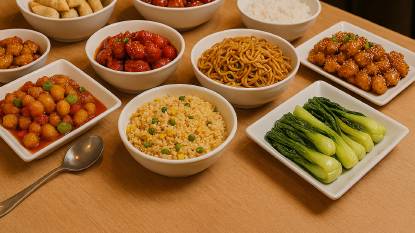

The huge land mass and deep history of China ripples through the enormously wide range of dishes, tastes and flavors that are generically called Chinese food. Although Chinese food is one of the most popular cuisines of the world, for a foreigner to start to make sense of this is it useful to take the four major Chinese regions into account. There are Beijing and the Northern Plains, the East made fertile by the Yangste River, The southern region well-known for its Guandong Cantonese cooking and the Western region with its Hunan and Szechwan provinces.
🧭 Historical Origins and Culinary Philosophy
Chinese cuisine is not merely a collection of recipes—it is a reflection of one of the world’s oldest continuous civilizations. Rooted in over 5,000 years of history, the culinary traditions of China are deeply intertwined with philosophy, medicine, and social structure.
Confucianism emphasized harmony, ritual, and balance—principles that shaped everything from banquet etiquette to the pairing of flavors and textures. Taoist influence encouraged seasonal eating and the pursuit of longevity through food, giving rise to the concept of 食疗 (shi liao, food therapy). These philosophies still echo in the modern Chinese kitchen, where meals are designed to nourish both body and spirit.
Imperial cuisine, developed in the courts of dynasties like the Tang, Song, and Qing, elevated cooking to an art form. Techniques such as red cooking, elaborate carving, and multi-course banquets were refined in palace kitchens and later disseminated across the country. Today, these traditions live on in formal dining and festival meals.
Possibly the most famous area in China for food is Canton. The humid year-round climate is the best environment in which to cultivate anything. Seafood is pletiful by the coast and the plantation groves are filled with all kinds of fruits. Both recipes and cooking methods are extremely varied and sophisticated. Canton cuisine relies less on pungent sauces because the cooking highlights the freshness of ingredients, and since the local produce is so plentiful and varied, fresh flavors have become the signature of Canton cooking.
In contrast, the western regions of Hunan and Szechwan are high-altitude and mountainous in which citrus fruits, bamboo, rice and mushrooms can grow in abundance. Spicy aromas and steam pour from the kitchens into the restaurants and the chile flavors speaks to the local produce as well as the regional palate.
The land of fish and rice lies to the east of Hunan. As with the Western region, it benefits from low-lying land for a rich coastal harvest of fish and seafood as well as rice farming.
The region in the North of China spills over into Mongolia which includes the hostile Gobi desert, with its Artic Winters. Mutton and Lamb are commonplace here as Pork is generally forbidden by the observant Muslim population. The Mongolian fire pot, commonly used to cook in gives away its nomadic roots. Because cultivation is virtually impossible in Mongolia and the North, the staples consist of Soybeans, Barley, Wheat and Millet while noodles and bread accompany most meals.
The fruits and veegetables that can be grown are similar to those found in North America i..e. Squash, Cabbage, Grapes, Pears and Apples. The pearl of the North is Beijing. Royal Chinese high cuisine was born inside her city walls and have now filtered down through the centuries to become the accumulated wisdom of China’s finest chefs. This achievement now belongs to all of China.
🍽️ Regional Cuisine Table
To better understand the diversity of Chinese food, it helps to compare the regional cuisines side by side:
| Region | Key Ingredients | Signature Dishes | Flavor Profile |
|---|---|---|---|
| Canton (South) | Seafood, tropical fruits | Char Siu, Dim Sum, Roast Duck | Light, fresh, aromatic |
| Szechwan (West) | Chiles, garlic, citrus | Mapo Tofu, Hot Pot, Dan Dan Noodles | Spicy, bold, numbing |
| Yangtze (East) | Rice, fish, soy | Sweet & Sour Fish, Lion’s Head Meatballs | Sweet-savory, delicate |
| Beijing/North | Lamb, wheat, cabbage | Peking Duck, Jiaozi, Mongolian Fire Pot | Hearty, rich, warming |
This table offers a snapshot of how geography, climate, and cultural exchange shape the flavor profiles and ingredient choices across China.
Cooking Methods in China
Many cooking methods from stir-frying to poaching to braising are used for Chinese recipes, almost all of which can be accomplished in a wok. Steaming is a favorite, especially when cooking the many delicious types of breads and buns. Smoking and roasting are less common but used — grilling, too, in spite of its profligate expenditure of cooking fuel. And, of course, there’s that favorite of health police, deep-frying.
Once the meal is cooked, it is served all at once to the family, who eat with chopsticks and drink soup with a wide spoon. The average dinner includes a starch — rice, noodles, bread, or pancakes — a meat dish, vegetable, and soup, which serves as a beverage. For formal meals and banquets, there are many successive courses which are served in a strict traditional order.
🥢 Dining Etiquette and Food Culture
Chinese dining is as much about ritual as it is about nourishment. Meals are typically served family-style, with all dishes placed at the center of the table for communal sharing. Round tables symbolize equality, and seating arrangements often reflect age and status. Chopsticks are the primary utensils, and their use comes with etiquette: never stick them upright in rice (a funerary symbol), never point with them, and never spear food. Soup is sipped from wide ceramic spoons, and slurping is not only acceptable—it’s encouraged as a sign of enjoyment. Seasonal eating is deeply embedded in Chinese food culture. In winter, warming dishes like lamb hot pot and braised meats dominate. Summer calls for cooling foods such as mung bean soup and chilled tofu. Many ingredients are chosen for their medicinal properties, reinforcing the belief that food and health are inseparable.
🧂 Essential Chinese Pantry Staples
To cook authentic Chinese food at home, a well-stocked pantry is essential. These foundational ingredients appear across nearly every region: • Soy Sauce 🥢 – Light and dark varieties add umami and depth. • Shaoxing Wine 🍶 – A fermented rice wine used for marinades and braising. • Sesame Oil 🌿 – Adds nutty aroma, often used as a finishing touch. • Five-Spice Powder 🌟 – A blend of star anise, cloves, cinnamon, Sichuan peppercorns, and fennel. • Fermented Black Beans 🫘 – Salty, pungent, and used in stir-fries and sauces. • Dried Shiitake Mushrooms 🍄 – Rehydrated for soups and braises, adding earthy depth.
These staples form the backbone of countless Chinese recipes and are key to achieving authentic flavor profiles
Some Chinese Dishes
Hong Shao Dou Fu (Red Cooked Pork with Tofu)
Red cooked indicates any dish cooked slowly in a soy sauce- based liquid, which gives the food a rich red-brown color. For this classic process one marinates the meat and tofu in a combination of soy sauce, red wine and sesame oil before quick frying it in a wok. After this, the meat is braised slowly with vegetables in broth and a soy sauce-based sauce to which a thickener such as cornstarch has been added.
Ma You Ji Mi Fen (Sesame Chicken with Rice Noodles in Broth)
To make this simple soup, one sautees a chopped up whole chicken in sesame oil, ginger and sake, then simmers it in a light broth with noodles.
Shuan Niu Rou (Mongolian Beef Fire Pot)
This popular dish, introduced by the Mongolians in the north, originally migrated to China via Beijing. It is a form of table-top fondue, where the eater cooks pieces of marinated beef, tofu, vegetables and noodles in a chicken broth. The meats and broths vary from cook to cook, as do the dipping sauces that complete the meal.
Steamed Breads and Buns
A standard yeast dough is the basis of the many variations on the steamed bun in Chinese cooking — some are sweet, others are savory, some are stuffed, others are shaped into delicate blossoms and deep-fried.
Xang Su Ya (Crispy-Skin Duck)
Crispy-skin duck is a popular Szechwanese dish that mixes the textures of a tender, moist duck, the result of steaming, with a crisp and flavorful skin, which is achieved by deep frying.
Yan Su Xia (Crispy Fried Shrimp)
In this dish delicately seasoned shrimp are deep fried with their shells on, then tossed in a salt seasoning. The shrimp are served with the shells on, which adds an unusual light and crunchy texture.
Yue Shi Kao Ya (Cantonese Roasted Duck)
This dish gets its distinct flavor by a three-step process: the duck is covered with a honey and wine coating, hung over steaming water, then, finally, the duck is roasted.
🥡 Modern Influence and Global Adaptations
Chinese cuisine has traveled far beyond its borders, evolving in response to local tastes and ingredients. In the United States, dishes like General Tso’s Chicken and Chop Suey reflect a hybrid of Cantonese techniques and American preferences. In the UK, Chinese takeaway culture has become a staple of weekend dining, with sweet-and-sour sauces and crispy duck leading the charge. Diaspora chefs have played a vital role in preserving tradition while innovating boldly. From Sichuan fusion in London to plant-based dim sum in San Francisco, modern Chinese cooking is dynamic, inclusive, and globally influential.
Yet despite these adaptations, the core principles remain: balance, seasonality, and respect for ingredients. Whether served in a Beijing banquet hall or a Birmingham high street, Chinese cuisine continues to evolve while honoring its roots.
No articles found.