Mid Summer's Peak Harvest: Navigating the Season's Greatest Abundance (Mid-July Through Mid-August)

By: Simon
July 19, 2026 | Updated: September 12, 2026
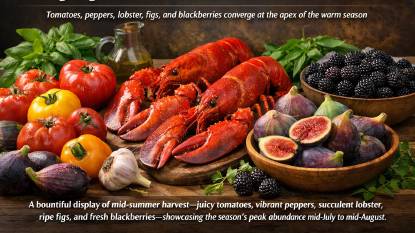

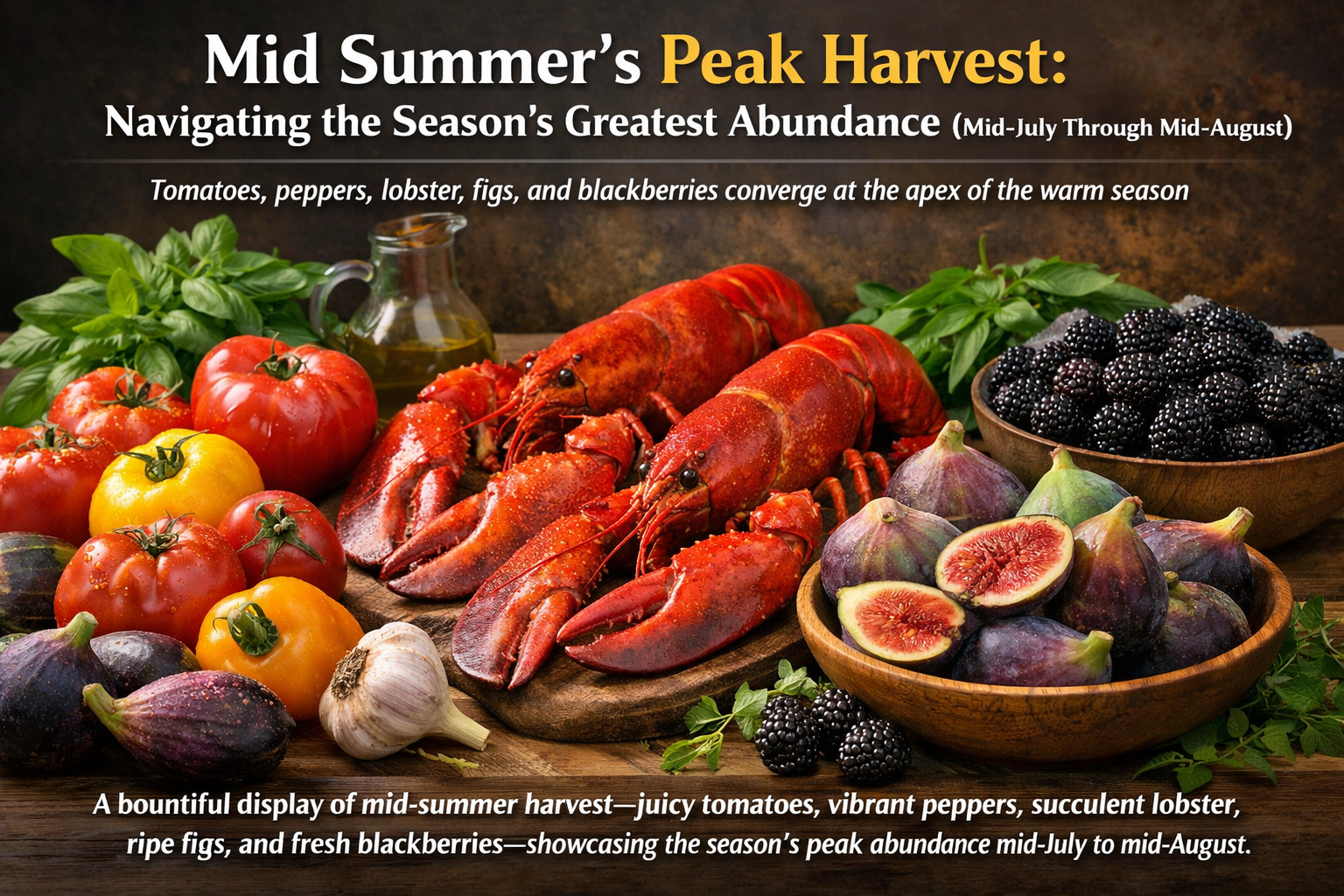
This is the apex of the seasonal cooking calendar. The sun is at its strongest. The garden is at its most generous. The farmers’ market stalls groan under the weight of tomatoes, peppers, eggplants, melons, and berries of every description. Mid summer, from mid-July through mid-August, is the season that defines what summer eating is all about.
This is when the cooking becomes effortless. A perfect tomato needs only salt. A ripe fig needs nothing at all. A fresh lobster needs only butter. The challenge of mid summer is not finding good ingredients. It is deciding which ones to cook first.
Fruits of Mid Summer
The fruit selection broadens dramatically in mid summer. Early berries are still going strong, and they are joined by pears, melons, figs, and the deep, winey flavors of blackberries.
Early Pears (Bartlett and Asian)
The pear is an Old World fruit with two distinct lines of the family: Asian and European. European pears are native to the Middle East and the Caucasus. Asian varieties appear to have come from eastern China, Japan, and Korea. The two differ in several important ways.
Asian pears are usually round. The ripe fruits are not significantly softer than unripe ones, and they are ready to eat immediately after the harvest. European pears define the term “pear-shaped,” being bulbous at the bottom and tapering at the top. They are not ready to eat until they have reached just the right stage of softness, but they must not be allowed to stay on the tree until fully mature, as tree-ripened European pears tend to develop brown cores and an unpleasant taste.
In the United States, the most popular Asian pear is the Japanese type called 20th Century (or Nijisseki), which is round with smooth yellow skin. Another Japanese pear, the bronze-toned Hosui, is also common in markets, as is the conventionally pear-shaped Ya Li, a pale-green Chinese variety. Plump, pale-green Bartletts (known in Europe as Williams’ Bon Chretien) are the most common commercially grown pears. Not only are more fresh Bartletts sold in the United States than any other kind, they are also the pears used for canning. There is a red variety of Bartlett, but it ripens later in the season.
The distinctive graininess of pear flesh comes from the presence of hard cells interspersed among the softer ones. These rigid-walled cells contain lignin, a component of wood, and are known as sclerenchyma growths. Nutshells are made almost entirely out of them.
Look for fresh pears poached in spiced red wine, cut into thin slices and added with blue cheese and walnuts to endive salads, or used in place of apples in custardy tarte Tatins. Poire William is the best of several brands of fragrant and potent pear-based eaux de vie. Several West Coast microbreweries also manufacture perry, or pear cider, though it is not as popular as hard apple cider.
Blackberries and the Boysenberry Story
Blackberries, like raspberries, are bramble fruits. The roots of the plants live indefinitely and send forth thorny canes that sprout up one year, bear fruit the next, and then die back to be replaced by new growth. Blackberry plants either grow upward like large bushes or trail along the ground. Trailing blackberries are known as dewberries.
Most varieties of blackberries are so soft and perishable that they cannot be shipped. With the exception of a few hybrids engineered to hold up long enough to get to market, they are not sold in stores. This means that most people who enjoy them still get them the old-fashioned way: by grabbing a bucket, walking out to a nearby field or garden plot, and plucking them off the canes.
There are some well-established blackberry hybrids, all achieved by crossing blackberries with raspberries. These include loganberries, marionberries, youngberries, and probably the most famous, boysenberries. The exceptionally large, deep purple boysenberry was developed by Rudolph Boysen of Napa, California, in the 1920s. Boysen actually abandoned his creation when he sold his farm. But a fruit seller named Walter Knott, who had heard rumors of the berry, rescued a few canes from the neglected property. His success with them later inspired him to start a larger business, today known as Knott’s Berry Farm, which grew from a simple roadside berry stand into a world-famous theme park.
Fresh blackberries should never be left to sit at room temperature. They will soften and bleed. If they must be stored, put them in the refrigerator. Their rich, winey sweetness is a good complement to bananas, melons, and peaches.
Watermelons and Muskmelons
Melons can be divided into two types: watermelons and muskmelons. All are in the gourd family, but the musky varieties (which include cantaloupe, crenshaw, Persian, casaba, and honeydew) are more closely related to the cucumber.
People have cultivated watermelons for a very long time. They are native to southern Africa, and by 4000 BCE they were familiar to the Egyptians, sometimes appearing in their artwork. The origins of the muskmelon are not as well documented. It is known that the Romans ate them in salads and that, at the time, the melons were not yet sweet. They were still vegetables, like the cucumber. Over the centuries, through selective cultivation that took place mostly in the Mediterranean, farmers managed to create the sweet, musky melons we enjoy today.
The name cantaloupe comes from the town of Cantalupo in Sabina, Italy, where the melon is said to have been cultivated on the grounds of a papal palace. True cantaloupes are not readily available in America. The term is used loosely to identify any of several varieties of orange-fleshed muskmelons with a “netted” pattern on the rind.
Good cantaloupes are notoriously difficult to pick out, but buying from local producers in peak season is half the battle. Check to be sure the stem scar on the fruit is smooth. If there is a jagged stub remaining, the melon was picked before it was ready and will not ripen off the vine. The melon should be fragrant. Sometimes, when the fruit is particularly juicy, you can hear the seeds sloshing inside when you shake it.
The accepted wisdom for picking a watermelon is to slap it. A high-pitched tone means the melon is not ripe. A dull thunk indicates it is past its prime. A resonant tone means it is just right.
Figs
The fig is one of the oldest known foods. The Egyptians were eating them over 6,000 years ago. In addition to using the fruit, the ancient Hebrews discovered that adding the sap of the fig tree to milk would curdle it into cheese. This gave them an acceptable substitute for the meat products that could also be used in cheesemaking but that violated their food laws.
Many fruits are not technically fruits in the scientific sense, and this is true of the fig in a particularly interesting way. The fig is actually an enlarged, hollow flower stem called a peduncle. The male flowers cluster at the tip of this stem, and the female flowers are tucked inside. After fertilization, those inner flowers swell and turn into tiny fruits, each containing a single seed. Some varieties of fig will not even produce fruit without the help of certain types of small fig wasps, which are singularly well adapted to crawl into the fig and pollinate its flowers.
There are hundreds of varieties of fig. Among them are the golden brown Smyrna and Calimyrna (the California version of the Smyrna), the green Adriatic, the deep purple Black Mission, the Brown Turkey, and the pale yellow-green Kadota. Fresh figs, expensive and hard to find out of season, are best eaten as simply as possible. Dried figs can be used for cooking, as sauces for game, fillings for pastries (as in Fig Newtons), and stewed or brandied as dessert toppings. Capuchin nougats, dried figs stuffed with green walnuts, are a traditional French Christmas treat.
Vegetables of Mid Summer
This is the heart of the vegetable garden. Mid summer delivers the produce that defines the season. Tomatoes, peppers, eggplants, and beans all converge at once.
Chanterelles
These ruffle-edged, funnel-shaped mushrooms range in color from pale, buttery hues to deep orange. They range in size from no more than an inch in diameter at the cap to as large as six inches across. In France, chanterelles are known as girolles; in Germany, they are called pfifferlings. Their scientific name is Cantharellus cibarus, derived from the Latin word for “drinking vessel,” which refers to the shape of all members of this genus.
The chanterelle requires only a short cooking time to bring out its fruity fragrance and nutlike flavor. Overcooking will toughen this already-chewy mushroom. Although some people enjoy them raw, they have a peppery quality that strikes others as unpleasantly bitter. As with any mushroom, avoid submerging them in water to wash them; the best method is to wipe dirt off gently with a damp cloth.
The chanterelle bears a resemblance to the thoroughly poisonous jack-o-lantern mushroom (Clitocybe illudens), which glows in the dark. Those who wish to gather mushrooms for themselves must be absolutely sure to identify chanterelles correctly before cooking them. Wild mushrooms are usually prepared by sauteing, and butter or olive oil is the perfect complement to their delicate flavor. Try an omelette filled with sauteed chanterelles, fresh parsley, and green onions.
Eggplant
The eggplant, or aubergine as it is known in Europe, is native to India. As a member of the deadly nightshade family, it is related to the potato, tomato, and tobacco. The ideal eggplant is firm and heavy, with skin as glossy and smooth as lacquer. The exceptionally spongy flesh can dry out without affecting the surface appearance, so you must pick one up to evaluate it. If an eggplant seems light for its size, it is past its prime.
Eggplants are in the markets year-round, but they are decidedly better in the summer, and there is greater variety. At farmers’ markets, they appear in shades from white to lavender to the familiar black-purple. Some varieties are patterned, as if their streaks and blotches have been painted in watercolors. They grow in round, oval, pear-shaped, and elongated forms. You may even find the small, oval, white type that presumably inspired the name “eggplant.”
It is common to salt an eggplant before cooking it. This is done by cutting the flesh, sprinkling it with salt, and allowing the pieces to sit under weight for about half an hour. There are several reasons for this. Eggplants contain a lot of water that can dilute a stew or dampen a saute. They are very spongy and will absorb significant amounts of fat during frying. Salting reduces this absorbency somewhat. And older eggplants can have a bitter taste, which the salting process counteracts.
During summer, look for small, young Chinese or Japanese eggplants. Their tender, thin skin does not need to be peeled before cooking, and they are rarely bitter. Eggplant has a substantial, almost meaty texture and flavor. It is one of the key ingredients in ratatouille, the focus of the Middle Eastern dip baba gannouj, and an ingredient in the Italian pasta sauce arabbiata. It appears in Indian curries and Chinese, Japanese, and Indonesian stir-fries.
Peppers (Sweet and Hot)
Peppers are New World natives. Christopher Columbus noticed hot peppers (chiles) almost immediately after he struck land in the Americas. He soon sent a cargo back to Spain, suggesting they might be a good substitute for black pepper, one of the precious spices that had driven merchant explorers to take to the sea.
Sweet and hot peppers all belong to the genus Capsicum. They are so closely related that if a bell pepper plant is placed next to a jalapeno plant in the garden, the two will cross-pollinate, sweetening the jalapenos and adding heat to the bells. The substance that makes chile peppers hot is capsaicin, which is most concentrated in the white tissue inside the pepper where the seeds are attached.
There appear to be several different compounds of capsaicin, each with a different effect on the taste buds. This may explain why different peppers are perceived as being “differently hot,” some producing a sudden but fleeting flash of heat and others becoming steadily more potent as the meal progresses. Scientists have theorized that the brain releases endorphins in response to the pain of the burn, inducing a state of euphoria in the eater. Recent research also suggests capsaicin is effective in decreasing inflammation and pain caused by arthritis and that it relieves many other sorts of chronic pain.
The green bell peppers that are always in stores are simply immature fruits. If left on the plant, they will ripen into the bright yellows, oranges, and reds that are usually sold at much higher prices. At farmers’ markets, even more exotic colors are available, including rich brown and purple varieties, as well as white bell peppers that become a mellow ivory when fully matured.
Shell Beans
The huge variety of shell beans is probably best appreciated in the dried bean section of a good grocery store. There you will find white beans (navy, Great Northern, cannellini, flageolets), red and pink beans (kidneys), black beans, multicolored beans (pinto, cranberry, and borlotto), and lima beans, to name only a few. The selection of fresh shell beans in markets is improving, and cranberry beans and lima beans are often sold fresh in their pods.
When Europeans encountered shell beans in the New World, they must have felt right at home. The similar broad bean (fava) had been a staple in the Old World for centuries. The Europeans adopted shell beans and integrated them so thoroughly into their cooking that the legumes were later believed to be Old World natives. In fact, the shell bean originated in Central and South America, where it has been domesticated for millennia.
Approximately one-quarter of the nutritional composition of a bean is protein. A one-cup serving is considered the protein equivalent of 2 ounces of meat. Winter savory is the traditional herb for flavoring shell beans, but other aromatic herbs such as thyme, rosemary, or sage will also do them justice. Beans appear in soups and summer salads, and pureed to make spreads and dips. The famous Provencal dish cassoulet is made with flageolets or other small white beans.
Tomatoes
Most of the vitamin C in a tomato is concentrated in the translucent jelly that surrounds the seeds. Those who prefer to remove the seeds before using a tomato are discarding nutrients as well. The tomato, like the potato and the eggplant, belongs to the deadly nightshade family, so its roots and leaves are mildly poisonous. The negative effects are usually no more severe than a skin rash where a sensitive gardener comes in contact with the foliage.
The tomato is native to Peru and Ecuador and was likely domesticated centuries before Europeans arrived. The word “tomato” comes from the Aztec tomatl. In 16th century Europe, the fruit was given a number of romantic names, among them “love apple” (in French, pomme d’amour; in Italian, pomo d’amore). It was regarded as an ornamental plant and had the contradictory reputation of being both an aphrodisiac and poisonous.
Although the tomato did not catch on as a food in Italy until the 18th century, few flavors are more associated with Italian cuisine today. After the United States, Italy is the world’s largest producer of tomatoes and tomato products. A really superb fresh tomato can be hard to find, because it takes a long, hot summer to ripen them to perfection. The best thing you can do when you have good tomatoes is to slice them, sprinkle the pieces lightly with salt, pepper, and fresh chopped basil, and drizzle the whole with olive oil before serving.
Meat and Fish of Mid Summer
Mid summer seafood tends toward the rich and flavorful, with plenty of options for the grill. This is also the season for lobster, that most celebrated of summer indulgences.
Mackerel
The mackerel is one of the most common food fishes and has given its Latin name, Scomber, to the family that also includes tuna and bonito. All the Scombroids are fast-swimming, spiny-finned ocean fishes that travel in large schools. Common mackerel are found in the northern coastal waters on both sides of the Atlantic.
During cold weather, they occupy a region about 600 feet below the ocean surface. But when the weather gets warmer, they ascend and migrate inland. Mackerel spawn from spring to midsummer, which is when most of the fishing is done. They are not particularly large fish, usually growing to be only about a foot long. The smaller ones are sometimes called “tinkers.”
Mackerel have distinctive blue-green scales patterned with undulating lines on the upper body and a white belly. This makes them an attractive choice for whole-fish preparations such as poaching or grilling. These fish, with their high fat content, are an especially good source of the essential fatty acid omega-3, which is believed to have numerous healthful effects. The French traditionally serve mackerel with gooseberry puree.
Lobster
The American lobster is found only on the East Coast of the United States, most famously in Maine. There have been many attempts to introduce this delicacy to the waters off the Pacific coast, but they have consistently failed. If westerners want to feast on Homarus americanus, they have to ship it cross-country.
Lobsters are slow-growing creatures. The 1-pounder that commonly makes it to the table is between four and seven years old. Though the full lifespan of a lobster is not certain, they are believed to live at least 50 years and reach a maximum weight of 45 pounds. Lobsters are nocturnal, scavenging for molluscs, invertebrates, and small fish on the ocean floor in darkness. They have an extremely sharp sense of smell, with their “nose” located in the antennae that wave over their heads.
Just like people, lobsters appear to be either right- or left-handed. One claw is always larger than the other and is used for crushing, while the smaller one cuts. If a predator grabs one of its appendages, the lobster can jettison the limb and make its escape. Later, during molting, the leg will be replaced.
The red pigment in a lobster’s shell is always present, but it is usually masked by the green and brown pigments that distinguish the living lobster. Only the red can withstand the heat of boiling water; the other compounds break down and become colorless. Firm, sweet lobster meat is appropriate for many preparations, from whole boiled lobster with melted butter to bisques, bouillabaisses, salads, and classics like Lobster Newburg and Lobster Thermidor.
Squid
The squid is a mollusk, like oysters and clams, and closely related to octopuses. Although the squid is not surrounded by a shell like its shellfish relatives, it does have a hidden one. A rigid, feather-shaped object called the gladius or quill is found inside the squid’s elongated body.
The name “squid” is believed to be a form of “squirt,” an activity the creature relies upon extensively. Most squid move by jet propulsion, expanding their bodies to draw in water and then shooting forward by forcefully expelling it. The squid also has the ability to squirt ink into the water to distract predators.
The edible parts of the squid are the tentacles, body, and fins. Of the two species of food squid, longfin (Loligo) and shortfin (Illex), the longfin are considered better for eating. Squid is well suited for grilling or stir-fries, where it should be cooked only briefly to prevent it from toughening. Look for it in spicy Thai salads, Chinese curries, and Italian preparations such as fried calamari.
Rainbow and Steelhead Trout
Steelhead and rainbow trout are genetically identical. However, rainbows are freshwater fish, living their whole lives in rivers, lakes, and streams. Steelhead are born and spawn in freshwater but live for most of their lives in the ocean. As a result, steelhead grow to be at least twice as large, reaching weights of 20 pounds or more.
Steelhead trout are native to the West coast, though they have been successfully naturalized in the Great Lakes area. In the West, where their habitat has been seriously affected by overfishing, pollution, and the construction of hydroelectric power stations, they are being considered for endangered-species status. The freshwater rainbow trout, however, is extensively farmed, which allows for year-round availability and assures the survival of the species.
Trout are closely related to salmon, and their flesh sometimes acquires the same pink hue because they share a similar diet. The color comes from astaxanthin, a rosy pigment found in the bodies of many river insects, small crustaceans, and fish. Rainbow trout are usually small enough to be served whole, with baking, grilling, and pan-frying being popular preparations.
Eating Mid Summer Well
Mid summer cooking is about abundance. There is so much good food available that the challenge is not finding it, but deciding what to do with it. The best approach is to keep things simple. A perfect tomato needs nothing more than salt and olive oil. A fresh lobster needs nothing more than butter. A ripe fig needs nothing at all.
This is the season to gather friends and family around the table, to fire up the grill, and to celebrate the peak of the harvest. Because mid summer does not last forever. The days will soon shorten, and the focus will shift to autumn’s stored goods. Enjoy this abundance while it is here.
Mid Summer Video
From the first bounty of Early Summer to the golden transition of Late Summer’s Final Harvest, this is the apex of the warm months.
Featured articles
Explore rich culinary stories, exclusive chef interviews, and expert insights from kitchens around the world. Discover cooking techniques, ingredient spotlights, and behind-the-scenes looks at the tools that shape global cuisine.

Georges Auguste Escoffier: Visionary Chef Who Revolutionized French Cuisine and Modern Cooking
Discover the life and legacy of Georges Auguste Escoffier, the legendary chef who transformed French cuisine and laid the foundation for modern culinary arts. This comprehensive historical profile …

How to Use a Knife, Fork, and Spoon
Master the basics of Western table etiquette with this guide to using a knife, fork, and spoon. Learn practical tips, cultural context, and the subtle rules that shape how we dine.

The History of Chocolate
Trace the fascinating history of chocolate, from its ancient origins with the Olmecs and Maya to its transformation into a global indulgence. Explore how cacao evolved from sacred ceremonial drink to …
Georges Auguste Escoffier: Visionary Chef Who Revolutionized French Cuisine and Modern Cooking
Discover the life and legacy of Georges Auguste Escoffier, the legendary chef who …
How to Use a Knife, Fork, and Spoon
Master the basics of Western table etiquette with this guide to using a knife, fork, and …
The History of Chocolate
Trace the fascinating history of chocolate, from its ancient origins with the Olmecs and …