Late Winter Cooking: Blood Oranges, Rhubarb, Belgian Endive, and the Turn Toward Spring (February Through Early March)

By: Simon
July 19, 2026 | Updated: September 12, 2026

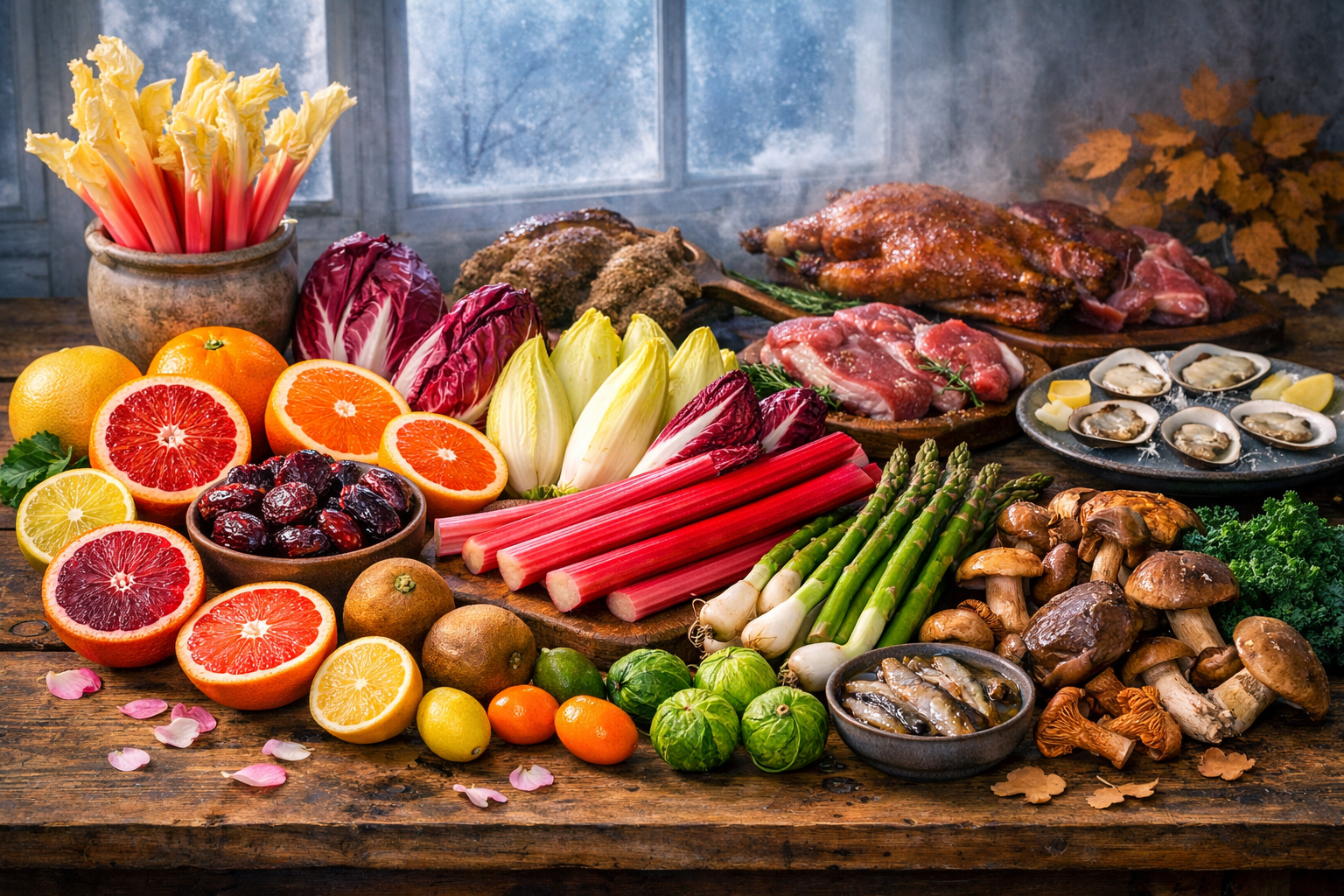
By February, winter has begun to loosen its grip. The days are perceptibly longer. The first signs of spring appear in the markets: forced rhubarb with its pale pink stalks, the first tender tips of asparagus from warmer climates, the earthy perfume of wild mushrooms. But winter is not finished yet. There are still root vegetables to use up, citrus fruits at their peak, and the last of the stored squash to finish.
Seasonal cooking in late winter is filled with anticipation. The kitchen is a place of transition, where the hearty braises of deep winter begin to give way to lighter, brighter flavors. This is the time to use up what remains in storage and to welcome the first hesitant arrivals of the new growing season.
Fruits of Late Winter
The fruit selection in late winter is dominated by citrus in its most dramatic forms, with the first forced fruits of spring beginning to appear.
Blood Oranges and Cara Cara Oranges
February is the peak season for blood oranges, the most striking of all citrus fruits. Their flesh ranges from orange streaked with red to deep, dramatic crimson, depending on the variety and the growing conditions. The color comes from anthocyanins, the same pigments that color blueberries and red wine, which develop only when nights are cold.
Blood oranges originated in Sicily, where the volcanic soil and cool Mediterranean nights produce the most intensely colored fruit. The three main varieties are the Tarocco (sweet and complex), the Moro (the deepest red, with a raspberry-like flavor), and the Sanguinello (the sweetest of the three). The Tarocco is considered the finest eating orange in Italy.
Cara Cara oranges are a newer variety, discovered as a mutation on a Washington navel orange tree in Venezuela in 1976. Their flesh is pinkish-red, like a grapefruit, but their flavor is sweet and low in acid, with hints of cherry and rose. They are a late-winter treat that bridges the gap between the navel orange season and the arrival of spring citrus.
Pomelos are the largest of all citrus fruits, with a thick rind and a mild, slightly sweet flavor. They are the ancestors of the grapefruit and are often used in Southeast Asian salads. Meyer lemons, a cross between a lemon and a mandarin orange, are sweeter and less acidic than regular lemons, with a fragrant, floral aroma. They are at their peak in late winter and are prized for both their juice and their zest.
Forced Rhubarb
Rhubarb is the first fruit of the spring, and forced rhubarb is the earliest of all. Grown in complete darkness, forced rhubarb produces pale pink stalks that are tender, sweet, and far less tart than the field-grown rhubarb that arrives later in the season.
The tradition of forcing rhubarb began in England in the early 19th century, when gardeners discovered that covering rhubarb crowns with soil or bringing them into dark sheds would produce earlier, more tender stalks. The Yorkshire Rhubarb Triangle, an area between Leeds, Wakefield, and Bradford, became the center of forced rhubarb production, and the vegetable was so prized that it was known as “English champagne.”
Forced rhubarb is best used in desserts: crumbles, pies, compotes, and sauces. Its natural tartness pairs perfectly with sugar, with vanilla, and with the sweetness of strawberries when they arrive later in spring. It also works in savory dishes, particularly with fatty fish like mackerel and with pork.
Winter Citrus
The last of the winter citrus varieties are still available in late winter. Honeybells, a cross between a tangerine and a grapefruit, are juicy and sweet. They are available for only a few weeks in February. Kumquats, those tiny citrus fruits that are eaten skin and all, are still in season. The rind is sweet, the flesh is sour, and the combination is bracing and refreshing.
Vegetables of Late Winter
Late winter vegetables are about transition. The storage vegetables of winter are dwindling, and the first fresh green things of spring are beginning to appear.
Belgian Endive
Belgian endive is one of winter’s great culinary gifts. It was discovered by accident in the 1830s, when a Belgian farmer named Jan Lammers stored chicory roots in his cellar intending to dry and roast them for coffee and found that they had sprouted tender, pale leaves instead. This method of forcing chicory roots in darkness became the foundation of a whole industry.
Belgian endive is known as “white gold” in its home country, and for good reason. The process of growing it is labor-intensive. Chicory roots are harvested in autumn, stored through the winter, and then forced in dark, temperature-controlled rooms. The result is a crisp, slightly bitter leaf that adds elegance to salads and can be braised, grilled, or used as a vessel for hors d’oeuvres.
The bitterness of endive is part of its appeal. It pairs well with sweet and rich ingredients: pears, walnuts, blue cheese, and prosciutto. Braised endive, cooked slowly in butter and a little stock until meltingly tender, is one of the great overlooked side dishes of French cuisine.
Chicories and Winter Greens
Radicchio, the purple-headed chicory from Italy, is at its best in late winter. It comes in several varieties, the most common being radicchio di Chioggia (round and densely packed), radicchio di Treviso (elongated, like a small romaine), and radicchio di Castelfranco (loose and speckled). All share a distinctive bitterness that mellows with cooking.
Radicchio can be grilled, roasted, or braised, which transforms its harshness into a pleasant, smoky complexity. It also adds color and texture to winter salads when combined with milder greens and a sharp vinaigrette.
Other winter greens include escarole and frisée, both members of the chicory family. Escarole has broad, slightly ruffled leaves and a mild bitterness. It is excellent in soups, particularly Italian wedding soup and white bean and escarole soup. Frisée has feathery, delicate leaves and a peppery bite. It is the classic green for salade Lyonnaise, paired with a poached egg and warm bacon vinaigrette.
Ramps
Ramps, also known as wild leeks, are one of the first signs of spring. They appear in late winter in warmer regions and early spring in colder ones. Ramps have broad, smooth leaves and a bulb that looks like a small scallion. Their flavor is a pungent combination of garlic and onion, with a wild, earthy intensity.
Foraged from the forests of the Appalachian region, ramps have developed a passionate following among chefs and food enthusiasts. Their short season, usually only a few weeks long, adds to their appeal. They can be sauteed, pickled, used in pesto, or added to eggs and pasta.
Because ramps are foraged rather than farmed, sustainability is a concern. Harvesters are encouraged to take only the leaves and leave the bulbs, or to take only a portion of any patch, allowing the plants to regenerate.
Asparagus
The first asparagus of the year arrives in late winter, usually from warmer growing regions like California’s Imperial Valley. It is a harbinger of spring, even if spring has not quite arrived in most of the country.
Asparagus is a perennial vegetable, meaning the same plants produce spears year after year. A well-tended asparagus bed can produce for 20 years or more. The spears are the young shoots of the plant and must be harvested by hand, which accounts for their relatively high price.
Green asparagus is the most common variety, but white asparagus (grown under mounds of soil to prevent photosynthesis) and purple asparagus (bred for higher sugar content) are also available. The best way to cook asparagus is simply: roasted with olive oil and salt, grilled over high heat, or steamed until just tender.
Morels and Early Wild Mushrooms
In very late winter, the first wild morels begin to appear, particularly after the first warm rains. Morels are the most sought-after of all wild mushrooms, with a honeycomb appearance and a nutty, earthy flavor that is almost impossible to describe. They are excellent sauteed in butter, added to cream sauces, or used in stuffings.
Morels cannot be cultivated commercially, so every morel in the market was foraged in the wild. This makes them expensive, but a small amount goes a long way. The genus Morchella encompasses dozens of species worldwide, each with its own distinct range and growing conditions. Look for firm, dry morels with no signs of mold. Fresh morels should be cleaned gently with a brush or a damp cloth, never soaked in water.
Storage Vegetables
The last of the storage vegetables are still available in late winter. Rutabagas, turnips, parsnips, and celeriac have been in storage since autumn, but they are still good. Potatoes and sweet potatoes are reaching the end of their storage life, so they should be checked carefully for sprouting or softening.
This is a good time to use up these vegetables in hearty soups, stews, and purees. A potato and celeriac puree is a classic French side dish that pairs well with roasted meats. A rutabaga and sweet potato mash is a colorful and nutritious alternative to regular mashed potatoes.
Meat and Fish of Late Winter
Late winter is a transitional time for meat and fish. The heavy game of autumn is gone, but the fresh fish of spring has not yet arrived. This is the time for preserved fish, for the last of the winter shellfish, and for early spring lamb. Each of these ingredients has been valued for centuries precisely because of when they appear in the calendar.
Lamb
Spring lamb is one of the most anticipated arrivals of the late winter table. Unlike mature lamb, which can be strongly flavored, spring lamb is mild, tender, and delicate. It is typically marketed as “new season lamb” and appears in markets in late winter and early spring. The arrival of the first lamb is an event celebrated across many culinary traditions.
The best cuts for spring lamb are the leg (for roasting), the rack (for elegant dinners), and the shoulder (for braising). Lamb pairs well with the last of the winter citrus, with fresh herbs like rosemary and mint, and with roasted root vegetables. A slow-braised lamb shoulder with blood oranges and olives is a dish that captures the transition from winter to spring in a single pot.
Preserved Fish
Before refrigeration, late winter was the time when preserved fish came into its own. Salt cod, or bacalao, has been a staple of European cuisine for at least 500 years, dating back to the European discoveries of the New World. The fish is salted and dried, which preserves it and concentrates its flavor. It must be soaked in several changes of water before cooking to rehydrate it and remove excess salt.
Salt cod is used in a remarkable variety of dishes across many cultures. The French make brandade de morue, a creamy puree of salt cod, olive oil, and potatoes. The Portuguese make bacalhau a Gomes de Sá, a baked casserole of salt cod, potatoes, onions, and olives. The Italians use it in fritters and pasta sauces. In Portugal alone, there are said to be over 1,000 recipes for salt cod.
Canned and jarred fish, including anchovies, sardines, and tuna, also come into their own in late winter. They add depth and umami to pasta sauces, salads, and vegetable dishes. A few anchovy fillets melted into a warm vinaigrette transform a simple salad of bitter greens into something extraordinary.
Oysters and Shellfish
Oysters are still at their peak in late winter. The “R months” rule (September through April) means oysters are still firm and flavorful. As the water begins to warm toward spring, the oysters will begin to spawn and their quality will decline, so late winter is the last chance to enjoy them at their best. A dozen freshly shucked oysters is one of the finest expressions of the season.
Mussels and clams are also excellent in late winter. They are at their most plump and flavorful in cold water. Both are quick-cooking and versatile. A pot of mussels steamed in white wine with garlic and herbs is one of the fastest and most satisfying meals of the winter kitchen. Serve it with crusty bread to soak up the broth.
Halibut
Pacific halibut season begins in March, making late winter the time when the first fresh halibut of the year appears. Halibut is a flatfish, a species of flounder that can grow to enormous sizes. The Pacific and Atlantic halibut are the largest flatfish in the world, with some specimens exceeding 500 pounds. The meat is white, firm, and mild, with a clean flavor that takes well to simple preparations.
Halibut is best grilled, roasted, or poached. It holds its shape well and does not flake apart the way more delicate fish do. A simple preparation with olive oil, lemon, and herbs is all it needs. The first halibut of the season is a sign that winter is finally loosening its grip and that the abundance of spring is on its way.
Eating Late Winter Well
Late winter cooking is about hope. The best of the storage season is behind us, but the best of the fresh season is just ahead. This is the time to use up what remains, to enjoy the last of the winter citrus and shellfish, and to welcome the first arrivals of spring.
The menu of late winter reflects this transition. A last batch of oven-roasted root vegetables. A final dozen oysters. A salad of bitter chicories dressed with a sharp vinaigrette. And then, the first asparagus, the first ramps, the first lamb of the year. Each meal is a step toward the light.
The kitchen in late winter is a place of anticipation. The days are getting longer. The light is changing. The first green shoots are pushing up through the soil. Spring is coming, and the table is ready.
Late Winter Video
From the quiet depths of Early Winter Eating through the final frost, this season of anticipation prepares the table for the fresh cycle ahead.
Featured articles
Explore rich culinary stories, exclusive chef interviews, and expert insights from kitchens around the world. Discover cooking techniques, ingredient spotlights, and behind-the-scenes looks at the tools that shape global cuisine.

Georges Auguste Escoffier: Visionary Chef Who Revolutionized French Cuisine and Modern Cooking
Discover the life and legacy of Georges Auguste Escoffier, the legendary chef who transformed French cuisine and laid the foundation for modern culinary arts. This comprehensive historical profile …

How to Use a Knife, Fork, and Spoon
Master the basics of Western table etiquette with this guide to using a knife, fork, and spoon. Learn practical tips, cultural context, and the subtle rules that shape how we dine.

The History of Chocolate
Trace the fascinating history of chocolate, from its ancient origins with the Olmecs and Maya to its transformation into a global indulgence. Explore how cacao evolved from sacred ceremonial drink to …
Georges Auguste Escoffier: Visionary Chef Who Revolutionized French Cuisine and Modern Cooking
Discover the life and legacy of Georges Auguste Escoffier, the legendary chef who …
How to Use a Knife, Fork, and Spoon
Master the basics of Western table etiquette with this guide to using a knife, fork, and …
The History of Chocolate
Trace the fascinating history of chocolate, from its ancient origins with the Olmecs and …