Late Summer's Final Harvest: Making the Most of the Season's Last Gifts (Mid-August Through Early September)

By: Simon
July 19, 2026 | Updated: September 12, 2026

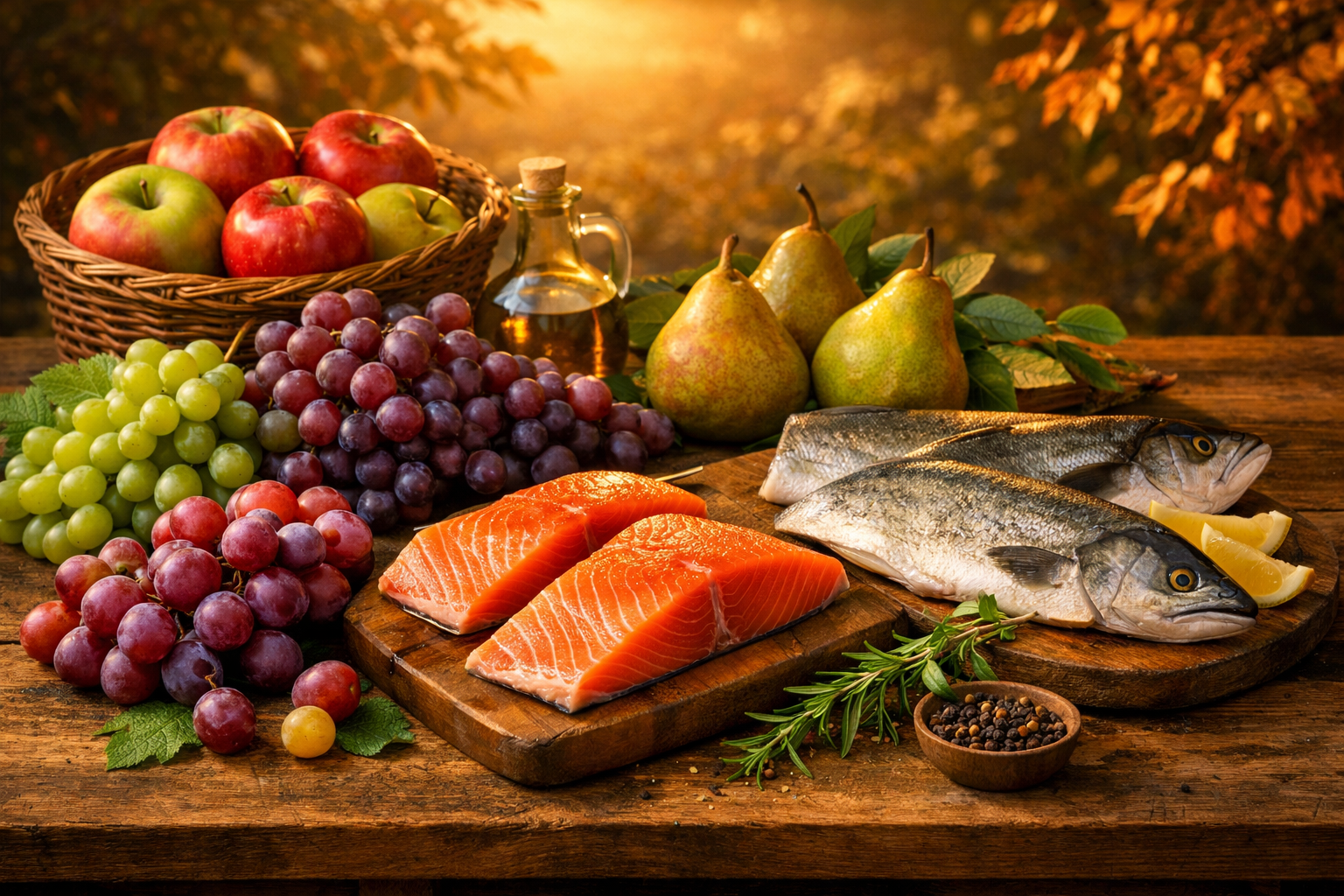
Late summer has a different feel for seasonal cooking. The frantic growth of early summer and the overwhelming abundance of mid summer give way to a mellower rhythm. The sun still shines, the days are still long, but there is a change in the air. The first apples appear. The grapes begin to color. The fish that migrate through these waters are at their richest and most flavorful.
This is the time of transition, when summer’s bounty begins to point toward autumn. The harvests are heavier. The flavors are deeper. And there is a gentle urgency to the season, a reminder to enjoy these last warm days before the turn of the year.
Fruits of Late Summer
Late summer fruits lean toward the sustaining. These are the fruits that will carry us into autumn, the ones that store well and travel far.
Early Apples
The first apples of the year begin ripening in late summer. Look for Red Delicious, McIntosh (round, red with tinges of green), Gravenstein (red striped), Lodi (yellow-green), Cortland (red with very white flesh), Gala and Royal Gala (orange-red, sometimes with streaks of green), and Ginger Gold (smooth and yellow).
Red Delicious is the most popular apple in America, probably more for its appearance than its taste. Unlike most apples, the Red Delicious looks just great even when it is considerably past its prime. Be sure to buy them in season and choose apples that are heavy and firm. These apples are best for eating out of hand and do not usually work well for cooking. Red Delicious apples are elongated rather than round, with a sort of high-cheekboned, strong-chinned shape and six distinctive lumps at the bottom.
The apple was discovered in the 1870s by an Iowa farmer named Jesse Hiatt. He named them Hawkeyes in honor of his new home state. When they won a fruit fair competition in 1893, the name was changed. Clarence Stark of the Stark Brothers Nursery declared it “delicious,” and the name stuck. Hiatt’s original Red Delicious tree is said to still be alive and well.
With the exception of the Gala variety, summer apples do not store as well as fall apples because they have a high water content and tend to become mealy. Apples continue to ripen rapidly even after they are picked, but refrigeration dramatically slows this process. Once your apples reach a stage of ideal ripeness, put them in the refrigerator if you will not be able to eat them right away.
The best late summer apples for cooking are Gravensteins, Lodis, Cortlands, Galas, and Ginger Golds. Apples go well in both sweet and savory dishes. A favorite European combination is fried apples with pork. In America, of course, there is the pie. Look for apples in summer dishes such as fruit salads, cole slaw, chilled soups, and fresh apple tarts.
Early Grapes
Most shoppers think only of green seedless when they look for grapes. But there are many kinds of grapes, and very often the ones with seeds have the best flavor. The late summer is just the beginning of grape season. Look for dark red Cardinals, blue-black Buffalos, golden Thompson Seedless, and the amber Interlaken Seedless.
There are three different types of grapes. American bunch grapes and muscadine grapes are both native to North America. European grapes come from the Old World but are widely grown in California. The majority of grapes on the market are European varieties, although there are quite a few American bunch and European hybrids.
Muscadine grapes are native to the southeastern United States and do not grow well in any other area. In the South, though, they thrive, and people often gather wild muscadines for their desserts. Unlike bunch grapes, which ripen all at once and can be snipped off the branch, muscadines ripen one at a time. They are harvested by shaking the plant so that the grapes fall off into a cloth. Muscadine grapes come in bronze and black cultivated varieties.
The most famous muscadine is the Scuppernong, a bronze grape that was first documented in the early 19th century by a North Carolina naturalist, Dr. Calvin Jones. In 2001, the Scuppernong was named the official state fruit of North Carolina. There is even a 400-year-old “Mother Vine” on Roanoke Island that still produces Scuppernong grapes, making it one of the oldest cultivated grapevines in North America.
There is some evidence that grape juice, or more specifically the flavonoid pigment in grape juice, might benefit heart patients because it appears to prevent blood cells from clumping. It was originally noticed that the wine-loving French, despite their high-fat diets, have a lower incidence of heart disease than might be expected. On further examination, researchers discovered that fermented or not, grape juice had the same effect.
Mid-Season Pears
The Bartlett pears of midsummer are followed by the more full-flavored Bosc, Comice, and Seckel varieties, all of European origin. Each has its own character and best use.
The Comice pear, also known as the Doyenne de Comice, was first produced in France in 1849 by the gardener Dhomme and Millet de la Turtaudiere, President of the Comice Horticole in Angers. It is generally regarded as the best of all pear varieties because it is particularly juicy and sweet. Comice pears are fat, bulbous green pears with a crimson blush. The skin is so delicate that even the tiniest bump can bruise it. Small scratches should not prevent you from buying the fruit, as they will not harm the flavor.
Bosc pears are slender and tall, with golden skin layered over with brown russeting. They have a smooth, buttery texture but are quite dense and hold their shape when cooked. Their spicy flavor is more assertive than that of other pears, which makes them good for baking. Tiny Seckel pears are often used for garnishes, but they are good for eating and cooking too. At little more than two or three inches high, they are olive green tinged with deep red.
There is no need to buy pears that are already ripe. In fact, the riper the pear is to start out with, the more likely it is to have been bruised during shipping. No matter how hard they seem at the store, pears will achieve delectable ripeness in a few days if allowed to sit at room temperature. If a pear is ready to eat, the flesh at the base of the stem will be just soft enough to give when pressed lightly.
Bosc and Seckel pears are better for cooking than the Comice, which falls into mush when exposed to heat. Pears go well with anise, maple syrup, stilton, and port.
Vegetables of Late Summer
Late summer vegetables are fewer but no less interesting. This is when the more unusual varieties come into their own.
Chayote
Chayote is a late-maturing, tropical variety of summer squash. Pear-shaped, it comes in shades of green and is usually smooth-skinned, although some varieties are prickly. Each chayote contains one large, flat seed. Although chayote that weigh as much as five pounds sometimes make it to market, most are smaller and often a perfect single-serving size for stuffed squash recipes.
Although it is not a very well-known squash, chayote does not lack for names. You may find it labeled as mirliton, sapote, huisquil, laboe siam, chuchu or xuxu, chocho, custard marrow, christophene, pipinella, mango squash, pear squash, or vegetable squash. This remarkable variety of names reflects the many cultures that have adopted this versatile vegetable into their cuisines.
The fruit is not the only edible part of the chayote plant. The tender new tips of the vine can be prepared and eaten as greens. The starchy roots resemble potatoes. Even the seed can be eaten. Of course, the tendrils and roots are unlikely to make it to markets, but gardeners can take advantage of them.
If the sticky juice in the peel of the raw chayote irritates your skin, it might help to rub the squash with vegetable oil before starting to peel it. Chayote is eaten baked, boiled, steamed, sauteed, and raw. It goes well with onions and fresh herbs, and its mild flavor is a nice complement to livelier Central American ingredients like tomatoes, hot peppers, and spiced meats.
Meat and Fish of Late Summer
Late summer brings fish with bold, assertive flavors. These are the fish that have spent the summer feeding heavily in northern waters, building up rich stores of fat and flavor.
Bluefish
The bluefish is a favorite among recreational fishermen because it puts up such a spirited fight once hooked. These fast-moving fish are fierce. An encounter between bluefish and their prey is likely to result in a wild feeding frenzy. Bluefish have impressive, sharp teeth that they use to tear apart their prey. For some reason, they do not always stop killing when their hunger pangs have eased but continue to attack, leaving uneaten meat floating in the water. Sea birds often follow schools of bluefish, hoping to scavenge the scraps.
Not surprisingly, bluefish need very strong digestive enzymes to process the food they gorge on. They should be gutted and cleaned as soon as possible after being caught, because those digestive chemicals can cause the fish to spoil. Bluefish migrate in large schools along the Atlantic coast from Maine to Argentina, moving north in the spring and south in the fall.
Although bluefish are popular with sportsmen, they are not always as big a hit at the table. Bluefish meat is dark, oily, and assertively flavored. Some say it tastes “fishy.” However, for those who find the taste too strong, there are a couple of things that can be done. First, the fish does not freeze well, so use it as soon as possible after purchase. Remove the dark strip that runs lengthwise along the fillet, as it tends to have a bitter flavor that diffuses through the fish during cooking. Then choose dishes that call for marinating in acidic blends and then baking, smoking, or grilling. Citrus, ginger, wine, and tomatoes all work well with bluefish.
Pacific Salmon
Salmon are born in freshwater and migrate downstream to the ocean, where they spend most of their adulthood. When the time comes to reproduce, they journey back to the same river where they began to lay their eggs. All Pacific salmon differ from their relative, the Atlantic salmon, in that they spawn only once and die shortly thereafter. Atlantic salmon may travel back and forth from ocean to freshwater as many as four times.
Like many fish native to the West coast, salmon populations have been threatened by overfishing and construction. Attempts to reestablish the species require increased oversight of the amounts harvested. Chinook salmon (also called king, spring, tyee, and quinnat) are the largest of all salmons, reaching weights of over 100 pounds. They are capable of swimming upstream for thousands of miles to return to the riverbeds where they were born.
Chum salmon, also known as keta, calico, or dog salmon, has comparatively pale, mild-flavored meat with low oil content for a salmon. Chum are not farm-raised, so when you find them at the market, they will have a good wild flavor. Coho salmon, also known as silver salmon, are at the center of population restoration initiatives in California. Pink salmon are the most plentiful of the Pacific species, sometimes called humpback salmon because of the distinctive hump that forms on the male during spawning season. Sockeye salmon are renowned for their orange-red, richly flavored meat, popular both fresh and canned.
Silver-skinned, velvety-textured salmon is particularly high in vitamins A and B and omega-3 fatty acids. Any method of preparation works well, as long as the flavors of the other ingredients are not so strong as to mask the buttery, perfumy quality of the fish. Look for it grilled and infused with the flavor of hickory, drizzled with mild creamy sauces like hollandaise, or seasoned with dill, watercress, tarragon, or other fresh herbs.
Yellowfin Tuna
Yellowfin tuna, also known as ahi, are found in the eastern Pacific and tropical Atlantic waters. They are extremely important commercial fish in the United States, where they are eaten fresh and canned. Yellowfin are used for “chunk light” tuna. If the can is labeled “white chunk,” it contains the slightly more expensive albacore.
Because yellowfin have an affinity for dolphins and often swim with them, it used to be common practice for commercial fishermen to look for dolphins (who cavort at the surface while the yellowfin swim below) and cast their tuna nets accordingly. When it was revealed how many dolphins were drowned in this process, the general public and environmentalists were outraged. In 1990, a widespread consumer boycott influenced the government to enact legislation requiring changed fishing methods, leading to significantly fewer dolphin deaths.
With their bright yellow fins and smooth blue-black bodies, yellowfin are spectacular looking fish, all the more so because they grow to be large. It is not unusual for a yellowfin tuna to weigh 300 pounds. Yellowfin tuna is as firm and meaty as swordfish. It is deep red when raw (as sushi lovers know) and turns pinkish ivory when cooked. Any preparation is appropriate for tuna, especially searing, grilling, or broiling, and it can stand up to assertive sauces or ingredients like those used in salade nicoise.
Eating Late Summer Well
Late summer cooking is about capturing the last of the season’s energy. The tomatoes are still abundant. The corn is still sweet. But there is a new presence in the market: apples, pears, and grapes that will carry us into the cooler months. This is the time to preserve what you can, to make sauces and jams and pickles that will taste of summer when the snow flies.
But it is also the time to enjoy the present. Grill a piece of salmon while the evenings are still warm. Slice a perfect pear and eat it with a wedge of stilton. Pour a glass of something cold and sit outside while the light fades.
The season is ending, but it is not over yet. There is still plenty of good eating to be done.
Late Summer Video
From the peak harvest of Mid Summer to the crisp arrival of Early Autumn Harvest, the season turns toward hearty flavors.
Featured articles
Explore rich culinary stories, exclusive chef interviews, and expert insights from kitchens around the world. Discover cooking techniques, ingredient spotlights, and behind-the-scenes looks at the tools that shape global cuisine.

Georges Auguste Escoffier: Visionary Chef Who Revolutionized French Cuisine and Modern Cooking
Discover the life and legacy of Georges Auguste Escoffier, the legendary chef who transformed French cuisine and laid the foundation for modern culinary arts. This comprehensive historical profile …

How to Use a Knife, Fork, and Spoon
Master the basics of Western table etiquette with this guide to using a knife, fork, and spoon. Learn practical tips, cultural context, and the subtle rules that shape how we dine.

The History of Chocolate
Trace the fascinating history of chocolate, from its ancient origins with the Olmecs and Maya to its transformation into a global indulgence. Explore how cacao evolved from sacred ceremonial drink to …
Georges Auguste Escoffier: Visionary Chef Who Revolutionized French Cuisine and Modern Cooking
Discover the life and legacy of Georges Auguste Escoffier, the legendary chef who …
How to Use a Knife, Fork, and Spoon
Master the basics of Western table etiquette with this guide to using a knife, fork, and …
The History of Chocolate
Trace the fascinating history of chocolate, from its ancient origins with the Olmecs and …