Late Autumn's Table: Cranberries, Brussels Sprouts, Duck, and the Last of the Harvest (Mid-October Through Early November)

By: Simon
July 19, 2026 | Updated: September 12, 2026

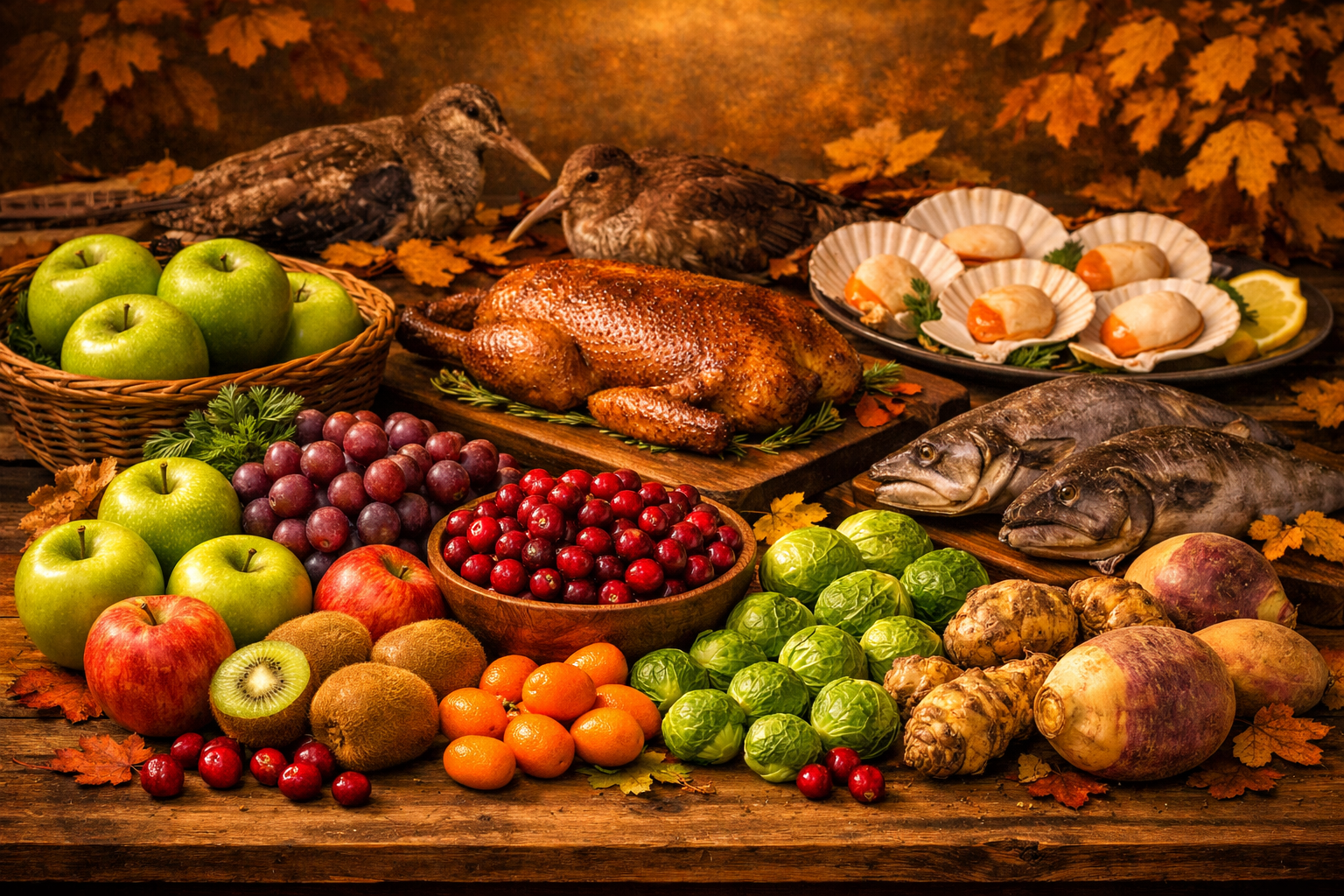
Late autumn is the season of final things. The last apples are picked. The first frost has come and gone. The kitchen becomes the warmest room in the house, filled with the aromas of roasting root vegetables, simmering cranberries, and browning duck.
This is not a season of food abundance in the way that summer is. There is no overflowing cornucopia here. Instead, there is a focused, intentional quality to late autumn ingredients. Every apple, every Brussels sprout, every carefully shucked scallop has a purpose. This is food that sustains, that comforts, that carries us through the darker months ahead.
Fruits of Late Autumn
Late autumn fruits are the keepers. These are the fruits that store well, that travel well, that bring a flash of brightness to the grayest days.
Late-Season Apples
The last of the apples are harvested as fall draws to a close. Of course, the fruit keeps so well that you can enjoy them year-round. But an apple out of season is never as crisp and sweet-tart as one that has been freshly picked.
Yellow-green Newtown Pippins are one of the oldest varieties of commercially available apples in America. Though not as fashionable as they once were, they are great all-purpose apples with a flavor that has been described as subtly piney. Bright, shiny Granny Smiths are the most popular of all green apple varieties. In fact, even though the public is known to prefer red apples, in 1996 California apple growers devoted more acreage to Granny Smith trees than to any other variety. The secret to the Granny Smith’s success is its fantastic storage ability. Even after several months in cold storage, it emerges crisp, tart, and unbruised.
The apple is said to have been discovered when an Australian woman, Maria Ann Smith, tossed out a pile of apple remains in 1868 and a chance seedling grew from the discarded pile. She would never know how famous her apple would become. The increasingly popular Braeburn apples were developed in New Zealand. Oval shaped with red skin streaked with hints of green, Braeburns are juicy and sweet. Macoun apples have purplish skin and a rather boxy silhouette, noted for their crispness and perfection for out-of-hand eating and salads. Winesap apples are small and round with deep red, almost purple skin that tinges the pale white flesh. They have a distinctive tart, spicy flavor that makes them excellent for cooking and cider.
Cranberries
Cranberries grow on creeping vines that thrive in wetlands and bogs in the eastern and central United States. There are cranberries that originated in northern Europe, but the native American varieties are larger and better for commercial uses. Americans consume far more cranberries and cranberry products than the rest of the world combined.
Cape Cod, Massachusetts, is the place most intimately associated with cranberries. When the Pilgrims landed at Plymouth in December of 1620, cranberries would have been at their peak. The bright red berries floating in the marshy bogs must have been a welcome sight to a group of people who had been at sea and likely needed a good source of vitamin C to counteract scurvy. Two hundred years later, a Revolutionary War veteran named Henry Hall began to cultivate cranberries at his Cape Cod farm, fencing in a field of wild cranberries and transplanting the vines. He noticed that sand blown over the bogs by the wind improved the crop, and the practice of sanding cranberry bogs was born.
There are several commercially cultivated varieties of cranberry. The most popular on the East coast are Early Black and Howes. McFarlin and Searls are cultivated in Wisconsin. On the West coast, McFarlin is the principal variety. A good, ripe cranberry bounces. This is the principle behind the staircase-style sorting machine: berries that are sound bounce merrily to the bottom, while those too flaccid to make it down are discarded.
Kiwifruit
Before New Zealand thought up the name kiwifruit as part of a 1960s marketing campaign, these fuzzy brown fruits with jewel-green insides were known as Chinese gooseberries. They are native to China, although New Zealand and California now produce far more of them. The name change was prompted by Cold War era trade concerns. The prominent produce company Turners and Growers announced in June 1959 that it would export Chinese gooseberries under the name “kiwifruit”, linking the fruit to New Zealand’s flightless national bird.
The juice of the kiwifruit contains an enzyme known as actinidin, which is a very effective meat tenderizer. This makes kiwi a good addition to marinades. If you prefer not to have the fruit’s flavor in your meat dish, cut a kiwi in half and rub it on the meat, then wait half an hour before cooking. It is not necessary to remove the skin from a kiwifruit before eating it. In fact, the skin has a pleasant taste reminiscent of lemon rind. Just wash the kiwi, scrubbing gently to remove the fuzz.
Kumquats
The word “kumquat” comes from the Chinese kin ku, meaning “gold orange.” The kumquat, native to eastern Asia, grows on an attractive evergreen shrub that reaches 8 to 12 feet high under optimal conditions. Small potted kumquat plants are popular ornamental plants in the United States, especially at Christmas time.
The kumquat most commonly found in American markets is known as Nagami. Other varieties you might encounter include round Marumis, egg-shaped Meiwas bred to have particularly sweet pulp, and plum-sized, teardrop-shaped Changshous, which are actually a cross between the kumquat and the mandarin orange.
Unlike most citrus fruits, the kumquat is not peeled before eating, and that is for the best, since the delicious rind is the sweetest part of the fruit. If the sour flesh is not to your taste, try rolling the kumquat between your palms until it softens. This presses some of the sugar out of the rind and sweetens the pulp.
Vegetables of Late Autumn
Late autumn vegetables are the survivors. These are the plants that thrive in cold weather, that actually become sweeter after a frost.
Brussels Sprouts
Not surprisingly, considering that they look like miniature cabbages, Brussels sprouts belong to the cabbage family. Like many of their relatives, they grow best in cool weather. The Brussels sprout plant starts out looking unremarkable, but soon it sprouts a thick stem studded with odd little buds, the parts we eat, all up and down its length, which may be as much as 3 feet. If the gardener does not cut the stem but harvests the sprouts one by one, a pretty pink rose-like flower will bloom at the very top.
Some people do not harvest their Brussels sprouts until after one or two light snowfalls. The chill is said to make the sprouts sweeter. Brussels sprouts thrive in the cool, wet weather of Belgium, and they are Old World plants. The earliest records associating the vegetables with Brussels date only as far back as the late 16th century.
Look for bright green, tightly furled Brussels sprouts. Blowsy ones are past their prime. When cooking them, it is helpful to cut a cross shape in the base of each sprout. This helps the dense stem cook through at the same rate as the leafy parts. Roasting has become the most popular method, as the high heat caramelizes the outer leaves and transforms their reputation from the soggy boiled sprouts of childhood memory to something altogether more appealing.
Jerusalem Artichokes
The Jerusalem artichoke is a kind of sunflower, which explains how this New World native got such a misleading Old World name. “Jerusalem” is apparently a corruption of girasole, the Italian word for sunflower, bestowed on the plant by early explorers. Further confusion surrounds the designation “artichoke,” as the vegetable is completely unrelated to artichokes. In an attempt to find a more appropriate name, marketers sometimes call them sunchokes.
What the Jerusalem artichoke actually is, is a member of the Aster family that grows up to 10 feet tall and bears bright yellow flowers. The edible part of the plant is the tuberous root. With its pale brown, smooth, thin skin, it looks quite a bit like a large gingerroot. Both dieters and diabetics appreciate Jerusalem artichokes because they contain a kind of carbohydrate known as inulin, which can be processed to form fructose, sweeter than sucrose but with fewer calories and no adverse effects for diabetics.
Jerusalem artichokes are good both raw and cooked. Raw, they are as crisp as water chestnuts and can substitute for them. Cooking them with the skin on causes the vegetable to darken a bit but does not affect the flavor. If you want to preserve the bright white color, peel the tubers and immediately submerge them in acidulated water until they are ready to go into the pot.
Rutabagas
The rutabaga and its close relative, the turnip, belong to the cabbage family, Brassicaceae. Rutabagas are believed to be a hybrid of the turnip and the cabbage. While turnips originated in eastern Asia and have nourished people since ancient times, rutabagas do not appear on the scene until the 17th century.
The Swedish word for the vegetable, rotabagge, is the source of our word “rutabaga.” For this reason, some people call them Swedish turnips, or Swedes. Despite the close association between the two vegetables, rutabagas have advantages over turnips. They are harvested later, so they belong to the small elite group of cold-weather vegetables. After harvest, turnips last only about a week, whereas rutabagas can be stored for over twice that. They are more nutritious too, with more fiber, calcium, magnesium, potassium, vitamins C and A, and folate. At larger markets, rutabagas are sometimes sold with a wax coating to prevent dehydration and extend storage life.
Meat and Fish of Late Autumn
Late autumn is the heart of game season. The birds are at their peak, and the cold waters have produced some of the finest seafood of the year.
Duck
Ducks may have been the first domesticated birds. It is known that the Chinese and the Egyptians kept them over 4,000 years ago. The mallard, ancestor of most varieties of domestic duck, is one of the most popular wild game ducks. Mallards are known as “dabbling ducks” because of the way they feed, tipping their heads underwater to nibble at plants while leaving their tails visible above.
In addition to dabblers, there are also diving ducks and perching ducks. Divers frequent deeper waters like lagoons and estuaries, feeding by diving completely underwater. The eider and merganser are divers. Perching ducks, which include the muscovy, have clawed feet that allow them to grab tree limbs and often build their nests in trees.
Being water birds, ducks have a thick layer of fat to insulate them from the cold. This means there is less meat on a duck than on a chicken of the same size. Most ducks available in markets are quite young, so the terms duckling and duck are often interchangeable. Officially, a duckling is less than 2 months old. Duck pairs beautifully with fruit-based sauces, particularly those made with cherries, oranges, or the late autumn apples and pears that are at their peak.
Snipe and Woodcock
The woodcock and its smaller relative, the snipe, are migratory shorebirds that fly north in the spring and chase the warm weather southward in the fall. They are very popular with hunters, both for the superior flavor of their meat and because their intriguing flight patterns make shooting them quite a challenge. As with many kinds of game, their habitats have been reduced by expanding development, and the US Fish and Wildlife Service has proposed shortening woodcock hunting seasons to help maintain populations.
Woodcock and snipe are most active at dusk and on overcast days. Woodcock, in particular, are known for hiding motionless in the underbrush, with eyes set so far back on their heads that they have nearly 360-degree vision. If a hunter manages to flush a woodcock, it bursts out of the grass with a sudden rush and soars upward almost vertically before racing to safety.
A “snipe hunt” is such a well-known practical joke and initiation ritual that some people do not even realize there really is such a bird as a snipe. A flock of snipes is known as a “wisp.” Woodcock and snipe have dark meat on the breast and light meat on the legs, the exact opposite of chicken. This is because well-used muscle becomes dark meat. Chickens are flightless, using their legs to move, while woodcock and snipe fly often and vigorously.
Scallops, Bay and Sea
Scallops are bivalve mollusks, like oysters, but you are never going to encounter scallops on the half shell. The only part of the scallop that is usually eaten is its large adductor muscle, and it is nearly always cooked. Sea scallops are shucked right on the boat after being caught, so the shells never even make it to shore.
The symmetrical, fan-shaped scallop shell appears often in art. During the Middle Ages, it was worn by pilgrims along the Camino de Santiago on their way to the shrine of St. James in Compostela, Spain. Over time, the scallop shell became symbolically associated with James, hence the French term for scallops, coquilles St. Jacques, or St. James’ shells.
The scallop is fairly unusual for a mollusk in that it remains free-floating throughout its life, swimming by opening and closing the two halves of its shell. Sea scallops are the largest commercial scallops, growing up to 2 inches across, harvested along the Atlantic coast from New Jersey to Labrador from March through early December. Bay scallops are considerably smaller, particularly tender and sweet, and generally more expensive. They are found in bays along the northeastern Atlantic coast and are best between October and December.
Fresh, raw scallops will not last longer than a day in the refrigerator. The perfectly cooked scallop is sweet and velvety, while one heated just a bit too long is fibrous and chewy. Keep a close eye on the skillet.
Eating Late Autumn Well
Late autumn cooking is about patience and care. The ingredients of this season reward slow cooking, gentle roasting, and thoughtful preparation. A duck takes time to render properly. A Brussels sprout needs enough heat to caramelize. A scallop needs barely a minute in the pan.
This is also the season of gathering. The Christmas holidays are approaching. The table becomes the center of the home. The foods of late autumn are the foods we share: a roasted duck for Sunday dinner, a bowl of cranberry sauce for Thanksgiving, a plate of seared scallops for a special occasion. These are the ingredients that bring people together.
Take the time to enjoy them while they are here. Winter, with its reliance on stored goods and preserved foods, is just around the corner. But for now, there are still fresh apples to crunch into, fresh cranberries to simmer, fresh scallops to sear. Late autumn is the last hurrah of the fresh harvest. Make it count.
Late Autumn Video
From the rich harvest of Early Autumn to the quiet sustenance of Early Winter Eating, the kitchen becomes the heart of the home.
Featured articles
Explore rich culinary stories, exclusive chef interviews, and expert insights from kitchens around the world. Discover cooking techniques, ingredient spotlights, and behind-the-scenes looks at the tools that shape global cuisine.

Georges Auguste Escoffier: Visionary Chef Who Revolutionized French Cuisine and Modern Cooking
Discover the life and legacy of Georges Auguste Escoffier, the legendary chef who transformed French cuisine and laid the foundation for modern culinary arts. This comprehensive historical profile …

How to Use a Knife, Fork, and Spoon
Master the basics of Western table etiquette with this guide to using a knife, fork, and spoon. Learn practical tips, cultural context, and the subtle rules that shape how we dine.

The History of Chocolate
Trace the fascinating history of chocolate, from its ancient origins with the Olmecs and Maya to its transformation into a global indulgence. Explore how cacao evolved from sacred ceremonial drink to …
Georges Auguste Escoffier: Visionary Chef Who Revolutionized French Cuisine and Modern Cooking
Discover the life and legacy of Georges Auguste Escoffier, the legendary chef who …
How to Use a Knife, Fork, and Spoon
Master the basics of Western table etiquette with this guide to using a knife, fork, and …
The History of Chocolate
Trace the fascinating history of chocolate, from its ancient origins with the Olmecs and …