Early Winter Eating: Citrus, Root Vegetables, Oysters, and the Season of Sustenance (December Through January)

By: Simon
July 19, 2026 | Updated: September 12, 2026

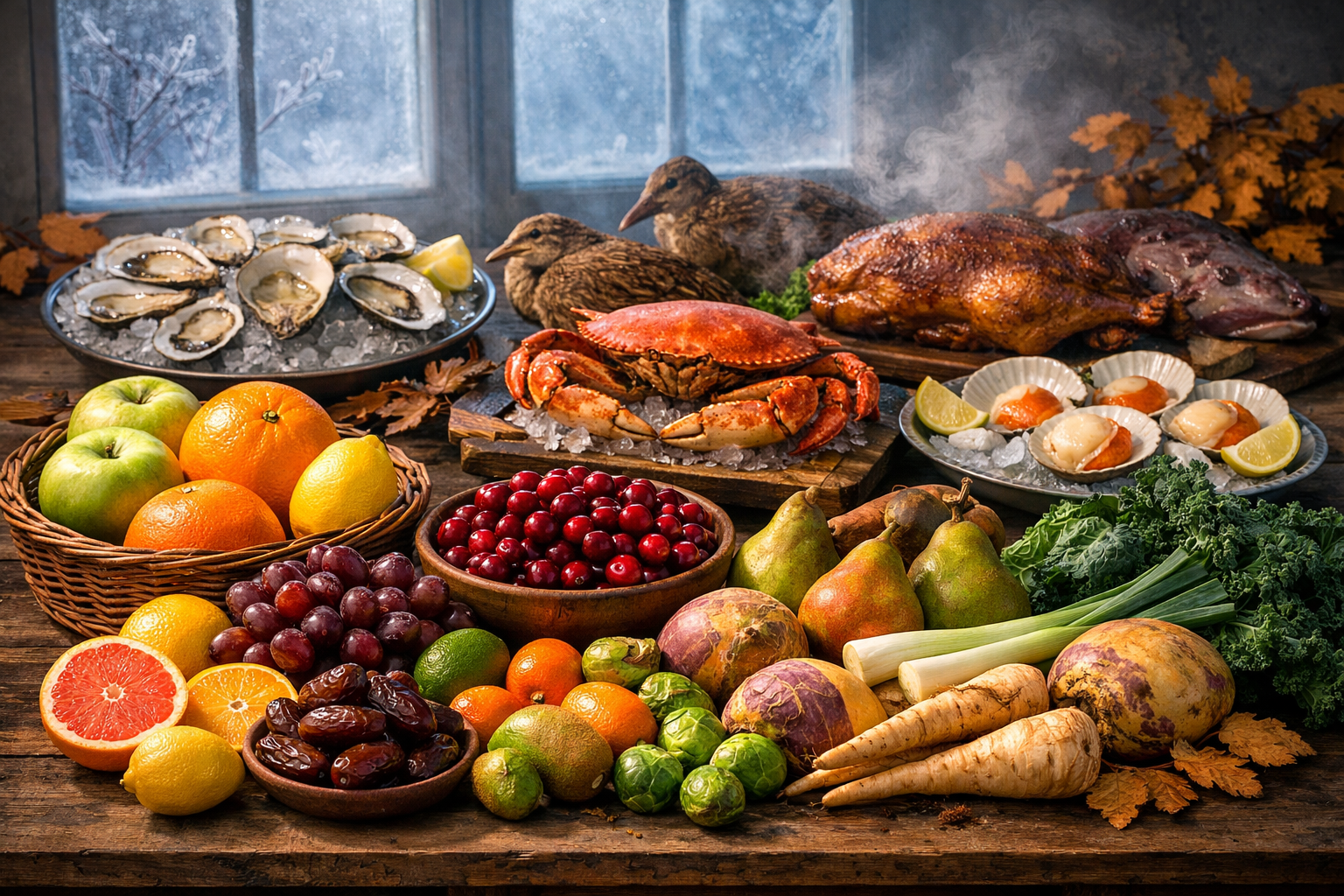
Winter is the season of quiet in the kitchen. The frantic abundance of summer and the urgent harvest of autumn give way to something calmer. The markets are no longer overflowing, but what is there deserves attention. This is the time for citrus in all its glory, for root vegetables that have been sweetened by frost, and for the shellfish that reach their peak in cold waters.
The CuisineNet Digest, that pioneering culinary web resource from the late 1990s, organized the year into seasons but never completed a winter edition. Drawing on the same spirit of seasonal awareness, this guide covers early winter from December through January, when the deep cold transforms ingredients in ways that summer can only hint at.
Fruits of Early Winter
Winter fruits are different from summer fruits. They are not about immediacy and quick pleasure. They are about depth, about storage, about the slow development of sugars that comes with cool temperatures.
Citrus Fruits
Winter is the season of citrus. Oranges, grapefruits, tangerines, clementines, and mandarins all reach their peak in the cold months. The most famous of them all, the navel orange, has a remarkable origin story. It was discovered as a chance mutation on a Brazilian monastery estate in the early 1800s, a single tree that produced seedless, sweet fruit unlike any other. In 1873, cuttings were sent to Eliza Tibbets in Riverside, California, where they thrived in the Mediterranean climate and launched the entire California citrus industry.
Navel oranges are a genetic wonder. Because they are seedless and sterile, every navel orange tree on the planet is a clone of that original Brazilian tree, propagated through grafting. When you peel a navel orange in the depths of winter, you are eating fruit from a lineage that stretches back nearly two centuries.
Grapefruits come in white, pink, and red varieties, with the redder ones generally being sweeter. The Ruby Red grapefruit was discovered as a mutation in Texas in 1929 and went on to become the official state fruit. Tangerines, clementines, and mandarins are loosely grouped together, with clementines being the easiest to peel and most child-friendly. Blood oranges, with their dramatic crimson flesh, arrive later in the season and are prized for their raspberry-like undertones. The variety was first cultivated in Sicily and is still strongly associated with the island.
Citrus fruits store well at room temperature for about a week and in the refrigerator for up to two weeks. They are best eaten fresh, but they also shine in salads, in marinades, and in desserts. A simple plate of orange segments drizzled with olive oil and sprinkled with salt is a revelation.
Medjool Dates
The Medjool date, often called the “king of dates,” is a large, sweet, and almost caramel-like fruit that reaches its peak in early winter. Dates have been cultivated for thousands of years in the Middle East and North Africa, where the date palm was known as the “tree of life” for its ability to provide food, fiber, and shelter in harsh desert conditions.
The Medjool variety was traditionally grown in Morocco and was reserved for royalty. In the 1920s, offshoots from Moroccan trees were brought to the United States, and today the Coachella Valley in California produces more than 90 percent of the commercial date crop in the United States. Medjools are soft, meaty, and intensely sweet, with a flavor that suggests brown sugar and honey.
Dates are often eaten as a snack, but they also appear in baked goods, in stuffings for roasted meats, and wrapped in bacon as an appetizer. Their natural sweetness makes them a popular alternative to refined sugar in healthy cooking. Deglet Noor dates, which are firmer and less sweet, are the variety most commonly used in baking.
Kiwifruit and Late-Season Pears
Kiwifruit, those fuzzy brown fruits with jewel-green interiors, are at their best in early winter. New Zealand growers famously rebranded the Chinese gooseberry as the kiwifruit in 1959 to avoid Cold War trade restrictions and to associate the fruit with their national bird. California now produces a significant share of the domestic crop.
The enzyme actinidin in kiwifruit acts as a natural meat tenderizer. Rub a cut kiwi on a piece of meat and wait half an hour before cooking. The skin is also edible, with a tartness reminiscent of lemon rind. Just wash and scrub off the fuzz.
Pears from cold storage continue to be available. Bosc and Comice pears, harvested in autumn, reach their peak sweetness after a period of chilling. They are best eaten at room temperature, when their sugars have fully developed. A ripe Comice pear, with its buttery, melting texture, is one of winter’s great pleasures.
Vegetables of Early Winter
Winter vegetables are the survivors. These are the plants that either thrive in cold weather or are transformed by it. Frost sweetens some vegetables by converting their starches into sugars, a natural antifreeze that also improves flavor.
Root Vegetables
Parsnips, carrots, turnips, and potatoes are at their best in winter. Parsnips look like pale carrots and taste like a combination of carrot and celery, with a nutty sweetness that emerges only after frost. They are excellent roasted, mashed with butter, or added to stews.
Carrots are sweeter in winter than at any other time of year. The cold triggers the conversion of starches to sugars, concentrating their flavor. Look for carrots with their tops still attached, which indicates freshness. Remove the greens before storing, as they draw moisture from the root.
Potatoes are the ultimate storage vegetable, and winter is the time to enjoy them in all their forms. Russets for baking, Yukon Golds for mashing, red potatoes for roasting, and fingerlings for salads each have their ideal use. Sweet potatoes, though technically not related to regular potatoes, are at their peak now. Their orange flesh is packed with vitamin A and beta-carotene.
Winter Squash
The winter squashes of autumn continue to hold well into winter. Butternut, acorn, kabocha, and delicata squash are still available from cold storage. The longer they sit, the more their starches convert to sugars, making them even sweeter than they were at harvest.
Kabocha squash, sometimes called Japanese pumpkin, has a dense, creamy texture and a sweetness that rivals sweet potatoes. Delicata squash has a thin, edible skin and a flavor reminiscent of corn and sweet potatoes. Acorn squash, with its distinctive ridges, is perfect for halving, seeding, and baking with a pat of butter and a sprinkle of brown sugar.
Hearty Greens
Kale reaches its peak in winter. The cold converts its starches to sugars, mellowing the bitterness that can be off-putting in summer kale. Lacinato kale (also called dinosaur or Tuscan kale) is particularly tender. Curly kale holds up well to braising and is excellent in soups.
Collard greens are a staple of Southern cooking and are best after a frost. They are typically braised low and slow with smoked meat, which balances their slight bitterness with salt and fat. Cabbage, both green and red, is at its peak in winter. It keeps for weeks in the refrigerator and is the basis for slaws, braises, and stuffed cabbage rolls.
Leeks are the mildest member of the onion family and are at their best in winter. They grow by pushing up through soil, which means they need careful cleaning to remove grit between the layers. Leeks are excellent in soups, particularly potato leek soup, and as a base for braised dishes.
Brussels Sprouts
Brussels sprouts, those miniature cabbages that once haunted the dinner tables of childhood, have experienced a remarkable culinary rehabilitation. The key is roasting. High heat caramelizes their outer leaves and transforms their flavor from sulfurous to sweet. Belgian farmers have been perfecting them since the 16th century, and the best ones are harvested after a frost.
Look for bright green, tightly furled sprouts. Cut a cross in the base of each one to help the dense stem cook through. Toss them with olive oil and salt, roast at 400 degrees until charred, and finish with a squeeze of lemon. Even confirmed sprout-haters have been known to convert.
Meat and Fish of Early Winter
Winter is the season of shellfish, of oysters in particular, and of the rich, fatty fish that thrive in cold waters.
Oysters
The old rule about eating oysters only in months with an “R” (September through April) has some basis in science. Oysters spawn in the warm summer months, which makes their flesh soft and milky. In cold water, they are firm, lean, and at their very best. The “R months” tradition was a practical guide to quality long before refrigeration existed.
Oysters are categorized by where they are grown, and each region imparts its own character. East Coast oysters from the cold waters of Maine and Massachusetts are small, briny, and crisp. West Coast oysters from Washington and Oregon are larger, creamier, and more vegetal. Gulf Coast oysters are mild and plump. However they are grown, fresh oysters should smell like the sea and nothing else.
They are best eaten raw, on the half shell, with nothing more than a squeeze of lemon or a dab of mignonette sauce. But they also shine in stews, in stuffings, and in the classic French preparation of oysters Rockefeller.
Dungeness Crab
The Dungeness crab season on the West Coast typically opens in late fall or early winter, depending on testing for meat quality and shell condition. Named after the small fishing village of Dungeness on the Strait of Juan de Fuca in Washington State, these crabs have been harvested commercially along the Pacific coast since the late 1800s.
Dungeness crab is prized for its sweet, tender meat and high yield. A single crab can provide a substantial amount of meat, making it one of the best values in shellfish. It is typically steamed or boiled and served with melted butter, but it also appears in crab cakes, salads, and pasta dishes.
The Dungeness fishery is considered one of the best-managed in the world, with strict regulations on size, sex, and season. Only male crabs of a certain size can be kept, ensuring that the breeding population remains healthy. This sustainability has made Dungeness crab one of the most valuable fisheries on the West Coast.
Scallops
Both sea scallops and bay scallops are at their peak in winter. Sea scallops, harvested from New Jersey to Labrador, can grow up to two inches across and are available through early December. Bay scallops, found in bays along the northeastern Atlantic coast, are smaller, sweeter, and more expensive, with their peak season running from October through December.
Fresh scallops should smell sweet, not fishy. They should never be soaked in water, which causes them to absorb liquid and lose flavor. The key to cooking scallops is to pat them dry, season them well, and sear them in a hot pan with butter until they develop a deep golden crust. The interior should be just warmed through, tender and translucent.
Seared scallops are one of the fastest and most elegant dishes in the winter cook’s repertoire. They pair well with citrus, with brown butter, and with the earthy flavors of root vegetables.
Duck and Wild Game
Duck is at its best in winter, when the birds have built up a layer of fat for insulation. The mallard, ancestor of most domestic duck breeds, reaches its peak flavor in the cold months. Ducks may have been the first domesticated birds, kept by the Chinese and Egyptians over 4,000 years ago.
Domestic duck, particularly the Pekin and Muscovy varieties, is widely available and much less gamey than wild duck. The key to cooking duck is to render the fat slowly, crisping the skin while keeping the meat moist. Duck breast pairs beautifully with citrus sauces, dried fruits, and the sharpness of winter greens.
Wild game, including venison, pheasant, and rabbit, is still available from the autumn hunt. Properly aged venison is tender and rich, with less fat than beef. Pheasant, introduced to North America in 1881 by Judge Owen Denny, is milder than many game birds and takes well to roasting with bacon. Rabbit, whether farmed or wild, is a lean, versatile meat that adapts to braises, stews, and sautes.
Eating Early Winter Well
Early winter cooking is about comfort and patience. This is the time for long braises, for slow-roasted roots, for the kind of cooking that fills the house with warmth and the kitchen with good smells. A pot of oyster stew simmering on the stove, a tray of roasted root vegetables caramelizing in the oven, a duck slowly rendering its fat to crispy perfection these are the dishes that define the season.
The key is to work with what winter gives you. Do not look for tomatoes or peaches. They will return in their own time. Instead, celebrate the citrus, the roots, the shellfish, and the game that are at their very best right now. A perfect navel orange, a freshly shucked oyster, a properly seared scallop these are winter’s gifts, and they are worth the wait.
Early Winter Video
From the last gatherings of Late Autumn to the hopeful turn of Late Winter Cooking, the cold months have their own deep rewards.
Featured articles
Explore rich culinary stories, exclusive chef interviews, and expert insights from kitchens around the world. Discover cooking techniques, ingredient spotlights, and behind-the-scenes looks at the tools that shape global cuisine.

Georges Auguste Escoffier: Visionary Chef Who Revolutionized French Cuisine and Modern Cooking
Discover the life and legacy of Georges Auguste Escoffier, the legendary chef who transformed French cuisine and laid the foundation for modern culinary arts. This comprehensive historical profile …

How to Use a Knife, Fork, and Spoon
Master the basics of Western table etiquette with this guide to using a knife, fork, and spoon. Learn practical tips, cultural context, and the subtle rules that shape how we dine.

The History of Chocolate
Trace the fascinating history of chocolate, from its ancient origins with the Olmecs and Maya to its transformation into a global indulgence. Explore how cacao evolved from sacred ceremonial drink to …
Georges Auguste Escoffier: Visionary Chef Who Revolutionized French Cuisine and Modern Cooking
Discover the life and legacy of Georges Auguste Escoffier, the legendary chef who …
How to Use a Knife, Fork, and Spoon
Master the basics of Western table etiquette with this guide to using a knife, fork, and …
The History of Chocolate
Trace the fascinating history of chocolate, from its ancient origins with the Olmecs and …