Early Summer Eating: A Guide to the Season's First Bounty (Mid-June Through Early July)

By: Simon
July 19, 2026 | Updated: September 12, 2026


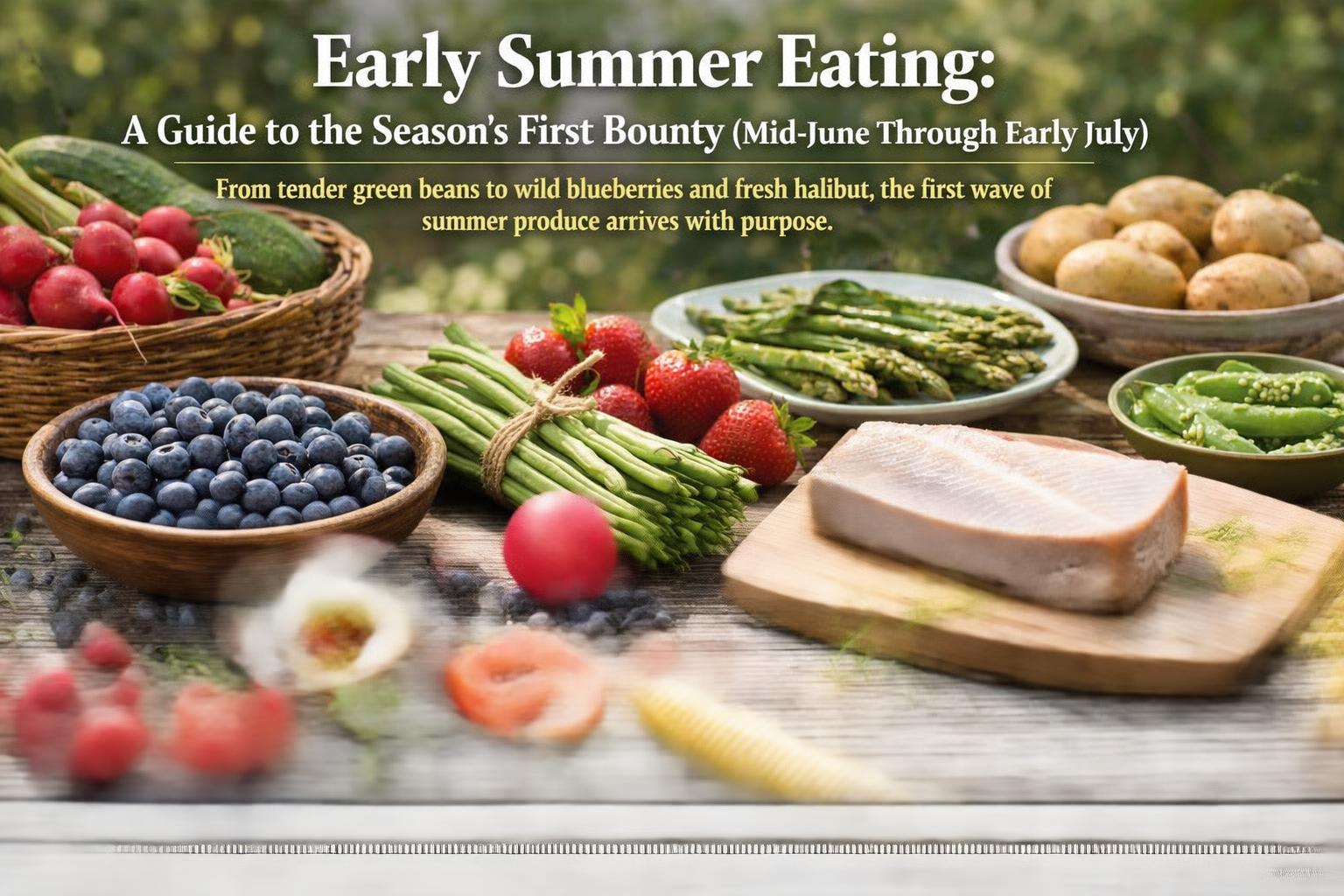
Early summer is a season of arrival for cooking. After the tentative green shoots of spring, the first real harvests of the warm months arrive with something close to relief. This is when the farmers’ market begins to look truly abundant, when the first berries appear, when the promise of summer cooking finally becomes reality.
The window from mid-June through early July is brief but glorious. The fruits are delicate and fleeting. The vegetables are tender and young. The fish are at their peak, having spent the spring feeding in colder waters. There is a freshness to early summer ingredients that cannot be replicated later in the season, when the heat bears down and the pace of growth accelerates. This is the time to pay attention and eat well.
Fruits of Early Summer
Early summer fruits tend toward the ephemeral. They arrive quickly, their season is short, and they demand to be eaten at the peak of ripeness. This urgency is exactly what makes them so special.
Blueberries
Blueberries appear at markets as early as July, though the very first ones may not yet have reached peak ripeness. The color of a blueberry is not an entirely reliable gauge. After they take on their proper blue hue, blueberries must still be allowed to mature for about 10 days on the bush before being harvested. Patience rewards the grower with that signature pop of sweet-tart juice.
The pigment that gives blueberries their purplish-blue color is called anthocyanin. This same compound is found in many richly colored fruits and flowers, and it has been credited with a wide range of health benefits, from supporting eye health to reducing inflammation. One persistent legend holds that during World War II, British pilots in the Royal Air Force ate jam made from bilberries (the closest European relative of the blueberry) to sharpen their night vision for nighttime bombing missions. While modern researchers have since debunked the idea that bilberry jam granted superhuman night vision, the anthocyanins in blueberries do support overall eye health by strengthening capillaries in the retina.
Blueberries are native to North America. Indigenous peoples used them as an ingredient in pemmican, a preserved food made by pounding and compressing dried buffalo meat, berries, and fat into dense, portable cakes that could sustain them through long journeys and harsh winters. Today, blueberries appear in fresh fruit tarts, fruit salads, muffins, pies, and jams. Cream or sour cream is probably the best accompaniment to a bowl of fresh blueberries. Store them dry in the refrigerator for five or six days, and do not wash them until just before they are used.
Berries marketed as wild blueberries are “lowbush” varieties, meaning they grow on bushes little more than a foot tall. Though smaller, these have a more concentrated flavor than their cultivated cousins, making them especially prized for baking.
Currants and Gooseberries
Currants and gooseberries are comparatively rare in the United States, though they are both quite popular in Europe. One reason for their scarcity here is that they can spread a disease known as blister rust, which affects white pine trees. As a result, they are not allowed to be grown in some states. However, they thrive in many parts of the country, especially the Pacific Northwest, where the climate suits them perfectly.
The word “currant” is actually a corruption of Corinth, the Greek city where the tiny dried grapes that we call currants originally grew. By a quirk of linguistic history, the name was transferred to the entirely unrelated Ribes genus of berries that we now know as fresh currants. These are red, white, or black, and each has its own distinctive character.
Gooseberries come in translucent green, pink, or red varieties. The most famous dish made with them is fool, a simple compote mixed with cream. In France, gooseberries are so associated with mackerel (for which they are traditionally used to make a sauce) that they are called groseilles-maquereau, which translates to “currants for mackerel.” A gooseberry sauce also complements other fish or game dishes, such as trout or duckling.
Gooseberries were first cultivated in the Caucasus and North Africa before being brought to Europe. Most gooseberries found in America are hybrids of European and native New World varieties, because pure European strains have never done well in American soil. European gooseberries are significantly sweeter than their American counterparts, sweet enough to eat fresh.
Black currants are famously used to make creme de cassis, a currant-flavored liqueur that is a staple of French cocktail culture. All varieties of currants appear in fruit tarts, preserves, and sorbets. Look for them at farmers’ markets in the Pacific Northwest and in specialty grocery stores that source from local growers.
Plums
There are dozens of varieties of plums, and they come in a remarkable range of colors. Greengages are golden or green fruits especially good for eating fresh. Tiny mirabelles range from yellow to ruby red and are used for cooking and to make eau de vie. Damson plums are oblong with dark blue skin and pale yellow flesh; they are considered cooking plums. Japan is the source of many plums now cultivated in America, usually large, round, and suitable for both fresh eating and cooking.
Prune plums have a very high sugar content, which allows them to be dried whole without fermenting. California produces most of the world’s prunes, using a French variety called La Petite d’Agen. It was brought to California in 1856 by a French immigrant named Louis Pellier, who had tried and failed to cash in on the Gold Rush before turning his attention to horticulture. This single import sparked the entire California prune industry, which by the turn of the century had grown to include an estimated 85 packing plants.
Dried plum paste (or lekvar) can be substituted for up to 50 percent of the fat in recipes for baked goods such as brownies, cookies, and cakes. The combination of pectins, sugars, and malic acid in lekvar retains moisture and enhances flavor the way fat does, making it a useful tool for lighter baking.
As dessert, plums appear in nearly every variety of baked goods, and they add a rosy glow to fresh fruit tarts. Prunes are also a popular dessert ingredient, combining well with chocolate, armagnac, and cream. They are often included in savory meat dishes, especially those involving pork chops, game, and stews.
Raspberries
The raspberry is a composite fruit rather than a true berry. It is a cluster of drupelets all connected to a central hull. (A drupe is a thin-skinned fruit that surrounds a single seed, like a plum or a cherry.) The ideal ripe raspberry is hollow. It must mature on the bush, all the while loosening its hold on the hull, which remains on the stem after the raspberry is picked. This makes raspberries quite fragile and perishable. Handle them gently and eat them quickly.
There are Old World varieties of raspberry, but most of the fruit sold in North America comes from native North American stock. Although the red raspberry is by far the most popular, yellow and deep purple varieties also exist and are worth seeking out for their slightly different flavor profiles.
Raspberry jams and sauces abound, but the best thing to do with fresh raspberries is serve them raw. They go very well with cream, and the complex, tart sweetness of the raspberry makes it a natural partner for bittersweet chocolate. A simple dish of fresh raspberries with lightly whipped cream and a shaving of dark chocolate is one of the finest desserts the season has to offer.
Vegetables of Early Summer
Early summer vegetables are defined by tenderness. This is the time to enjoy vegetables at their youngest and most delicate, before the heat of high summer toughens their skins and deepens their flavors.
Green Beans
Green beans are just as well known by the name string beans, although the eponymous “string” was bred out of the plant by the turn of the 20th century. The other popular name is snap beans, from the sound made when the tips are removed to peel away that fibrous string. In addition to green beans, there are translucent pale yellow wax beans and purple varieties that turn green when cooked.
French beans, or haricots verts, are very small, thin green beans, usually less than three inches long and not much wider than a matchstick. Regular green beans picked when extremely young achieve a similar effect. Mature, larger green beans are called “Frenched” when they have been julienned into strips about the size of actual French beans.
Green beans are native to Central America. In the 16th century, the Spanish brought them home to Europe not as a food source but as a flowering plant. There, the beans caught on as a food crop, and European settlers carried seeds back across the ocean to plant in their North American gardens. This roundabout journey is typical of how many New World crops made their way into the global cuisine.
The freshest green beans are usually best steamed and tossed with butter and salt as a side dish. As a salad, either by themselves or composed, they might be blanched and dressed with vinaigrette. Green beans are perfect for sautes and are a key ingredient in hearty vegetable soups like minestrone. Their flavor goes well with bacon or ham, nuts, and blue cheeses, as well as in vegetable combinations with chickpeas, kidney beans, potatoes, tomatoes, or spinach.
Summer Squash
The most common summer squashes are zucchini, yellow squash (both crookneck and straight), and patty pan. Botanically, pumpkins are also summer squashes, though in the kitchen they are treated like the winter varieties they more closely resemble.
This native American vegetable (actually a fruit, botanically speaking) is best when eaten as young and tender as possible. The older the squash gets, the larger the proportion of seeds to flesh and the more bitter the flavor. Often baby squashes are available at the market, looking just like miniature versions of the full-grown fruit. These are a true delicacy and should be snapped up when seen.
The bright yellow, trumpet-shaped flowers of the squash plant are also edible and are a summer delicacy. They can be added raw to salads or dipped in batter and fried. Often, before frying, the blossoms are stuffed with cheese and herb mixtures, creating a dish that is simultaneously crispy, creamy, and floral.
Shredded summer squash makes a good addition to baked goods such as muffins, sweet breads, and cakes, because it adds moisture without overwhelming the flavor. It is also a good way to use the extra squash that these prolific plants almost invariably produce. Zucchini is nearly as important to ratatouille as eggplant and is rarely omitted from the recipe.
Sweet Onions
Early summer is the season for northern hemisphere sweet onions, most famously Walla Walla Sweets and Vidalia onions. Texas SpringSweets and 1015 SuperSweets are also increasingly available as the category continues to grow in popularity.
Sweet onions, with their bruisable, thin skins, do not store as well as their hotter relatives and are best used in season. The reason these onions are so mild is twofold. First, they have a higher sugar content. Second, and more to the point, they contain a particularly small amount of the sulfur-based volatile compounds that disperse as gas when the onion is cut. This is what makes stronger, hotter onions cause cooks to cry.
A Georgia farmer named Mose Coleman stumbled upon Vidalia onions in 1931. He had planted a whole field of onions, and they turned out to be unusually sweet and mild, which allowed him to sell them for a higher price than ordinary onions. Today, Vidalia onions are protected by law, meaning only onions grown in a specific 20-county region of Georgia can bear the name. Walla Walla Sweets were brought to Walla Walla, Washington, at the turn of the century by a French soldier named Peter Pieri, who had picked up the seeds in Corsica while stationed there. Over generations, local farmers selected and replanted the sweetest, mildest bulbs, gradually developing the distinct variety known today.
Sweet onions can be used the same way regular ones are, but they contribute less when cooked into highly flavored melanges. They are perfect raw in salads or on sandwiches. When cooked, they are best as a major flavor component, as in grilled whole onions seasoned with herbs and drizzled with olive oil, or deep-fried into onion rings.
Fresh Summer Herbs
Basil, chervil, cilantro, dill, marjoram, mint, oregano, parsley, rosemary, sage, tarragon, and thyme are all at their peak in early summer. These herbs form the foundation of warm-weather cooking. A handful of fresh herbs can transform a simple dish of grilled vegetables or roasted fish into something memorable. Plant them in pots on a sunny windowsill or in the garden, and you will have a steady supply all season long.
Meat and Fish of Early Summer
Early summer brings fish that are firm, meaty, and well suited to the grill. The waters are still cool enough that the fish have firm flesh and clean flavors.
Halibut
Halibut are flatfish, a species of flounder, and they grow to be particularly large. A wily Atlantic halibut that escapes capture might reach a weight of 700 pounds, though most of the fish caught for market are around 10 pounds. Halibut, like all flatfish, are not born looking strange. At first, they swim upright like regular fish. Then, as they mature, they lean more and more to the left. Gradually, the halibut’s right side becomes the top of the fish, and the left eye shifts up and around next to the right one. This remarkable adaptation allows them to lie flat on the ocean floor while keeping both eyes pointed upward for prey.
Halibut are popular game fish, especially in the waters near Alaska, where the fishing season runs roughly from May to September. This is the time when the fish are returning from spawning far out at sea. Because they are among the best known food fish, halibut have become scarcer in recent years. Increased governmental regulation of the catch aims to allow the population to reestablish itself.
Halibut steaks are mild and white. The meat is firm enough for grilling, baking, and poaching, and it is also ideal for fish stews. Its clean flavor pairs well with citrus, herbs, and light butter sauces.
Skate
Although skate has long been popular in Europe, in the United States it was historically known as a “trash fish.” Fishermen who were out to catch more popular fish would remove skate from their nets and throw them back into the water. Now, as the populations of major food fish become threatened, these less well-known species are gaining ground. The strategy behind promoting them at markets is simple: if people broaden their tastes, the chance of fishing any one species to extinction diminishes.
Skates are a type of ray related to sharks. They must be treated properly just after being caught to be good for eating. Both skates and sharks have urea in their blood, which imparts an ammoniac smell to the meat if they are not bled soon after being removed from the water. Although the French consider the skate’s liver a delicacy, in the United States one is likely only to be able to get the “wings,” the large pectoral fins of the fish.
The flavor of skate is slightly sweet, not unlike that of scallops. Because the meat is fibrous rather than flaky, it is not appropriate for grilling, but it is perfect for poaching and baking. Traditionally, the French serve it with beurre noire, a simple sauce of browned butter, vinegar, and capers. It also stands up well to provencale sauces and highly spiced preparations.
Swordfish
The swordfish is unique. It is the only known member of its species, Xiphias gladius. Along with the marlin, which it resembles, the swordfish is an extremely popular big game fish that inhabits waters all around the United States. Swordfish are caught off both the East and West coasts in summer and fall; in the winter, they are found in the Gulf of Mexico.
The impressive swordfish can swim faster than any other fish and grows to weigh more than a ton. It is said to be able to drive its sword-shaped bill through the hull of a boat. In the past, it was believed that swordfish contained dangerously high levels of mercury. However, the FDA says the fish is generally safe and suggests only that people not indulge too often.
The moderately oily flesh of the swordfish has a robust, meaty flavor that can stand up to bold seasonings. It takes marinade well and any cooking method shows it off to advantage, with grilling and searing being among the most popular. Italians, who call it pesce spada, have numerous preparations. Look for swordfish served with aioli, flavored with rosemary, poached in wine, sprinkled with capers, or sweetened with pine nuts and currants.
Eating Early Summer Well
The key to early summer cooking is restraint. The ingredients are so fresh, so full of flavor on their own, that they need very little help. A perfect raspberry needs nothing at all. A fresh halibut steak needs only salt, pepper, and a hot grill. A bowl of green beans needs only butter.
This is the season to let the ingredients speak for themselves. Buy what looks best at the market. Prepare it simply. And pay attention, because in a few short weeks, these early summer treasures will be gone, replaced by the next wave of the season’s bounty.
Early Summer Video
From the generous harvest of Late Spring to the sun-drenched abundance of Mid Summer’s Peak Harvest, the season’s best flavors keep building.
Featured articles
Explore rich culinary stories, exclusive chef interviews, and expert insights from kitchens around the world. Discover cooking techniques, ingredient spotlights, and behind-the-scenes looks at the tools that shape global cuisine.

Georges Auguste Escoffier: Visionary Chef Who Revolutionized French Cuisine and Modern Cooking
Discover the life and legacy of Georges Auguste Escoffier, the legendary chef who transformed French cuisine and laid the foundation for modern culinary arts. This comprehensive historical profile …

How to Use a Knife, Fork, and Spoon
Master the basics of Western table etiquette with this guide to using a knife, fork, and spoon. Learn practical tips, cultural context, and the subtle rules that shape how we dine.

The History of Chocolate
Trace the fascinating history of chocolate, from its ancient origins with the Olmecs and Maya to its transformation into a global indulgence. Explore how cacao evolved from sacred ceremonial drink to …
Georges Auguste Escoffier: Visionary Chef Who Revolutionized French Cuisine and Modern Cooking
Discover the life and legacy of Georges Auguste Escoffier, the legendary chef who …
How to Use a Knife, Fork, and Spoon
Master the basics of Western table etiquette with this guide to using a knife, fork, and …
The History of Chocolate
Trace the fascinating history of chocolate, from its ancient origins with the Olmecs and …