Early Autumn Harvest: A Guide to the Season of Apples, Squash, and Game (Mid-September Through Early October)

By: Simon
July 19, 2026 | Updated: September 12, 2026
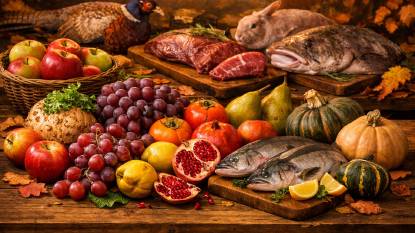

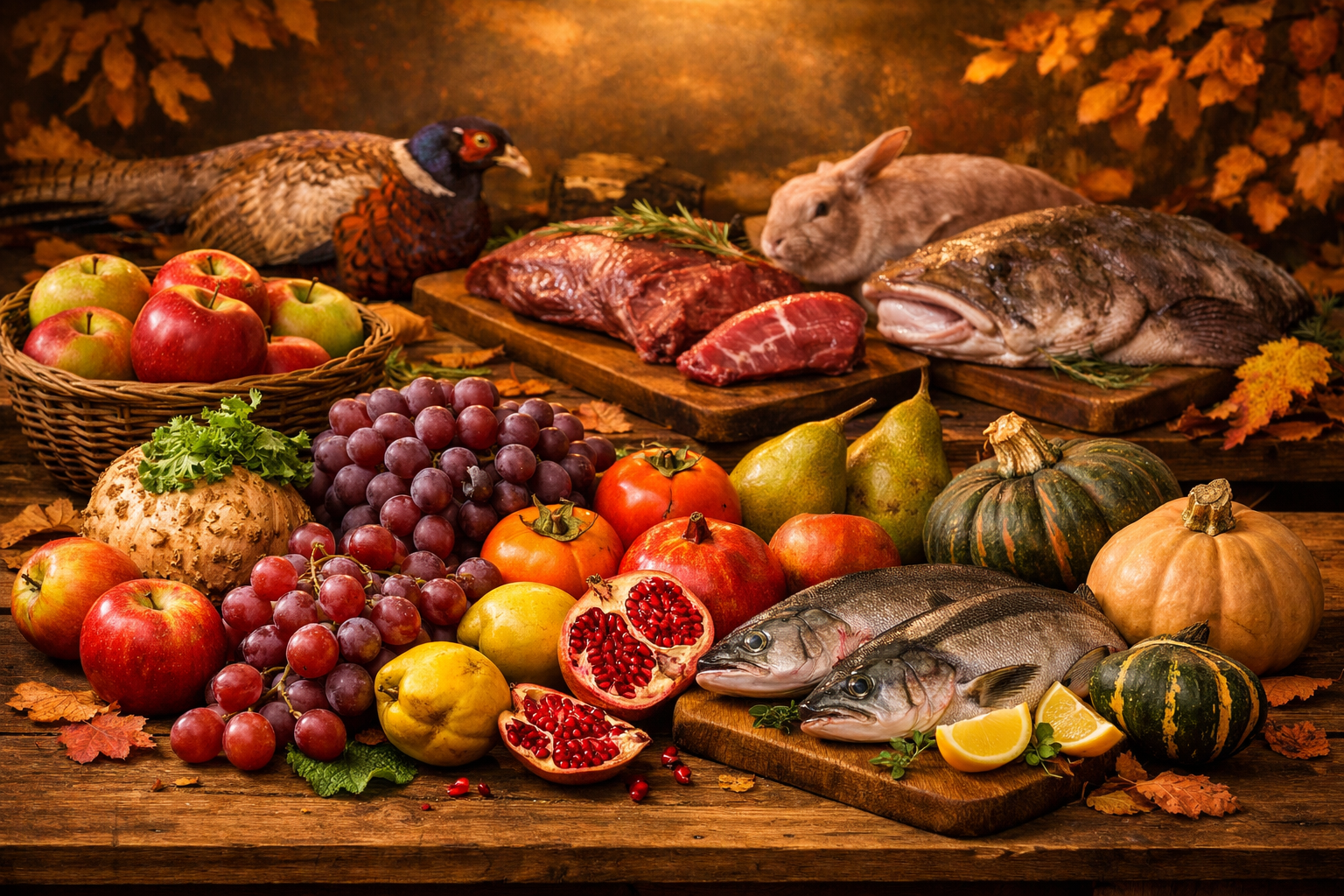
Early autumn is a food season of transition, and this is where some of the best cooking happens. The tomatoes and peppers of summer are still lingering, but the market is filling with apples, pears, grapes, and the first winter squashes. The air turns crisp. The kitchen becomes a welcoming place again.
This is the season of the harvest, literally. For centuries, this time of year meant putting food by for the winter, filling the pantry with preserves, root vegetables, and cured meats. Even if you are not planning to stock a root cellar, early autumn offers some of the richest, most satisfying ingredients of the entire year.
Fruits of Early Autumn
Early autumn fruits are defined by depth and complexity. These are not the fleeting berries of summer. These are the fruits that store well, that develop their sugars slowly, and that pair beautifully with savory flavors.
Mid-Season Apples
Early fall offers a wealth of apples. Look for Spartan (dark red), Red Rome (a baking apple with very firm pulp), Rome Beauty (large, red, with a slightly mealy texture), Empire (round and dark red), and Northern Spy (pale green with yellow streaks). Each has its own character, and each deserves its moment.
Mutsu or Crispin apples, large and green with a crisp, tart bite, were developed in Japan alongside the increasingly popular Fuji apple, which is yellow-green with red stripes. Both have become staples of American orchards. Golden Delicious is one of the most popular apples in the country. It holds its shape when baked and is tart enough for salads. The original Golden Delicious tree grew by chance in West Virginia. The Stark Brothers purchased the rights to it in 1914 for about $5,000, a sum that speaks to the profitability of the apple business at the time. The Golden Delicious was later crossed with the Jonathan, a popular red variety, to create the versatile Jonagold.
No discussion of apples in America would be complete without mentioning John Chapman, better known as Johnny Appleseed. Chapman’s true name was John Chapman, and he got his start by salvaging apple seeds from cider presses in western Pennsylvania. He traveled westward, stopping from time to time to plant orchards and sell seedlings to settlers. Chapman had an eccentric, missionary reputation. He traveled continually even in the worst weather, tried to negotiate peace between settlers and Native Americans, and became an ardent evangelist for the Swedenborgian Church of the New Jerusalem. When Chapman died in Indiana in 1845, it was discovered that he owned 1,200 acres of land.
A note for gardeners: you can grow apple trees from seed like John Chapman, but they will not produce fruit identical to the parent apple. By a botanical quirk, all orchard fruits behave this way. To produce a consistent type of apple, it is necessary to graft branches onto a compatible rootstock, often using quince trees. This also limits the height of the tree, speeds up the time to first harvest, and allows the selection of rootstocks resistant to pests in the soil.
Late-Season Grapes
Some of the best known grapes ripen in early fall. Look for Thompson Seedless, Sultana, Concord, Muscat, and Ribier. Blue-black Concord grapes are the variety used to make the grape juice and jelly so familiar to American children, but they are delicious fresh too. Concords are known as slip-skin grapes, because the inner flesh slips easily out of the thick skin, which many people find bitter.
The flavor of Concord grapes, as well as Catawbas which also ripen late, is described by wine lovers as “foxy.” This tart, musky sweetness that is definitive for juice and jams is often considered a fault in wines. For as long as people have grown grapes, they have dried them into raisins. Thin-skinned, golden Thompson Seedless (also known as Sultanina) is the variety most often used for this today. Golden raisins, the so-called Sultanas, are actually made from Thompson Seedless grapes treated with sulfur to preserve their light color. Darker raisins are sun-dried.
Currants (the dried kind, not the fresh fruits related to gooseberries) are made from the tiny Black Corinth grape. Seeded green Muscat grapes also produce particularly sweet, large raisins. Wine grapes must have a fairly high sugar content to carry out fermentation, so table grapes and wine grapes have been cultivated for distinctly different purposes for centuries.
Late-Season Pears
The last pears to be harvested before the cold weather sets in are Anjous, Forelles, and Winter Nelises. There are both green and red varieties of Anjou pears, known for their delicate flavor and juicy texture. Most Anjous are kept in cold storage for at least a month after harvest, which allows the sugar content to reach its optimum level.
Winter Nelis pears are firm-fleshed and fat, with green skin bearing a delicate hint of russeting. These all-purpose pears resemble Bartletts in flavor. Forelle pears are almost as small as Seckels, yellow-green with bright red patches. Their small size and striking appearance make them a favorite for cheese boards and garnishes.
Persimmons
There are two basic types of persimmon: the Asian (or kaki), grown in China and Japan, and the American, which grows in the southeastern and central eastern United States. A relative of ebony, the persimmon tree is a source of hard, strong wood traditionally used to make golf club heads. Kakis were introduced into France and the Mediterranean in the 19th century and soon after brought to California. These brightly colored fruits, which may be yellow, orange, or red, look a lot like tomatoes.
American persimmons are quite a bit smaller and more subdued in color, an earthy maroon. These native fruits are not marketed the way their showier relatives are, though it is generally agreed that they are much more flavorful. Those in the know get them the old-fashioned way, by gathering the fruits off the ground when they tumble from the tree at the first frost.
There is no pucker quite as unpleasant as that caused by an unripe persimmon. It feels as if your mouth has been vacuumed out. But a fully ripe persimmon is deliciously rich and sweet, almost chocolatey. Let the persimmon get so soft you can barely believe it is not rotten before sampling it. The Fuyu variety is the best known of the non-astringent Asian types that can safely be eaten while still crisp.
Pomegranates
Pomegranates are Old World fruits that have been cultivated in Egypt, Babylon, India, and Iran for 5,000 years or more. They were known to the ancient Greeks, who attributed the existence of winter to them. Persephone, daughter of the Earth goddess Demeter, was abducted by Hades, god of the Underworld. While in his custody, she ate a few pomegranate seeds and accidentally committed herself to spending one-third of the year below ground. Ever afterward, the anguished Demeter mourned for that entire season, allowing the Earth to become cold and barren.
Spanish missionaries brought the trees to California and Mexico in the 17th century. Today, California produces most of the pomegranates sold in the United States. Pomegranate trees are long-lived; a few trees in Europe are known to be over 200 years old. The list of medicinal applications of pomegranates in the ancient world is long and includes tapeworm, ulcers, and contraception. Boiled pomegranate rind made a yellow dye for staining leather and cloth.
Many people are familiar with the flavor of pomegranates even if they have never had the fresh fruit. Grenadine, the key ingredient in a Tequila Sunrise cocktail, is pomegranate syrup. To cut a pomegranate, score the rind lengthwise into quarters, then break it apart over the kitchen sink. Pluck the seeds from the skin and membrane and eat them. They will keep for a couple of weeks in a closed, refrigerated container.
Quinces
The quince, related to apples and pears, is out of fashion these days, probably because it is used mostly for making preserves. In Colonial times, it was considered indispensable for preserving fruits because of its high pectin content. The fruit looks like a knobbly, slightly fuzzy, yellow apple and is extremely bitter and hard when fresh. As it ripens, the quince changes to a deep gold color and gives off a delicious, spicy fragrance. Cooking inspires the quince’s flavor to match its fragrance, and it takes on an attractive rosy hue.
The number of specialized words for quince jelly hints at how popular the fruit was a few centuries ago. Cotignac, or quince paste, was a delicacy of 16th and 17th century France. Quiddany was the 17th century English word for quince jelly. The word marmalade originally meant, quite specifically, quince preserves. Marmelo is Old French for quince. Today, few would think true marmalade could be made without citrus fruits.
Vegetables of Early Autumn
Early autumn vegetables are the sturdy, substantial ones. These are the vegetables built for roasting, for long simmering, for the slow heat of the autumn kitchen.
Celeriac
Celeriac, also known as celery root, knob celery, or turnip-rooted celery, is an Old World vegetable native to the Holy Land and the Mediterranean. It belongs to the same species as the familiar celery plant, but the celeriac variety develops a large root with comparatively meager stems sprouting from the top.
The ancient Greeks and Romans were fond of celery and used it for both flavoring and medicine. The celery plants they cultivated resembled wild varieties called smallage. It was during the 18th century that the plant was bred to produce oversized stalks. Celery root contains the same essential oil that gives stalk celery its distinctive flavor, so it tastes quite similar, perhaps with a slightly nutty undertone.
When buying celeriac, look for firm, bulbous roots. It is bound to be knobby, but the smoother the surface, the less you will have to peel away. Celeriac can be eaten raw, but it is usually blanched before use. Look for it in comforting vegetable purees, often mixed with potatoes, and in soups and stews where it contributes the celery flavor with the more substantial texture of a root vegetable.
Winter Squash and Pumpkins
If you have winter squash in your garden and want to prepare them for winter storage, let them cure for about a week in a sunny place after cutting them off the vine, leaving about a 2-inch length of stem attached. Then store them in a cool, dry place. The squash should keep until at least the following spring.
Although a large summer squash is sure to be tough and fibrous, the bigger a winter squash is, the better. It shows the squash has been left to age on the vine, allowing natural sugars to form and ensuring the flesh will be sweet and tender. Winter squash display a great variety of colors and shapes. The Hubbard ranges from dark green to lichen-green to yellow and can grow to more than 30 pounds. Butternut squash has a bulbous end and an elongated neck, growing about a foot long. The dark green acorn squash is roughly acorn shaped with deep ridges, often found in single-serving sizes perfect for baking and stuffing. Turban squashes come in every size and color, shaped like a wrapped turban.
Whatever their outside appearance, all winter squashes have dense, smooth-textured, starchy orange flesh, with the exception of spaghetti squash. When steamed, spaghetti squash separates into strands resembling short lengths of pasta. It still tastes like winter squash though, so it should be paired with delicate sauces.
Botanically speaking, pumpkins are summer squashes belonging to the same species as zucchini. But they behave like winter squashes: they ripen late, they are best aged on the vine, they keep well, and their flesh is starchy, sweet, and nutty. Winter squash is good steamed, baked, sauteed, and stewed. They make delicious soups, either pureed until smooth or hearty and chunky. Maple syrup, brown sugar, and apples are common flavorings, as are more savory options like onions and garlic.
Meat and Fish of Early Autumn
Early autumn is the beginning of game season. This is when the richer, darker meats that have been feeding all summer begin to appear at markets.
Venison
The word venison, whose roots are in the Latin venatus (to hunt), once simply meant game meat. Now it is used more narrowly to mean the meat of any kind of deer. Venison resembles beef in texture, color, and flavor, but it is significantly less fatty. A three-ounce serving of cooked venison has less than 3 grams of fat, while the same amount of flank steak has nearly 9 grams.
Deer meat, like beef, is usually aged in a cool place for several days to enhance flavor and tenderness. Cooks should keep in mind that the tenderest parts of the deer are the back and saddle, while the shoulder and leg are best reserved for long, slow cooking. An acidic marinade made with wine, vinegar, tomatoes, or citrus can also help tenderize tougher cuts.
Pheasant
Pheasants are Old World birds that have been kept by people since ancient times, both as a food source and for the male’s stunning ornamental plumage. The common ring-necked pheasant was introduced to North America in 1881, when Judge Owen Denny, a diplomat, shipped several back from China and released them at his Oregon farm. George Washington kept pheasants at Mount Vernon.
The word “pheasant” comes from the classical Greek phasianos, or the Phasian bird, named after the Phasis River in the ancient region of Colchis. Today the area belongs to the Republic of Georgia. There are 50 or so species of pheasant, and almost all have resounding, hoarse calls. The peacock is a type of pheasant. The metallic green Japanese kiji is known for being a foreteller of earthquakes, sensitive to the slightest tremor.
Pheasant meat is very flavorful, so devotees usually prefer to keep the preparation simple. Roasted pheasant is complemented by simple autumn stuffings flavored with nuts, onions, sage, and thyme. A slice of bacon laid over the bird during cooking is another common approach.
Rabbit
Rabbits and hares are very popular small game animals, and their famously rapid rate of reproduction guarantees they are rarely in danger of extinction. Farm-raised meat is available year-round and will be milder and tenderer than wild. Although Americans do not always make the distinction, there is a difference between a rabbit and a hare. Rabbits are born blind, hairless, and helpless. Cottontails are true rabbits native to North America. Hares are born with their eyes open, fully furred, and able to hop around almost immediately. The jackrabbit, common in California, is a true hare.
Hare is darker and has a gamier taste than rabbit. Look for rabbit prepared in all the ways chicken is: baked, braised, stewed, sauteed, roasted. Among the many flavors that complement it are dried fruits, olives, mustard, rosemary, and bourbon.
Monkfish
Monkfish is also known as lotte in France, anglerfish, lawyerfish, and devilfish. It is an astonishingly ugly creature, almost all hideous head, with an oversized jaw that cannot close its jagged-toothed mouth. Lurking on the sea bottom, the monkfish feeds by dangling a lure-like filament over its head until a fish comes near, then it snaps.
Because the monkfish is so unattractive and scavenges for food on the ocean floor, it was considered a trash fish in the United States for quite a long time. In recent years, it has come into fashion and been fished more heavily than the population can support. The tail yields two cylindrical fillets of firm, mild-flavored, sweet meat that many people think tastes like lobster. Just be sure to remove absolutely all of the white membrane that covers the meat before cooking, as heat causes it to contract and toughen.
Eating Early Autumn Well
Early autumn cooking is about warmth and substance. The salads of summer give way to roasted vegetables. The quick grilling of warm evenings yields to braises and stews. This is the time to fill your kitchen with the smells of apples cooking down, squash roasting, and game browning in the pan.
The key is to match the ingredient to the method. A delicately flavored piece of monkfish wants a light touch. A dense butternut squash wants long, slow heat. A pear wants nothing more than to be sliced and eaten with a wedge of cheese. Pay attention to what each ingredient asks for, and the early autumn table will take care of itself.
Early Autumn Video
From the final gifts of Late Summer to the warming table of Late Autumn’s Table, the harvest deepens with each passing week.
Featured articles
Explore rich culinary stories, exclusive chef interviews, and expert insights from kitchens around the world. Discover cooking techniques, ingredient spotlights, and behind-the-scenes looks at the tools that shape global cuisine.

Georges Auguste Escoffier: Visionary Chef Who Revolutionized French Cuisine and Modern Cooking
Discover the life and legacy of Georges Auguste Escoffier, the legendary chef who transformed French cuisine and laid the foundation for modern culinary arts. This comprehensive historical profile …

How to Use a Knife, Fork, and Spoon
Master the basics of Western table etiquette with this guide to using a knife, fork, and spoon. Learn practical tips, cultural context, and the subtle rules that shape how we dine.

The History of Chocolate
Trace the fascinating history of chocolate, from its ancient origins with the Olmecs and Maya to its transformation into a global indulgence. Explore how cacao evolved from sacred ceremonial drink to …
Georges Auguste Escoffier: Visionary Chef Who Revolutionized French Cuisine and Modern Cooking
Discover the life and legacy of Georges Auguste Escoffier, the legendary chef who …
How to Use a Knife, Fork, and Spoon
Master the basics of Western table etiquette with this guide to using a knife, fork, and …
The History of Chocolate
Trace the fascinating history of chocolate, from its ancient origins with the Olmecs and …