Frederik Henry Harvey

By: Simon
July 18, 2026 | Updated: September 12, 2026

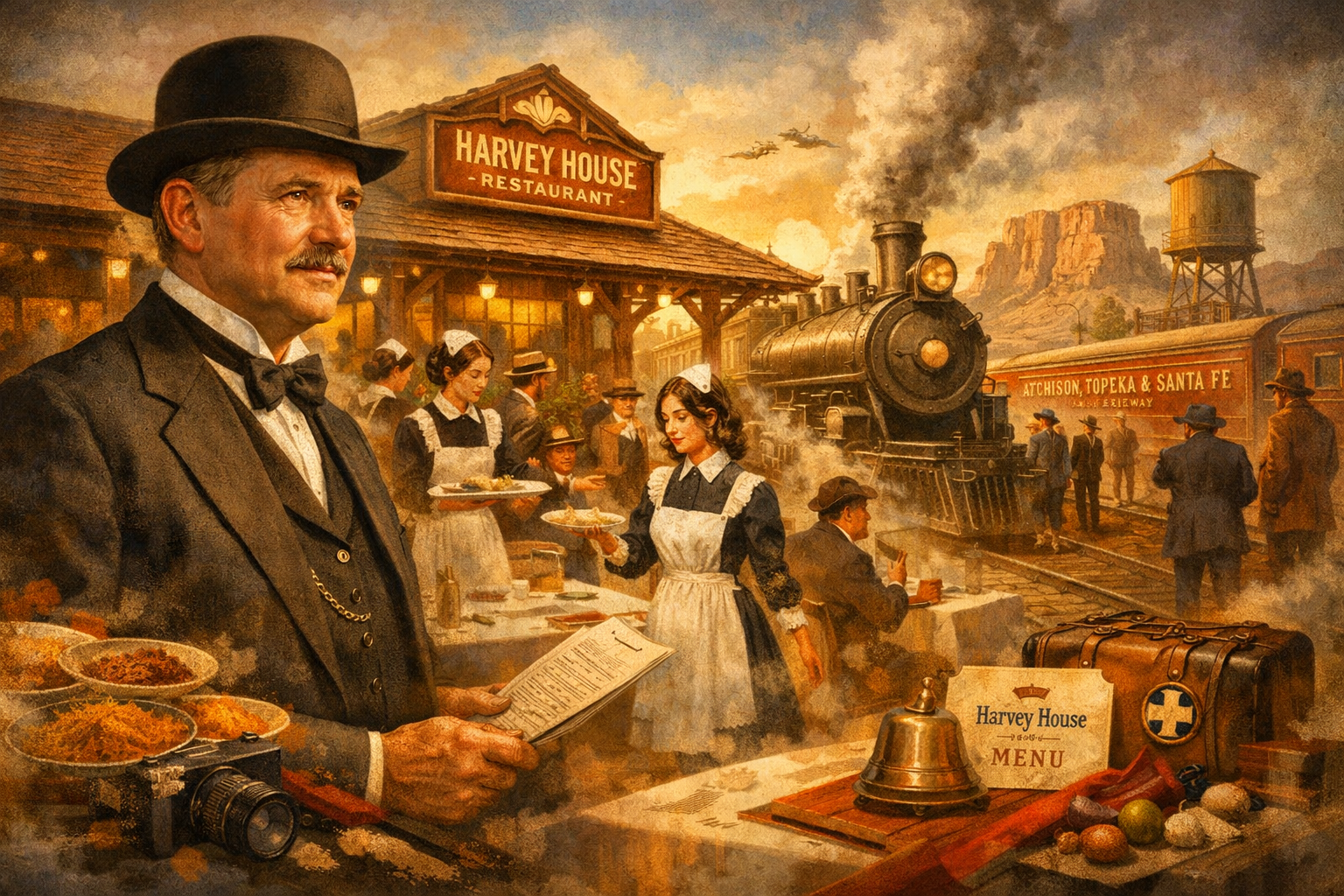
Frederick Henry Harvey didn’t just build restaurants; he engineered a hospitality empire that civilized the American West. In an era when railroad food was notoriously inedible—serving “uneatable dry biscuits, greasy ham and weak coffee”—Harvey, an English immigrant, saw an opportunity to transform travel dining into a hallmark of elegance, efficiency, and cultural exchange.
The Harvey House Concept
The Harvey House concept was a revolutionary partnership between food service and rail travel. In 1876, Harvey opened his first railroad restaurant in Topeka, Kansas, after striking a handshake deal with Charles Morse, president of the Santa Fe Railway. The railroad provided the buildings and transported all supplies—including fresh beef from Kansas City and seafood from California—while Harvey’s company handled everything else: hiring, training, and maintaining impeccable standards.
This partnership succeeded because of Harvey’s uncompromising philosophy: “maintenance of standards, regardless of cost”. He operated on a unique principle—the railroad sponsored the restaurants to attract ticket buyers, not to generate revenue. This allowed Harvey to demand the utmost in cleanliness, elegance, and service. He was a tireless manager who traveled constantly for personal inspections, enforcing strict rules even in Western territories where men were required to wear jackets while dining.
The efficiency of Harvey Houses was legendary. Conductors would collect menu selections from passengers and teletype them ahead to the cooks. When trains arrived, a white-coated staffer hit a brass gong outside the restaurant, signaling passengers to enter—and Harvey Girls served hundreds of meals in about 20 minutes, the average time a train stopped for servicing.
The Harvey Girls: A Workforce That Changed the West
In 1883, Harvey made a decision that would become iconic: he hired women to serve the food. Though not motivated by feminism, he believed female servers would “socialize” rough Western customers. The “Harvey Girls” signed one-year contracts and agreed not to marry during that time. They lived in supervised dormitories with strict curfews, wore distinctive black uniforms with starched white aprons, and were forbidden from wearing jewelry, makeup, or chewing gum.
The Harvey Girl recruitment ads promised: “Wanted, young women of good character, attractive and intelligent, 18 to 30 years of age as waitresses in Harvey Eating Houses in the West. Good wages with room and meals furnished”. It’s estimated that 100,000 women applied from 1883 through the 1960s. Harvey hired primarily white women, including European immigrants; minority workers—both male and female—worked in kitchens, hotels, and as maids and dishwashers.
Will Rogers famously quipped: “Fred Harvey should have his picture on one side of the dime and one of his waitresses with her arms full of delicious ham and eggs on the other side, ‘cause they have kept the West supplied with food and wives”.
A Hospitality Empire: Hotels, Resorts, and Retail
Beyond restaurants, Harvey expanded into hotels, newsstands, gift shops, barber shops, liquor stores, and even department stores in Union Stations across the U.S.. He pioneered branded merchandise, selling “Fred Harvey” hats, shirts, shaving cream, candy, playing cards, and Harvey Special Blend whiskey. As a forerunner to Starbucks, Harvey packaged his own select coffee for public sale in 1948, selling 7,000 pounds in the first two weeks.
Harvey built luxurious resort hotels near major Western attractions, including the Grand Canyon’s El Tovar Hotel (1905) and Bright Angel Lodge, and La Fonda in Santa Fe, New Mexico. One of his most spectacular but now-forgotten hotels was the Montezuma Hotel in Las Vegas, New Mexico—a castle-like wooden structure with 270 rooms, an eight-story tower, and mineral spring bathhouses that served 500 people daily. After burning to the ground in 1884, Harvey rebuilt it, only for it to suffer another fire and be replaced again in 1899.
The press dubbed Harvey the “Civilizer of the West,” with one 1880s article saying he “made the desert blossom with beefsteak and pretty girls”.
Legacy and Decline
Fred Harvey died in 1901, but his company remained a fixture on the Atchison, Topeka & Santa Fe route until the 1940s. By then, faster trains and the growing popularity of automobiles made the Harvey Houses obsolete. They closed gradually; by the 1960s, all were gone.
Today, only three Harvey-built hotels remain in operation: El Tovar and Bright Angel Lodge at the Grand Canyon, and La Fonda in Santa Fe, New Mexico.
Harvey’s legacy endures not just in these buildings, but in the very concept of hospitality as a blend of business acumen, cultural respect, and unwavering standards. He never cooked a single meal, but he changed how America ate—and how the West was won. He proved that vision, not just technique, can transform an industry.
Harvey House Documentary
Featured articles
Explore rich culinary stories, exclusive chef interviews, and expert insights from kitchens around the world. Discover cooking techniques, ingredient spotlights, and behind-the-scenes looks at the tools that shape global cuisine.
Georges Auguste Escoffier: Visionary Chef Who Revolutionized French Cuisine and Modern Cooking
Discover the life and legacy of Georges Auguste Escoffier, the legendary chef who transformed French cuisine and laid the foundation for modern culinary arts. This comprehensive historical profile …

How to Use a Knife, Fork, and Spoon
Master the basics of Western table etiquette with this guide to using a knife, fork, and spoon. Learn practical tips, cultural context, and the subtle rules that shape how we dine.

The History of Chocolate
Trace the fascinating history of chocolate, from its ancient origins with the Olmecs and Maya to its transformation into a global indulgence. Explore how cacao evolved from sacred ceremonial drink to …
Georges Auguste Escoffier: Visionary Chef Who Revolutionized French Cuisine and Modern Cooking
Discover the life and legacy of Georges Auguste Escoffier, the legendary chef who …
How to Use a Knife, Fork, and Spoon
Master the basics of Western table etiquette with this guide to using a knife, fork, and …
The History of Chocolate
Trace the fascinating history of chocolate, from its ancient origins with the Olmecs and …