Tortilla: The Unbroken Circle of Mexican Life

By: Simon
December 20, 2025 | Updated: February 17, 2026
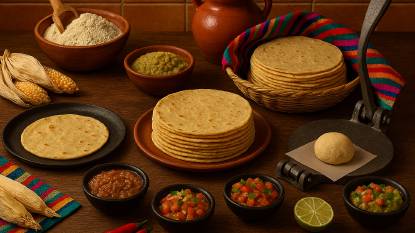


To understand Mexico is to understand the tortilla. It is far more than a simple flatbread; it is the edible plate, the primary utensil, the historical backbone, and the culinary soul of a nation. Its story is the story of Mexico itself—a narrative of deep indigenous tradition, colonial disruption, regional adaptation, and enduring daily ritual. From the humblest street stall to the most refined restaurant, the tortilla remains the indispensable circle at the center of the Mexican table.
A History Etched in Maize: From Nixtamal to Nation
The tortilla’s genesis is inextricably linked to the domestication of maize over 9,000 years ago in Mesoamerica. The true culinary revolution, however, came with the process of nixtamalization. This ancient technique, developed as early as 1500-1200 BCE, involves simmering dried maize kernels in an alkaline solution, traditionally water mixed with slaked lime (cal). This process, a cornerstone of pre-Hispanic food science, achieves several miraculous feats: it loosens the tough pericarp (hull) for easy removal, dramatically increases the grain’s nutritional value by making niacin and amino acids bioavailable, improves its flavor and aroma, and allows the treated corn (nixtamal) to be ground into a cohesive, pliable dough called masa.
For the Aztecs, Mayans, and other civilizations, maize was not merely a crop but a sacred entity, deified in figures like Centeotl. The tortilla, known in Nahuatl as tlaxcalli, was therefore sacred sustenance. Bernardino de Sahagún’s Florentine Codex meticulously describes the variety and social importance of tortillas in the Aztec world, from the large, thin tlaxcalpacholli served to nobles to the simpler versions for commoners. The Spanish conquest introduced wheat, and with it, the flour tortilla—a northern adaptation that tells a story of ecology, cattle ranching, and cultural fusion. Yet, despite this colonial import, the corn tortilla held fast as the true, enduring symbol of Mexican identity.
The Anatomy of a Perfect Tortilla: Craft Over Convenience
A truly great tortilla is a testament to craft. The process begins with quality nixtamal, ground to a specific texture—fine for smooth tortillas, coarser for more rustic, hearty ones. The masa’s hydration is critical; it must be moist enough to hold together without sticking, described in Spanish as having “la punto” (the right point). While modern tortillerías use automated presses and conveyor-belt comals, the traditional method is an art form.
The skilled tortillera takes a ball of masa, deftly pats it into a perfect, even circle between her palms—a rhythmic, slapping sound known as “paloteo”—and lays it onto a scorching-hot comal. This round, flat griddle, traditionally made of clay or now more commonly of steel or cast iron, cooks the tortilla quickly. The magic happens in stages: first contact causes bubbling, the tortilla is flipped, it puffs with steam (a sign of well-made masa), and finally develops subtle, toasty manchas (spots). A good tortilla should be pliable, with a slight resistance or “chew,” a distinct corn aroma, and a flavor that is subtly sweet, nutty, and complex.
The Great Divide: Corn vs. Flour and Their Regional Souls
The choice between corn and flour tortillas is a geographic and culinary declaration.
-
The Corn Tortilla: The undisputed heart of central, southern, and southeastern Mexico. Its flavor is more pronounced—earthy, tangy from the nixtamal, and corn-forward. It is the essential vessel for tacos, enchiladas, chilaquiles, totopos (chips), and is used as a scoop (sope base) or a wrapper (tamal, though for tamales the masa is often softer). Regional specialties abound: the robust, thick tortillas of Oaxaca, the small, palm-sized tortillas de maíz azul (blue corn) of Puebla, and the giant, paper-thin tortillas used for tlayudas.
-
The Flour Tortilla: Born in the arid north—Sonora, Chihuahua, Nuevo León—where wheat cultivation outpaced corn. Softer, more pliable, and milder in flavor, it was historically favored by ranchers and travelers for its durability. It is the star of the northern culinary tradition: the oversized burrito (literally “little donkey”), the grilled quesadilla (in the north, often exclusively with cheese in a wheat tortilla), burritas, and carne asada tacos. Its texture makes it ideal for rolling and grilling.
Beyond the Basic: A Universe of Tortilla-Based Dishes
The tortilla is a culinary chameleon, its form transforming to create entire categories of Mexican cuisine.
- The Soft & Simple: The foundational state. Warm corn tortillas served alongside nearly every meal to scoop, wrap, and savor.
- The Fried & Crisp:
- Tostadas: Tortillas fried flat until golden and crisp, topped with refried beans, shredded meats, seafood, and fresh garnishes.
- Totopos / Tortilla Chips: Wedges of tortilla fried for dipping into salsa, guacamole, or chile con queso.
- Chalupas: Boat-shaped fried masa (similar to a tortilla) from Puebla.
- The Sauced & Baked:
- Enchiladas: Tortillas lightly fried, dipped in a chile sauce, rolled around a filling, and baked.
- Enfrijoladas / Entomatadas: As above, but dipped in a pureed bean sauce or a tomato sauce.
- Chilaquiles: Day-old tortillas cut into pieces and simmered in salsa until they soften, served for breakfast with eggs and cream.
- The Stuffed & Folded:
- Tacos: The ultimate expression—a warm tortilla folded around an infinite variety of fillings.
- Quesadillas: A tortilla folded and filled (most commonly with cheese) and grilled or fried. The definition and contents vary passionately by region.
- Flautas / Taquitos: Tortillas rolled tightly around a filling, fried until crisp, resembling a “flute.”
- The Reinvented Base:
- Sopes, Huaraches, Garnachas: Thicker discs of masa pinched at the edges to form a vessel or shaped like a sandal, then topped.
- Tlayudas (Oaxaca): A giant, crisp, partially dried tortilla baked over charcoal and loaded with ingredients.
A Contemporary Recipe: Handmade Corn Tortillas
While store-bought are convenient, making tortillas at home connects you to the rhythm of Mexican kitchens for generations.
Ingredients:
- 2 cups masa harina (specifically masa harina para tortillas, like Maseca brand—this is not cornmeal)
- 1 ¼ to 1 ½ cups warm water
- Pinch of salt (optional)
Method:
- Mix: In a bowl, combine masa harina and salt. Gradually add warm water, mixing with your hands until a soft, pliable dough forms. It should feel like soft playdough—not sticky, not crumbly. Knead for 2 minutes until smooth. Cover with a damp cloth and rest for 30 minutes.
- Portion: Divide dough into 12-14 equal balls, about the size of a golf ball. Keep covered.
- Press: Cut two pieces of plastic (a zip-top bag cut open works perfectly). Place a dough ball between them. Using a tortilla press or a heavy flat-bottomed dish, press down firmly to form a 5-6 inch circle.
- Cook: Heat a dry comal, cast-iron, or non-stick skillet over medium-high heat. Carefully peel the plastic and lay the tortilla onto the hot surface. Cook for 45-60 seconds until the edges look dry and the bottom has light brown spots. Flip.
- Puff: Cook for another 60 seconds. If the masa is good, the tortilla should puff up dramatically—press it gently with a cloth to encourage this. Flip once more for a final 15-30 seconds.
- Keep Warm: Immediately place cooked tortillas in a cloth-lined basket (tortero) or wrapped in a clean kitchen towel to stay soft and pliable.
Serve immediately. The tortillas will be fragrant, tender, and incomparably different from their packaged counterparts—a taste of true, handmade tradition. To use them, one doesn’t just eat with a tortilla; one eats a tortilla, honoring its role as the fundamental, unbroken circle of Mexican life.
Featured Articles
Explore rich culinary stories, exclusive chef interviews, and expert insights from kitchens around the world. Discover cooking techniques, ingredient spotlights, and behind-the-scenes looks at the tools that shape global cuisine.
Georges Auguste Escoffier: Visionary Chef Who Revolutionized French Cuisine and Modern Cooking
Discover the life and legacy of Georges Auguste Escoffier, the legendary chef who transformed French cuisine and laid the foundation for modern culinary arts. This comprehensive historical profile …
How to Use a Knife, Fork, and Spoon
Master the basics of Western table etiquette with this guide to using a knife, fork, and spoon. Learn practical tips, cultural context, and the subtle rules that shape how we dine.
The History of Chocolate
Trace the fascinating history of chocolate—from its ancient origins with the Olmecs and Maya to its transformation into a global indulgence. Explore how cacao evolved from sacred ceremonial drink to …
Georges Auguste Escoffier: Visionary Chef Who Revolutionized French Cuisine and Modern Cooking
Discover the life and legacy of Georges Auguste Escoffier, the legendary chef who …
How to Use a Knife, Fork, and Spoon
Master the basics of Western table etiquette with this guide to using a knife, fork, and …
The History of Chocolate
Trace the fascinating history of chocolate—from its ancient origins with the Olmecs and …