Multi-Ply Stainless Steel Cookware: The Precision Chronicles

By: Simon
September 9, 2025 | Updated: February 17, 2026
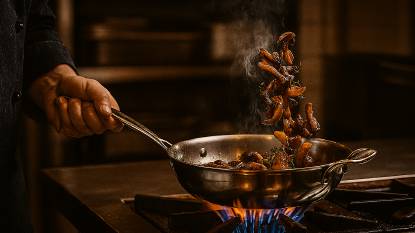


🍳 Cookware Type: Multi-Ply Stainless Steel
🏛️ Heritage: Mid-20th century America • Engineering-driven evolution
🔥 Use Case: All-purpose, precision cooking, professional kitchens
🧼 Care Level: Low to moderate
The Rational Revolution
The first time I witnessed the true power of multi-ply stainless steel was not in the gleaming showroom of a high-end culinary retailer, but in the controlled chaos of a three-star Michelin kitchen during dinner service. It was 2008, and I had finagled my way into a corner of Thomas Keller’s Per Se for a night of observation. What struck me most profoundly was not the balletic choreography of the line cooks or the near-telepathic communication between stations, but rather the unanimous devotion to a single species of cookware: multi-ply stainless steel pans that seemed to function as extensions of the chefs’ own hands.
“In a professional kitchen, you need a pan that tells no lies,” the chef de cuisine told me during a rare quiet moment. He gestured to a row of identical stainless steel sauté pans, their exteriors bearing the battle scars of countless services, their interiors still gleaming like liquid mercury. “These pans have no agenda. They don’t forgive sloppy technique or mask errors. They simply translate your intentions directly to the food—nothing more, nothing less.”
In that moment, I understood that multi-ply stainless steel represented something more profound than mere cookware—it embodied a particular philosophy of cooking itself: transparent, honest, technique-driven, and uncompromising. Where copper exudes romantic traditionalism and cast iron speaks to rustic heritage, stainless steel articulates modernity, precision, and the belief that engineering can perfect what tradition began.
This devotion to rational performance over sentimentality traces back to multi-ply’s origin story—a narrative not of ancient craft or inherited wisdom, but of mid-century American innovation and the distinctly modern belief that metallurgical science could build a better pan.
The Birth of a Standard: Metallurgy Meets Culinary Science
🔬 Technical Specifications
- Construction: 3-7 alternating layers of metals
- Core Materials: Typically aluminum or copper
- Exterior/Interior: 18/10 surgical-grade stainless steel
- Heat Conductivity: Moderate to excellent (depending on core)
- Responsiveness: Moderate to high (copper core versions offer greater responsiveness)
- Weight: Medium (typically 2-4 pounds for a 10-inch frying pan)
Unlike many culinary tools whose origins disappear into the mists of pre-industrial history, multi-ply stainless steel cookware has a precise birthday. In 1967, metallurgist John Ulam—a pioneer who held patents for bonding dissimilar metals for the U.S. Mint and various defense applications—realized that the same technology could revolutionize cookware. Ulam’s insights were elegant in their clarity: stainless steel offered durability, non-reactivity, and ease of maintenance but conducted heat poorly, while aluminum and copper excelled at heat conduction but reacted with foods and required significant maintenance.
The solution was brilliantly logical—bond these metals together in alternating layers, creating a composite material that harnessed the virtues of each while neutralizing their individual shortcomings. Ulam founded All-Clad Metalcrafters in 1971, introducing the first fully-clad cookware to the American market. The primary innovation—what we now call “multi-ply” or “fully-clad” construction—was revolutionary not for its exotic materials (stainless steel and aluminum were both common in kitchens) but for its architectural approach to cookware design.
“What Ulam understood was that cookware is fundamentally a thermal engineering problem,” explains Dr. Ashlie Martini, professor of mechanical engineering at UC Merced and an expert in material interfaces. “By creating a layered structure with stainless steel on the outside and aluminum or copper in the core, he developed a material that could conduct heat rapidly across the cooking surface while maintaining a stable, non-reactive interface with food.”
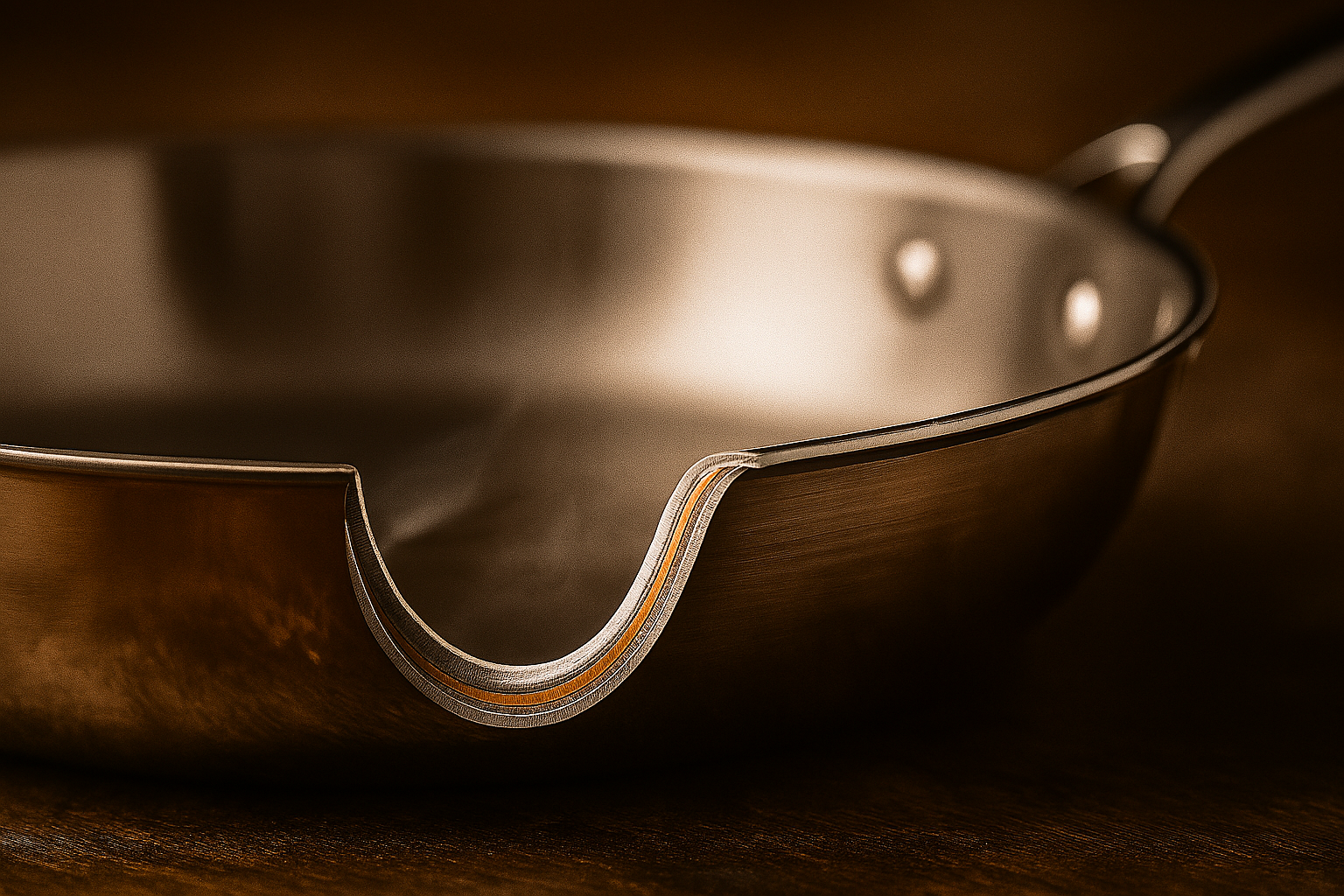
The typical construction of multi-ply stainless begins with 18/10 stainless steel for the cooking surface—a formula indicating 18% chromium and 10% nickel, providing corrosion resistance and durability. The exterior layer is often 18/0 magnetic stainless steel, which enables compatibility with induction cooktops. Between these lies the core—typically aluminum or copper, metals chosen specifically for their superior thermal conductivity.
The manufacturing process itself is an industrial marvel. Sheets of different metals are stacked together and then subjected to tremendous pressure through a bonding process called cladding. This creates a metallurgical bond—not just a mechanical connection—where the atoms of the different metals actually intermingle at their boundaries. The bonded sheets are then formed into cookware through impact extrusion, spinning, or other forming methods, followed by finishing processes that create the characteristic polished exterior.
What emerges is not just a pan but a purpose-built thermal instrument, where each layer serves a specific function in the cooking process. The stainless exterior provides durability and ease of maintenance, the aluminum or copper core ensures rapid and even heat distribution, and the stainless cooking surface offers a stable, non-reactive interface with food.
“The genius is in the layering,” notes Christopher Kimball, founder of Milk Street. “Medieval armorers discovered that alternating layers of hard and soft steel created weapons that were both sharp and flexible. Multi-ply cookware operates on the same principle—combining different metals to achieve properties that no single metal could provide.”
The result is a cooking vessel capable of remarkably even heat distribution—eliminating the hot spots that plague single-material cookware—while maintaining the durability and ease of maintenance that made stainless steel a staple in professional kitchens.
Beyond Three-Ply: The Architecture of Modern Multi-Ply
While Ulam’s original three-ply construction remains the industry standard, manufacturers have continued to iterate on the basic concept, creating increasingly specialized thermal architectures designed for specific cooking applications.
Five-ply construction typically introduces additional layers of aluminum or may include a copper core between aluminum layers for enhanced heat distribution. Seven-ply versions, the current apex of multi-ply engineering, can incorporate multiple types of aluminum (such as pure aluminum and aluminum alloy) along with copper to create highly specific heating profiles.
Demeyere, a Belgian manufacturer founded in 1908 that entered the multi-ply market in the 1960s, takes a different approach with their “7-PlyMaterial” construction. Rather than using the same layering throughout the pan, they strategically vary the construction based on the intended function of each part of the vessel.
“What we recognized is that different cooking methods require different thermal properties,” explains Demeyer’s technical director. “The base of a sauté pan needs maximum heat retention and distribution, while the sidewalls benefit from less mass to allow for quicker response when adjusting heat.”
This function-driven approach results in cookware where the base might feature seven layers with copper and aluminum cores for maximum heat distribution, while the sides use a three-ply construction for better responsiveness. This differential construction comes closer to the thermal ideal—pans that provide the steady, even heat of thick vessels while maintaining the responsiveness of thinner ones.
Further innovation appears in specialty lines designed for specific cooking methods. Multi-ply fish poachers feature elongated designs with slightly thinner construction for the gentle, precise heat needed for delicate proteins. Paella pans employ wider diameters with thinner profiles to achieve the socarrat (crispy bottom layer) essential to authentic paella. Woks feature more conductive cores in the center where intense heat is required, with less conductive sidewalls to create the temperature gradient needed for proper stir-frying.
“What we’re seeing is the evolution from general-purpose thermal designs to application-specific thermal architectures,” notes Chad Williams, culinary director for a major cookware manufacturer. “It’s similar to how racing bicycle frames evolved from standard geometries to specialized designs for different race conditions.”
The Professional Standard: Why Chefs Choose Stainless
In professional kitchens worldwide, from Michelin-starred establishments to high-volume hotel operations, multi-ply stainless steel has achieved near-ubiquity. This dominance represents one of the few areas where restaurant kitchens have largely abandoned tradition in favor of modern materials.
Marcus Samuelsson, the Ethiopian-born, Swedish-raised chef behind Red Rooster Harlem and numerous other restaurants, explains the professional preference: “When service hits and you’re cooking a hundred covers, you need cookware that becomes invisible. Multi-ply lets you focus entirely on the food and technique rather than managing the quirks of your pan. It’s like a Formula One car—it translates the driver’s intentions directly to the road.”
This transparency—the ability to function as a nearly invisible intermediary between chef and food—explains much of stainless steel’s professional appeal. Unlike traditional materials that require specific adaptations in technique (the careful temperature management of copper, the seasoning maintenance of cast iron), multi-ply stainless steel simply performs without demanding accommodation.
The professional kitchen also values multi-ply’s exceptional durability. Commercial kitchens subject cookware to punishments rarely seen in home settings: extreme heat variations, constant use, abrasive cleaning methods, and the occasional treatment as impromptu percussion instruments during particularly stressful services. Multi-ply construction withstands this abuse while maintaining its essential performance characteristics.
“We replace our nonstick pans every three months,” notes Daniel Boulud, whose global restaurant empire includes Daniel in New York City. “But our stainless pieces? Some have been with us for twenty years. The initial investment is higher, but the longevity makes it far more economical in professional settings.”
The steady, predictable heating profile of quality multi-ply also allows for standardization across kitchen stations—crucial for maintaining consistency in restaurant settings. When each pan behaves identically, recipes can be precisely replicated regardless of which line cook is working which station on a given night.
This precision extends to the moment of service itself. Multi-ply’s ability to maintain steady temperature even when cold ingredients are added allows sauces to remain stable during plating and proteins to continue cooking at the intended rate during resting. This predictable thermal performance creates a higher ceiling for precision in professional cooking.
“There’s a reason cooking school students are required to purchase multi-ply stainless sets,” observes Anne Willan, founder of La Varenne cooking school. “It teaches pure technique without the crutch of nonstick surfaces or the variables of less consistent materials. If you can master protein cookery in stainless steel, you can cook in anything.”
The Domestic Conquest: From Professional Secret to Home Kitchen Standard
While professional kitchens adopted multi-ply stainless almost immediately after its introduction, its journey into home kitchens followed a slower, more complex trajectory. Through the 1970s and early 1980s, All-Clad and similar products remained primarily professional tools, available mainly through restaurant supply channels and prohibitively expensive for most home cooks.
The watershed moment came in the late 1980s when gourmet retailers like Williams-Sonoma began positioning multi-ply stainless as the ultimate aspiration for serious home cooks. This coincided with America’s burgeoning food culture, as interest in restaurant-quality cuisine prepared at home began to replace convenience as the primary value in domestic cooking.
“It was a perfect storm of influences,” recalls Chuck Williams, founder of Williams-Sonoma, in a 2010 interview. “The rise of food television, the emergence of celebrity chefs, and a generation of home cooks who wanted to replicate restaurant experiences at home. Multi-ply stainless became a tangible connection to that professional world.”
This connection to professional technique was reinforced through the emerging medium of food television. When viewers watched Julia Child, Jacques Pépin, or later Gordon Ramsay working with gleaming stainless steel pans, the association between serious cooking and this specific cookware became firmly established in the culinary consciousness.
The aesthetic dimension also played a crucial role in multi-ply’s domestic conquest. The minimalist, utilitarian appearance of stainless steel—its gleaming surfaces and architectural handles—aligned perfectly with evolving kitchen design. As kitchens transformed from hidden workspaces into showcase rooms, cookware became an element of interior design, and multi-ply’s visual language of understated technical sophistication matched the contemporary ideal of the kitchen as both functional workspace and aesthetic statement.
“What’s fascinating about multi-ply stainless is how it bridges multiple design languages,” notes Sarah Archer, author of “The Midcentury Kitchen.” “It has the clean lines and material honesty of modernism, the technical sophistication valued by professional users, and a certain timeless quality that prevents it from looking dated as kitchen fashions evolve.”
Today, multi-ply stainless steel occupies a unique position in the cookware market—simultaneously the professional standard and a status symbol for home cooks. Entry-level sets from reputable manufacturers start around $400, while premium collections can exceed $2,000. This price range reflects multi-ply’s market positioning as an investment rather than a disposable good—cookware expected to deliver decades of service rather than seasons.
“We’ve tracked the same All-Clad pans through three generations in some families,” notes Jennifer Trent, a retail analyst specializing in housewares. “There aren’t many consumer products with that kind of longevity. It changes the purchase from expenditure to heirloom.”
Technical Truths: Understanding Multi-Ply’s Thermal Behavior
🏠 Best Applications
- Searing and sautéing: Provides even heat with excellent browning
- Pan sauces: Nonreactive surface preserves flavor clarity
- High-heat applications: Maintains structural integrity at high temperatures
- Acidic foods: Doesn’t react with tomatoes, wine, or vinegar
- Visual cooking: Light-colored interior shows fond development and caramelization
To fully appreciate multi-ply stainless steel’s culinary advantages requires understanding its particular thermal behavior—the way it captures, distributes, and releases heat during cooking.
While all cookware fundamentally serves to transfer heat from a source (flame, electric coil, or induction field) to food, different materials accomplish this with distinctly different characteristics. Cast iron, for instance, heats slowly but retains heat exceptionally well. Thin aluminum heats rapidly but is prone to hot spots. Copper offers both rapid heating and excellent distribution but loses heat quickly when removed from the source.
Multi-ply stainless occupies a middle ground that many professional cooks find ideal—reasonably responsive to temperature changes while maintaining enough heat capacity to provide stability during cooking.
“The thermal behavior of multi-ply is best described as ‘controlled responsiveness,’” explains Harold McGee, food science writer and author of “On Food and Cooking.” “It responds to heat adjustments more quickly than cast iron but doesn’t have the sometimes mercurial behavior of copper. This makes it forgiving without being sluggish.”
This balanced thermal profile arises directly from multi-ply’s layered construction. The aluminum or copper core provides thermal conductivity—essentially spreading heat horizontally across the cooking surface to eliminate hot spots. The stainless steel exterior layers provide thermal mass and stability, moderating the speed of temperature changes and helping maintain consistent cooking temperatures when food is added to the pan.
The result is cookware with a predictable thermal “signature” that experienced cooks learn to read and manipulate. A properly heated multi-ply pan will maintain consistent temperature even when cold food is added, allowing for proper Maillard reaction (browning) without sticking. It will respond to heat adjustments within seconds rather than minutes, enabling the precise heat control needed for delicate sauces and custards.
“Understanding this thermal delay is the key to mastering multi-ply,” advises J. Kenji López-Alt, culinary scientist and author. “You need to anticipate heat changes rather than react to them. Turn down the heat slightly before a sauce reaches the simmer point, eliminate heat entirely a minute before eggs have reached their final consistency. Multi-ply rewards the cook who thinks ahead.”
This characteristic makes multi-ply particularly suited to techniques requiring precise temperature control and adjustment—the delicate process of sweating aromatics without browning them, the progressive building of a pan sauce, or the careful management of protein browning. Its moderate responsiveness provides a margin of control impossible with more thermally extreme materials like cast iron (too stable) or thin aluminum (too reactive).
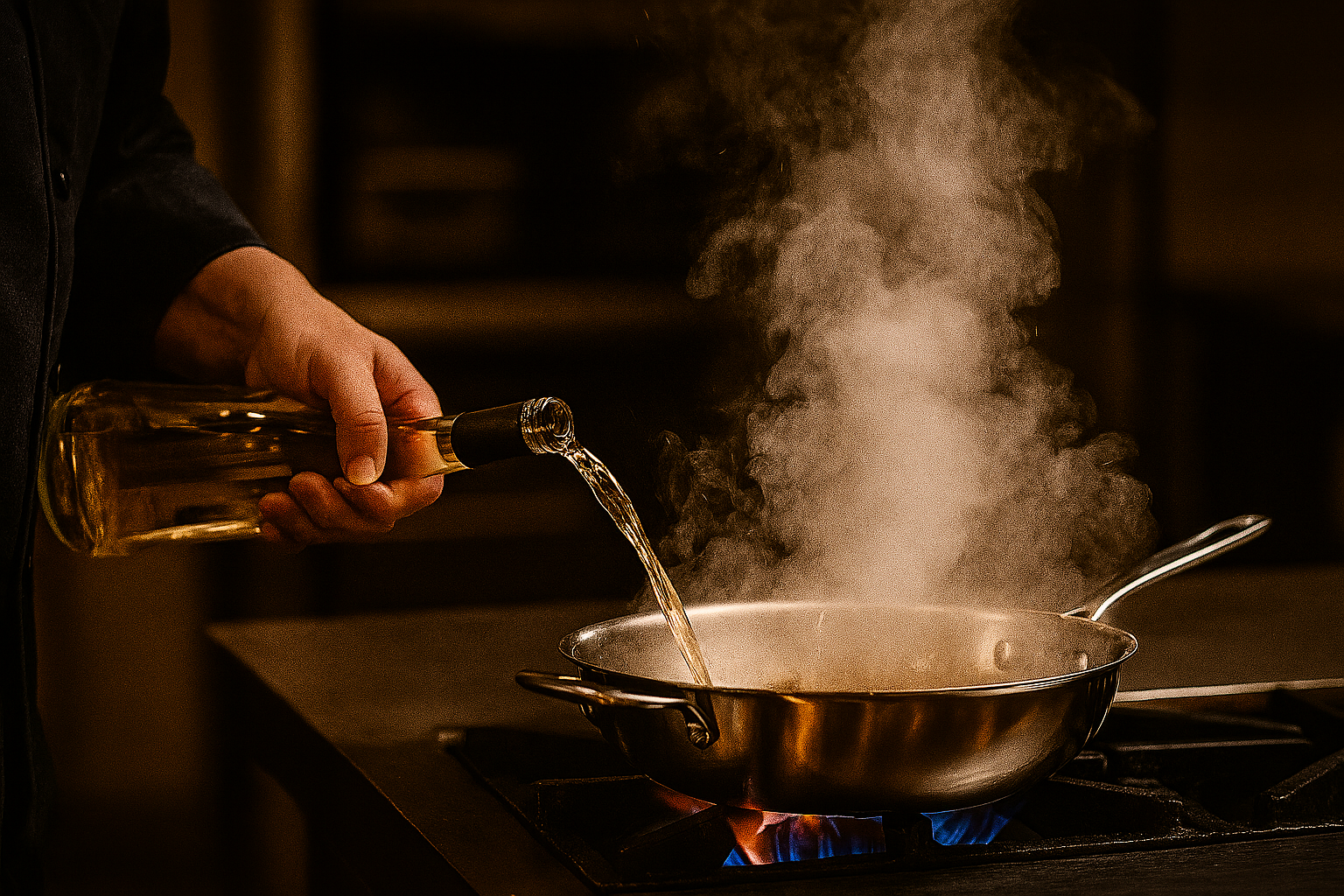
The nonreactive surface creates additional advantages for flavor development. Unlike reactive metals (copper, aluminum, carbon steel, cast iron) that can interact with acidic or alkaline ingredients, stainless steel provides a neutral cooking environment that preserves the pure flavor of ingredients. This makes it particularly valuable for deglazing with wine, reducing vinegars, or long-simmering tomato sauces—all techniques where metal reactivity can introduce metallic notes or color changes.
The Challenges: Understanding Stainless Steel’s Learning Curve
Despite its technical advantages, multi-ply stainless steel presents certain challenges that both professional and home cooks must navigate. The most common complaint from those accustomed to nonstick surfaces is food adhesion—the tendency for proteins in particular to bond to the stainless cooking surface during the early stages of cooking.
This phenomenon, often misunderstood as a defect, is actually an essential aspect of proper technique with stainless steel. The adhesion creates fond—the flavorful browned bits that form the foundation of pan sauces and contribute depth to numerous preparations. Managing this adhesion requires understanding the physics of protein cooking.
“The sticking that happens with proteins on stainless steel is temporary,” explains Shirley Corriher, biochemist and author of “CookWise.” “Proteins initially bond to the metal surface, but as the Maillard reaction progresses and proteins change structure, they actually release from the pan—but only if the pan is properly heated before the food is added and the protein isn’t disturbed too soon.”
This “stick, then release” phenomenon requires technique and patience. A properly heated pan, adequately fat-coated protein, and restraint in moving food too early all contribute to successful stainless steel cooking. This learning curve can frustrate cooks accustomed to the immediate gratification of nonstick surfaces.
Weight and heat retention create additional considerations. While not as heavy as cast iron, quality multi-ply cookware has significant heft—a 12-inch frying pan from a premium manufacturer typically weighs between 3-4 pounds empty. This weight, combined with handles that conduct heat to varying degrees, can create handling challenges, particularly for cooks with strength limitations or during lengthy cooking sessions.
Cost represents perhaps the most significant barrier to multi-ply adoption. Premium brands command prices that can approach $200-300 for a single frying pan—an investment that reflects both the materials and manufacturing complexity but places quality multi-ply out of reach for many cooks. While less expensive versions exist, truly budget-priced stainless cookware typically uses disc-bottom construction (where only the base contains the conductive core) rather than fully-clad design, sacrificing the sidewall heat distribution that distinguishes true multi-ply performance.
“There’s a significant difference between inexpensive stainless steel cookware and properly constructed multi-ply,” cautions Scott Graden, Executive Chef at the New Scenic Café in Duluth, Minnesota. “Disc-bottom construction creates a distinct heat boundary—you can see it when liquids simmer actively at the edges but barely move in the center. True multi-ply eliminates those thermal discontinuities.”
For the cook willing to invest the time and resources to master multi-ply stainless, these challenges become insignificant compared to the material’s advantages. The learning curve is steep but finite; the techniques required become intuitive with practice, ultimately expanding rather than limiting culinary possibilities.
Voices from the Kitchen: Multi-Ply in Professional Practice
The true test of any cookware comes not from technical specifications but from daily use in demanding kitchens. For many professional chefs, multi-ply stainless steel has become so fundamental to their cooking practice that it’s difficult to imagine working without it.
Nancy Silverton, founder of La Brea Bakery and Mozza Restaurant Group, describes her relationship with stainless steel as fundamentally liberating: “What I value most is the lack of constraints. I can go from stovetop to oven, use any utensil, scrape aggressively to build fond, deglaze with anything from wine to straight vinegar. There’s a freedom with quality stainless that lets me focus entirely on the food rather than babysitting my equipment.”
This sentiment—that multi-ply stainless enables rather than limits—appears consistently in conversations with professional cooks. Unlike specialized cookware that excels at specific tasks but falters in others, multi-ply’s versatility allows it to handle an astonishing range of cooking techniques competently, if not always optimally.
Michael Solomonov, the Philadelphia-based chef behind Zahav and multiple other restaurants, explains how this versatility translates to a professional environment: “In my kitchens, space and efficiency are always at a premium. We can’t have dedicated pans for every purpose. Multi-ply allows us to move from chicken schnitzel to deglazing with pomegranate molasses to making delicate egg creams—all with the same basic battery of equipment. That adaptability is invaluable.”
This adaptability extends beyond technique to the cultural diversity of contemporary cuisine. As professional kitchens increasingly embrace global flavors and methods, cookware must accommodate an ever-broadening range of culinary approaches.
“The beauty of stainless is its cultural neutrality,” suggests Edward Lee, chef-owner of 610 Magnolia and author of “Buttermilk Graffiti.” “It doesn’t belong to any single culinary tradition—it’s neither a wok nor a tagine nor a cast iron skillet. That neutrality makes it adaptable to virtually any cuisine. I can use the same pans for my grandmother’s Korean braised short ribs and classical French techniques I learned in culinary school.”
Even chefs who maintain collections of specialized traditional cookware often turn to multi-ply stainless for everyday professional use. Dominique Crenn, whose San Francisco restaurant Atelier Crenn has earned three Michelin stars for its artistic approach to French cuisine, explains this pragmatic choice: “There is certainly romance in traditional copper and beauty in hand-crafted specialty pieces. I treasure these and use them in specific contexts. But the backbone of my kitchen remains quality stainless steel. When service begins and we need absolute reliability under pressure, that’s what we reach for.”
Material Evolution: Multi-Ply’s Continuing Innovation
After fifty years of development, one might assume multi-ply stainless technology had reached its plateau. Yet manufacturers continue to refine both materials and construction techniques in search of the ideal cooking surface.
Recent innovations have focused on three main areas: improving heat distribution characteristics, enhancing surface properties, and optimizing ergonomics. All-Clad’s d7 line, introduced in 2013, features an alternating stainless-aluminum-stainless-aluminum-stainless-aluminum-stainless layering that creates more controlled heat distribution and retention. Demeyere’s Proline series uses a copper-aluminum hybrid core with seven total layers to achieve exceptional evenness while maintaining induction compatibility.
Surface technology has seen particularly rapid evolution. Traditional stainless steel cooking surfaces, while durable, have microscopic pores and irregularities that can contribute to sticking. Newer finishing techniques like Demeyere’s Silvinox treatment—an electrochemical surface enrichment that removes iron and impurities from the surface—create significantly smoother cooking surfaces with enhanced non-stick properties and resistance to discoloration.
“The surface science of stainless steel has advanced dramatically,” notes Geert Demeyere, whose family company pioneered many of these innovations. “We’re now working at the microscopic level to create surfaces that maintain the fundamental properties of stainless steel while addressing its historical limitations.”
American manufacturer Hestan has introduced what they call NanoBond technology—a surface treatment using titanium-based nanoparticles to create a bonded layer thousands of times harder than traditional stainless steel. This surface resists scratching, discoloration, and sticking while still providing the cooking characteristics of quality stainless.
Handle design and ergonomics represent another focus area. Traditional multi-ply handles, being solid metal, conduct heat from the pan body to the grip—an issue during extended stovetop cooking. Newer designs incorporate stay-cool features without sacrificing durability: hollow handles that reduce heat transfer, silicone or composite inserts that remain comfortable to touch, and improved balance that reduces wrist strain during lifting and pouring.
“The handle is where the cook physically connects with the cookware,” explains industrial designer Scott Henderson, who has created cookware for multiple premium brands. “Getting this interface right—the angle, the diameter, the thermal properties, the balance point—is crucial to the overall experience, yet it’s often overlooked in discussions of cookware performance.”
These continuing refinements suggest that multi-ply technology, despite its maturity, remains an active area of innovation. As manufacturing techniques advance and material science evolves, we can expect further improvements in this already exceptional cookware category.
Beyond the Kitchen: Multi-Ply’s Cultural Impact
The influence of multi-ply stainless steel extends beyond its practical cooking applications to shape broader cultural perceptions of cooking, kitchens, and culinary identity. As both symbol and tool, it has helped define contemporary relationships with food and cooking practice.
The visual language of stainless steel—its sleek, utilitarian aesthetic—has become shorthand for serious culinary intent. When food media depicts professional cooking or ambitious home kitchens, multi-ply stainless steel typically features prominently. This visual association helps distinguish “serious” cooking from mere food preparation and signals a particular approach to culinary practice—technique-driven, uncompromising, focused on fundamentals rather than shortcuts.
“The rise of multi-ply stainless coincided with a fundamental shift in American cooking culture,” observes food historian Laura Shapiro. “As we moved away from convenience foods toward a more engaged, technique-focused approach, cookware evolved to match this new seriousness. Stainless steel visually and functionally embodied this transition.”
This association extends to kitchen design itself. The contemporary kitchen aesthetic—with its emphasis on professional-grade equipment, functional layouts, and visible cookware—owes much to the visual influence of restaurant kitchens, where multi-ply stainless has long dominated. When home renovators request “chef’s kitchens,” they often reference the gleaming stainless aesthetic that has become synonymous with professional culinary spaces.
The gender politics of cookware also reflects multi-ply’s cultural position. Unlike more traditionally “feminine” cookware styles (floral patterns, pastel colors, lightweight construction), multi-ply stainless projects a gender-neutral or even masculine coding—emphasizing performance, durability, and technical specifications over decorative aspects. This coding has helped normalize male participation in home cooking by providing cookware that aligns with traditionally masculine value systems and aesthetic preferences.
“There’s a certain gendered history to cookware marketing,” notes Cristina Rosetti, professor of gender studies at Brown University. “Multi-ply stainless was among the first cookware categories marketed equally to men and women, emphasizing technical performance rather than domestic virtue. This helped create space for the contemporary male home cook who approaches cooking as craft rather than caregiving.”
Perhaps most significantly, multi-ply stainless steel embodies a particular philosophy about cooking—one that values precision, technique, and control above convenience or simplicity. Unlike cookware that promises to make cooking easier or more foolproof, multi-ply demands engagement and skill development from the cook. Its commercial success suggests a significant segment of both professional and home cooks embrace this philosophy—valuing culinary mastery over shortcuts.
“What stainless steel represents is honesty in cooking,” suggests Thomas Keller, whose restaurants The French Laundry and Per Se have defined contemporary fine dining. “It doesn’t disguise mistakes or compensate for improper technique. It simply translates the cook’s intentions—both good and bad—directly to the food. That transparency is what makes it both challenging for beginners and essential for those pursuing mastery.”
The Ethics and Economics of Excellence
The premium segment of multi-ply cookware raises interesting questions about value, sustainability, and the ethics of culinary consumption. With prices that can exceed $300 for a single pan, brands like All-Clad, Demeyere, and Hestan represent significant investments that merit consideration beyond mere performance.
From a purely economic perspective, quality multi-ply offers exceptional longevity that transforms the initial investment into reasonable long-term value. When amortized over decades of use—many original All-Clad pieces from the 1970s remain in daily service—the per-year cost becomes minimal compared to repeatedly replacing lower-quality alternatives. Most premium manufacturers offer lifetime warranties against defects, further enhancing the value proposition for those able to make the initial investment.
The sustainability equation is similarly favorable. The durability of quality stainless steel reduces landfill impact compared to disposable cookware, while the fully recyclable nature of the materials (both stainless steel and aluminum/copper cores) minimizes end-of-life environmental concerns. The energy-intensive initial production represents the primary environmental cost, offset by the exceptional lifespan of the product.
“When we discuss sustainability in consumer goods, longevity is often overlooked,” notes Mathis Wackernagel, founder of the Global Footprint Network. “A product that lasts fifty years instead of five represents a 90% reduction in manufacturing impact, even if the initial production requires more resources. Quality cookware exemplifies this longevity factor.”
The ethical dimension extends to manufacturing conditions and labor practices. Premium multi-ply brands typically maintain production in countries with stronger labor protections—All-Clad continues to manufacture in Pennsylvania, Demeyere in Belgium, Mauviel in France—rather than outsourcing to regions with weaker worker protections. This commitment to ethical production contributes to higher retail prices but supports manufacturing communities and helps preserve industrial craftsmanship in regions where these traditions might otherwise disappear.
Even the cultural meaning of the investment deserves consideration. In an era of disposable consumer goods and planned obsolescence, the purchase of cookware designed to last generations represents a statement about values—a prioritization of quality over quantity, of long-term thinking over immediate gratification, of craft over convenience.
“There’s something almost subversive about buying objects designed to last a lifetime,” suggests Elizabeth Currid-Halkett, author of “The Sum of Small Things: A Theory of the Aspirational Class.” “It challenges the consumption cycle that drives much of contemporary capitalism. Quality cookware represents an opt-out from the replace-and-upgrade mentality that defines most consumer categories.”
For those unable or unwilling to invest in premium brands, the multi-ply market offers alternatives at various price points. Tramontina, Made In, and All-Clad’s factory seconds provide entry points to true multi-ply construction at more accessible prices, while maintaining much of the performance that defines the category. The growing secondary market—through estate sales, online marketplaces, and cookware swap communities—offers additional paths to quality without maximum expense.
The Final Assessment: Multi-Ply in Modern Practice
After a half-century of evolution, multi-ply stainless steel has established itself not as a passing trend but as a fundamental standard in serious cookware—the benchmark against which alternatives are measured. Its combination of performance, durability, versatility, and maintenance simplicity creates a compelling package for both professional and ambitious home cooks.
The essence of its appeal lies in a particular balance—between responsive and stable, between traditional and modern, between technical and intuitive. Multi-ply stainless steel requires more from the cook than nonstick alternatives but offers far more in return: better sears on proteins, superior fond development for sauces, free use of metal utensils, unlimited high-heat applications, and a lifespan measured in decades rather than years.
“What separates the truly accomplished cook is the ability to understand how heat moves through food,” suggests Jacques Pépin, whose career spans the transformation from copper-heavy French kitchens to the stainless steel dominance of contemporary cooking. “Quality cookware doesn’t cook for you—it gives you the control to cook with precision. Multi-ply stainless provides that control more consistently than perhaps any other material.”
This uncompromising performance explains why, even as specialized cookware maintains devoted niches and traditional materials enjoy periodic revivals, multi-ply stainless steel remains the backbone of serious kitchens worldwide. Its presence transcends culinary philosophies and cultural boundaries—appearing in restaurants devoted to hypermodern technique and those dedicated to preserving ancient traditions, in professional kitchens from Tokyo to Lima, Paris to Melbourne.
For the home cook contemplating cookware choices, multi-ply stainless represents both challenge and opportunity. The learning curve is real—mastering temperature control, understanding the mechanics of food release, developing the technique to create proper fond—but the culinary possibilities expand dramatically once these fundamentals are internalized. What begins as investment becomes inheritance; what starts as tool evolves into companion.
The anthropologist Claude Lévi-Strauss famously observed that cooking is the activity that most definitively separates humans from other species—the transformation of the raw to the cooked being fundamentally an act of culture rather than mere sustenance. In this transformation, our tools matter profoundly. They shape not just what we can cook, but how we think about cooking itself.
Multi-ply stainless steel, with its engineered precision and uncompromising performance, embodies a particular philosophy about this transformation—one that values technique, understanding, and engagement over convenience or simplicity. It refuses to disguise culinary errors or compensate for improper method. Instead, it rewards study, practice, and attention with results impossible to achieve through shortcuts.
In a world increasingly divided between those who view cooking as burden and those who embrace it as craft, multi-ply stainless steel has firmly established itself as the material of choice for the latter group. Its gleaming surfaces reflect not just the flames beneath but a particular vision of what cooking can be: precise, controlled, technique-driven, and endlessly rewarding for those willing to master its fundamentals.
As we navigate the perpetual tension between tradition and innovation in contemporary cooking, multi-ply stainless offers a compelling synthesis—honoring the technical wisdom of classical technique while embracing the precision and efficiency of modern engineering. Neither nostalgically backward-looking nor blindly devoted to novelty, it occupies the productive middle ground where respect for culinary heritage meets appreciation for material science.
The poet and passionate cook William Matthews once observed that “cooking is the most massive rush of creativity any of us enjoys on a daily basis.” If cooking represents our most accessible art form, then our tools function much like the painter’s brush or sculptor’s chisel—not determining the quality of the work, but establishing both possibilities and limitations within which creativity operates. Multi-ply stainless steel, with its particular balance of responsiveness and stability, creates a culinary canvas that has proven exceptionally fertile for generations of cooks.
This enduring relevance—this capacity to serve as backdrop for culinary expression across decades and culinary traditions—ultimately defines multi-ply stainless steel’s true significance. Beyond specifications and beyond features, it has earned its central place in contemporary cooking by doing what truly great tools always do: disappearing into the work itself, allowing the cook’s intention to flow unimpeded from mind to plate, from conception to creation.
In the final analysis, perhaps that transparency—that capacity to serve rather than obstruct, to enhance rather than limit—represents multi-ply’s most profound contribution to modern culinary practice. In a craft fundamentally about transformation, it offers the clearest possible connection between the cook’s vision and its realization, between technique and result, between intention and achievement. That clarity—that honest translation of skill into outcome—remains the ultimate promise of multi-ply stainless steel, and the reason for its enduring place at the center of serious cooking.
Other Types of Cookware
While multi-ply stainless steel cookware is valued for its durability, non-reactive surface, and layered heat conductivity, it sits alongside other high-performance options in the kitchen. Copper cookware offers unmatched responsiveness and precision, making it ideal for delicate sauces and temperature-sensitive tasks. Enameled cast iron cookware, by contrast, excels in heat retention and is perfect for slow braises and oven-to-table presentations. Each material brings distinct advantages, but multi-ply stainless steel stands out for its balance—combining the strength of steel with the thermal efficiency of conductive core layers, making it a versatile choice for both everyday cooking and professional use.
Shop Multi-ply Stainless Steel Cookware 🛒
Sponsored links
| Tier | Brand | Notes |
|---|---|---|
| Budget | Amazon Basics | Tri-ply pans with induction compatibility, solid starter sets |
| Mid-range | KitchenAid | Multi-ply stainless with ceramic non-stick, oven-safe and ergonomic |
| High-end | All-Clad | Professional-grade 3-ply and 5-ply sets, made in USA, lifetime build |
3-Ply vs. 5-Ply Stainless Steel Cookware [Video]
Featured Articles
Explore rich culinary stories, exclusive chef interviews, and expert insights from kitchens around the world. Discover cooking techniques, ingredient spotlights, and behind-the-scenes looks at the tools that shape global cuisine.

Georges Auguste Escoffier: Visionary Chef Who Revolutionized French Cuisine and Modern Cooking
Discover the life and legacy of Georges Auguste Escoffier, the legendary chef who transformed French cuisine and laid the foundation for modern culinary arts. This comprehensive historical profile …

How to Use a Knife, Fork, and Spoon
Master the basics of Western table etiquette with this guide to using a knife, fork, and spoon. Learn practical tips, cultural context, and the subtle rules that shape how we dine.

The History of Chocolate
Trace the fascinating history of chocolate—from its ancient origins with the Olmecs and Maya to its transformation into a global indulgence. Explore how cacao evolved from sacred ceremonial drink to …
Georges Auguste Escoffier: Visionary Chef Who Revolutionized French Cuisine and Modern Cooking
Discover the life and legacy of Georges Auguste Escoffier, the legendary chef who …
How to Use a Knife, Fork, and Spoon
Master the basics of Western table etiquette with this guide to using a knife, fork, and …
The History of Chocolate
Trace the fascinating history of chocolate—from its ancient origins with the Olmecs and …