Enameled Cast Iron

By: Simon
September 9, 2025 | Updated: February 17, 2026
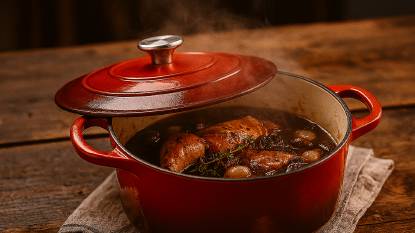


Fire & Glaze: The Enduring Allure of Enameled Cast Iron
🍲 Cookware Type: Enameled Cast Iron
🏛️ Heritage: 19th century France • Evolved from bare cast iron tradition with millenia-old roots
🔥 Use Case: Slow cooking, braising, roasting, artisanal bread baking
🧼 Care Level: Moderate
The Vessel That Carries Tradition
On a rain-slicked February evening in Burgundy, I found myself in the kitchen of a centuries-old farmhouse, watching as Madame Bonheur, eighty-three years old and formidable as the stone walls around us, reached for a flame-orange cocotte that seemed to generate its own gravitational pull. The heavy lid, when lifted, released a bouquet of wine-soaked aromatics and beef stock so profound it felt as though the essence of French culinary history had been distilled into vapor. The enameled cast iron Dutch oven—her faithful companion of fifty-four years—bore the battle scars of countless cassoulets and daube Provençals, its once-pristine interior now bearing the shadowed patina that only decades of magnificent meals can create.
“This pot,” she told me, gesturing with a wooden spoon worn smooth by a lifetime of stirring, “was a wedding gift from my grandmother. It cooked for my children, and now for my grandchildren. In this pot, there is memory.”
Madame Bonheur’s cocotte is more than a cooking vessel; it is a repository of familial history, a tactile link to generations past, and perhaps most importantly, a steadfast culinary tool that has survived revolutions in cooking technology without surrendering its essential place in the kitchen. The history of enameled cast iron is, in many ways, the history of modern cooking itself—a narrative of technological innovation meeting timeless technique, of function elevated to artistry, of practicality transformed into heirloom.
While its uncoated ancestor—traditional cast iron—traces its lineage back more than two millennia to Han Dynasty China, enameled cast iron emerged in the late 19th century, representing one of the most significant innovations in the evolution of cookware. What began as an attempt to address the limitations of traditional cast iron—its reactivity with acidic foods, its maintenance requirements, its tendency to impart a subtle metallic flavor—became a revolution that would transform how we cook and, perhaps more profoundly, how we think about cooking.
The Alchemical Marriage: Iron Meets Enamel
🔬 Technical Specifications
- Heat Retention: Exceptional (specific heat capacity of 0.46 J/g·K)
- Heat Distribution: Moderate speed, exceptional evenness once heated
- Weight: Substantial (typically 12-17 pounds for a 5.5-quart Dutch oven)
- Durability: Decades to generations with proper care
- Temperature Range: From freezer to 500°F (260°C)
The genius of enameled cast iron lies in its engineered duality—the marriage of opposites in service of culinary perfection. At its core is iron, elemental and unyielding, molten at 2,200°F and poured into sand molds where it solidifies into a material renowned for its exceptional thermal properties. Cast iron heats slowly but distributes heat with remarkable evenness and, most crucially, retains that heat with a persistence that approaches the miraculous.
“Cast iron has a thermal memory,” explains Harold McGee, food science writer and author of “On Food and Cooking.” “Once hot, it remains hot with a stubbornness that makes it ideal for techniques that require sustained, consistent heat—braising, searing, slow-roasting.”
This thermal mass—the ability to absorb, hold, and gradually release heat—explains why a properly heated cast iron vessel can create the perfect crust on a steak or maintain the gentle simmer essential for transforming tough collagen into silken gelatin over hours of cooking. But raw cast iron comes with limitations that threatened to relegate it to specialized use: its porosity makes it vulnerable to rust, its reactivity with acidic ingredients can affect both flavor and appearance, and its maintenance requirements demand a level of attention that contemporary cooks might find burdensome.
Enter enamel—the glassy, silica-based coating that would transform cast iron’s culinary potential. The vitreous enamel that defines these pots is essentially glass, formulated specifically to bond with the iron substrate and create a nonreactive, smooth surface. This coating is applied in multiple layers, fired at temperatures exceeding 1,500°F until it fuses permanently with the iron beneath. The best examples employ a white or light-colored interior enamel that allows cooks to monitor food browning precisely, while exterior enamel often features the signature vibrant colors that have made brands like Le Creuset and Staub instantly recognizable.
The process is both art and science, requiring precise control of materials and firing temperatures. too cool, and the enamel won’t properly adhere; too hot, and it may crack or bubble. The result, when executed properly, is a cooking surface that offers the thermal benefits of cast iron without its traditional limitations—nonreactive, relatively nonstick, and requiring no seasoning or specialized maintenance.
“The enamel coating solves the fundamental paradox of cast iron,” notes Leah Koenig, author of several definitive cookbooks on Jewish cuisine. “It gives you all the benefits with fewer of the complications. It’s why my grandmother could simmer tomato-based brisket sauce for hours without worry, and why that same pot could go straight to the table as a serving piece.”
From Workshop to Icon: The Brands That Defined an Aesthetic
The story of enameled cast iron’s rise to culinary prominence is inextricably linked to two French companies whose names have become synonymous with the category. Le Creuset, founded in 1925 in the northern French town of Fresnoy-le-Grand, introduced their first flame-colored cocotte that same year. Staub, a more recent arrival established in 1974 in Alsace, quickly established itself as a formidable presence in the market with distinctively designed pieces favored by professional chefs.
What both companies understood was that enameled cast iron could transcend mere utility—these were cooking tools that could simultaneously serve as objects of beauty. The iconic gradient orange of Le Creuset (officially “Flame”) was reportedly inspired by the molten iron used in their foundry, while Staub’s signature black interior enamel was developed specifically to enhance browning and disguise the inevitable marks of use.
“The genius of these pioneering brands was recognizing that cookware could be both supremely functional and aesthetically significant,” explains Sarah Coffin, former curator of product design at Cooper Hewitt, Smithsonian Design Museum. “They created objects that cooks didn’t want to hide away in cupboards—pieces worthy of permanent display, of passing down through generations.”
This marriage of function and form—of culinary utility and visual appeal—helped elevate enameled cast iron from mere kitchen tool to cultural touchstone. In midcentury America, a flame-orange Dutch oven became a status symbol for aspirational home cooks, a signal of both culinary seriousness and aesthetic discernment. Julia Child’s on-screen use of her beloved Le Creuset pieces introduced millions of Americans to these colorful French pots, creating an enduring association between enameled cast iron and sophisticated European cooking techniques.
Today, the category has expanded beyond its French origins. American company Lodge, long known for traditional cast iron, entered the enameled market in the 2000s with more accessible price points. Staub was acquired by the German company Zwilling J.A. Henckels in 2008. New direct-to-consumer brands have emerged offering enameled cast iron at various price points. Yet the fundamental appeal remains consistent—these are vessels that promise to transform both cooking process and dining experience through their unique combination of performance, durability, and beauty.
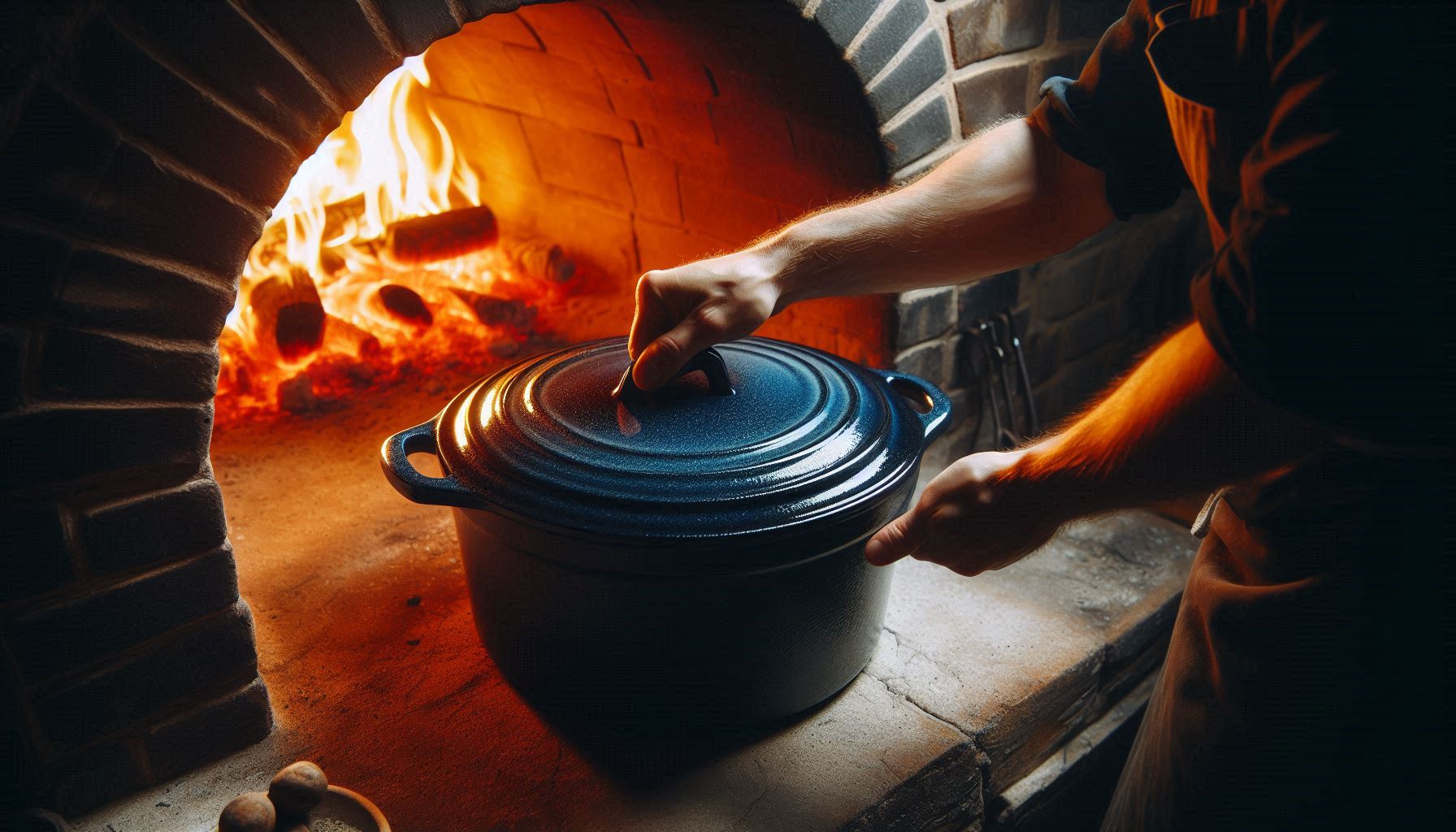
Global Cuisine Through Enameled Vessels
The cultural impact of enameled cast iron extends far beyond its French origins, having been embraced by culinary traditions worldwide. This global adoption speaks to the versatility of these vessels—their ability to adapt to diverse cooking techniques while delivering consistent, exceptional results.
In Morocco, the tagine (a conical-lidded cooking vessel traditionally made of clay) has found a modern interpretation in enameled cast iron versions that capture the same moisture-circulating properties while adding durability and even heat distribution. These adaptation has allowed Moroccan cooks to achieve the long, slow braises essential to dishes like lamb with preserved lemon and olives without the fragility concerns of traditional clay.
“The enameled cast iron tagine represents a perfect marriage of traditional technique and modern material,” explains Mourad Lahlou, chef-owner of Mourad in San Francisco and an authority on Moroccan cuisine. “It honors the essential function of the form—creating a closed environment where condensation continuously bastes the ingredients—while adding thermal properties that give the cook more control.”
In Jewish culinary traditions across both Ashkenazi and Sephardic communities, enameled cast iron has become the vessel of choice for cholent and hamin—the long-simmered Sabbath stews that must maintain consistent temperature for up to 12 hours. The thermal retention of these pots allows observant families to set their stew before sundown on Friday and return to a perfectly cooked dish for Saturday lunch, even with the heat source extinguished.
Perhaps most significantly, the Dutch oven (itself a misnomer, as the form was perfected in France) has been embraced by American cooks as the ideal vessel for everything from Mississippi pot roast to San Francisco sourdough bread. The enameled Dutch oven has become the centerpiece of a distinctly American approach to rustic, cookable food that emphasizes depth of flavor developed through long, slow cooking processes.
“What makes these pots so essential across cultures is their fundamental honesty,” suggests Samin Nosrat, author of “Salt, Fat, Acid, Heat.” “They don’t require tricks or special techniques—they simply do what they promise: transform humble ingredients into profound food through time and gentle heat.”
The Professional Perspective: Chefs and Their Faithful Companions
While home cooks may cherish their enameled cast iron for weekend projects and special occasions, for professional chefs, these vessels often serve as daily workhorses—reliable tools that deliver consistent results under demanding conditions.
Gabriel Rucker, the two-time James Beard Award-winning chef behind Le Pigeon and Canard in Portland, Oregon, maintains an extensive collection of enameled cast iron that forms the backbone of his French-influenced Oregon cuisine. “For certain dishes, there’s simply no substitute,” Rucker explains as he demonstrates his signature beef cheek bourguignon. “When I need something to hold a consistent temperature for hours with minimal fluctuation, I reach for enameled cast iron. The way it distributes and maintains heat means I can focus on other aspects of a complex service without worrying about babysitting a braise.”
The professional kitchen’s embrace of enameled cast iron speaks to its practical advantages beyond mere tradition. In restaurant settings where consistency is paramount and burner space is at a premium, the ability to start a dish on the stovetop, transfer it to the oven, and then hold it at serving temperature with minimal quality loss represents a significant operational advantage.
Yet professionals also note limitations that the home cook might overlook. “The weight becomes a real consideration in a commercial setting,” notes Renee Erickson, chef and author whose Seattle restaurants include The Whale Wins and Bateau. “When you’re moving pots many times a day, sometimes across a busy kitchen, the heft of enameled cast iron can become a physical challenge, especially for smaller cooks.”
This weight—a direct consequence of the material properties that make cast iron so effective for heat retention—represents the most significant trade-off in choosing these vessels. A 5.5-quart enameled Dutch oven typically weighs between 12-17 pounds empty; filled with a braise or stew, it can exceed 25 pounds. For elderly cooks or those with strength limitations, this can present a genuine barrier to use.
Professional chefs also approach the aesthetic dimension differently than home cooks. While consumers might select pieces in colors that complement their kitchen decor or dining table, professionals often prefer the black interior enamel pioneered by Staub, which shows wear less readily than the cream-colored interior of traditional Le Creuset pieces.
“In a restaurant kitchen, cookware gets used hard,” explains Nancy Silverton, founder of La Brea Bakery and Mozza Restaurant Group. “The dark interior enamel tells a more honest story—it embraces the marks of use rather than trying to hide them. There’s a truthfulness to that approach that resonates with professional cooking.”
The Home Kitchen Renaissance
🏠 Best Applications
- No-knead bread: Creates perfect crust formation through moisture control
- Long braises: Excels with tough cuts requiring sustained, gentle heat
- One-pot meals: Ideal for stovetop-to-oven transitions
- Stews and soups: Maintains consistent temperature for extended simmering
- Deep frying: Provides steady oil temperature with minimal fluctuation
The history of enameled cast iron in the home kitchen parallels broader trends in America’s evolving relationship with cooking. The mid-20th century saw these colorful French vessels embraced as symbols of sophisticated European cooking during a period when American cuisine was increasingly industrialized. The emergence of food television, particularly Julia Child’s influential “The French Chef,” introduced these pots to a generation of home cooks eager to expand their culinary horizons.
After a period of relative decline during the 1980s and 1990s—when nonstick surfaces and promise of convenience dominated—enameled cast iron has experienced a remarkable resurgence in the 21st century. This revival coincides with broader cultural movements: the slow food movement, renewed interest in traditional cooking techniques, the back-to-the-kitchen ethos of food blogs and social media, and perhaps most significantly, a reaction against disposable consumer culture.
“The appeal of enameled cast iron for today’s home cook lies partly in its permanence,” suggests Tamar Adler, author of “An Everlasting Meal.” “We live in an era of planned obsolescence, where consumer goods are designed to be replaced. A quality Dutch oven represents the opposite philosophy—it’s designed to last generations, to improve with use, to become imbued with history.”
This longevity factor has transformed how consumers view the considerable initial investment these pieces require. Premium enameled Dutch ovens from heritage brands can cost $300-600—a significant expenditure for a single cooking vessel. Yet when amortized over decades of use or viewed as a multigenerational purchase, the economics become more compelling.
“I tell people to think of their Dutch oven as cost-per-use over a lifetime,” says Chad Williams, culinary director for a major cookware retailer. “The initial sticker shock fades when you realize you’re buying something your grandchildren might use.”
The home cooking renaissance has also highlighted enameled cast iron’s versatility across techniques that have gained popularity. The explosion of interest in artisanal bread baking—particularly the no-knead method popularized by Jim Lahey and Mark Bittman—depends on the unique environment created inside a preheated Dutch oven, where steam is trapped to create the perfect crust. Similarly, the sous vide trend has created new appreciation for vessels that can provide the perfect sear on proteins after their precision temperature bath.
Perhaps most importantly for home cooks, enameled cast iron embodies a particular philosophy about cooking itself—one that values patience, process, and presence. These are not vessels for hurried weeknight meals (though they serve admirably for reheating them). They demand a different relationship with time and attention, rewarding the cook who understands that exceptional food often requires nothing more complicated than gentle heat applied consistently over time.
The Craftsmen: Creating Modern Heirlooms
The manufacture of premium enameled cast iron remains a complex process that combines industrial processes with handcraft. At the Le Creuset foundry in Fresnoy-le-Grand, where production has continued uninterrupted since 1925, each piece passes through the hands of at least 15 skilled workers during its creation.
The process begins with raw materials—primarily iron, which is melted in cauldrons at temperatures exceeding 2,200°F. This molten metal is poured into individual sand molds, which are broken after cooling to reveal the raw cast pieces. Each casting is inspected, polished, and prepared for enameling through a series of grinding and sandblasting steps that create the proper surface for enamel adhesion.
The enamel itself—essentially a specialized glass—is applied in multiple layers. The base coat provides adhesion to the iron substrate, while subsequent layers build color depth and functional properties. Each application requires firing at precise temperatures to create proper flow and adhesion without bubbling or cracking. The iconic gradient colors of Le Creuset pieces emerge from this process, with darker concentration at the edges where the enamel naturally pools during firing.
“What most consumers don’t realize is how much hand finishing still occurs in premium enameled cast iron,” explains Francis Staub, founder of the eponymous company. “Machines can’t make the judgments needed for consistent quality. The human eye and hand remain essential to the process.”
This combination of industrial process and artisanal judgment creates significant manufacturing challenges. Rejection rates can reach 30% for complex pieces, with even minor flaws rendering items unsaleable at premium price points. The knowledge required to maintain consistent quality represents a form of industrial heritage, passed from generation to generation of workers within these specialized factories.
American company Lodge, which entered the enameled cast iron market in the early 2000s, takes a different approach to production. While their traditional cast iron is manufactured in Tennessee, their enameled pieces are produced in partnership with foundries in China, allowing them to offer pieces at lower price points while maintaining quality standards through strict oversight.
“We recognized that for many home cooks, the heritage European brands represented a significant investment,” explains Mike Otterman, president of Lodge Cast Iron. “Our goal was to bring the essential cooking benefits of enameled cast iron to more kitchens by finding production efficiencies without compromising on performance.”
This democratization of enameled cast iron has expanded the category significantly, creating products at varied price points that maintain the fundamental cooking properties while differing in aspects like weight, enamel durability, and color selection. The market now spans from entry-level pieces priced under $100 to limited-edition collectibles exceeding $1,000.
Living With Iron: Maintenance, Care, and Evolution
One of enameled cast iron’s primary advantages over its uncoated ancestor is its relatively straightforward maintenance. Unlike traditional cast iron, which develops a polymerized oil coating (seasoning) that requires specific care, enameled cast iron needs no seasoning and can be washed with soap without damage to its cooking surface.
However, this ease of maintenance doesn’t render these pieces impervious to damage. The enamel coating, while remarkably durable, can chip or crack if subjected to thermal shock (rapid temperature changes) or physical impact. The most common injuries occur when empty pots are heated to high temperatures, when cold liquids are added to very hot vessels, or when pieces are dropped or struck against hard surfaces.
“We see the same patterns of damage repeatedly,” notes Sharon Franke, who tested cookware for Good Housekeeping for over 30 years. “Almost always, it’s thermal shock—putting a cold pot on a hot burner, or adding cold liquid to a very hot pot. The enamel and iron expand at different rates under temperature changes, which can cause the enamel to crack or separate from the base material.”
Most manufacturers recommend gentle heating—starting at low temperatures and gradually increasing—and avoiding empty heating beyond a few minutes. They also suggest wooden, silicone, or nylon utensils to prevent scratching the interior enamel, though these precautions matter less with the black interior enamel used by some brands, which is more resistant to visible marking.
The inevitable marks of use that develop over time—minor staining on light interiors, slight dulling of the exterior gloss—represent not damage but patina, the visible evidence of meals created and memories formed. Many collectors and longtime users treasure these marks, viewing them as similar to the way silver develops character through use.
“A pristine 30-year-old Dutch oven is a sad thing,” suggests cookbook author David Lebovitz. “It means those decades passed without memorable meals. The slight darkening, the shadow marks where the fond from countless braises has left its trace—that’s not damage, it’s history.”
Culinary Legacy: The Place of Enameled Cast Iron in Modern Cooking
As cooking technology continues its relentless advance—with induction, programmable multicookers, and app-connected appliances promising to revolutionize how we prepare food—enameled cast iron remains steadfastly relevant. Its continued prominence in both professional and home kitchens speaks to something fundamental about cooking itself: that certain culinary truths transcend technological evolution.
The principles that make a Dutch oven the perfect vessel for transforming tough collagen into silken gelatin are the same today as they were a century ago. The gentle, consistent heat that coaxes complex flavors from humble ingredients doesn’t require digital precision or wireless connectivity—it requires mass, conductivity, and intelligent design.
“What makes these pots so enduring is that they solve fundamental problems of heat management that haven’t changed since humans began cooking,” explains Kenji López-Alt, culinary scientist and author. “Heat retention, even distribution, moisture control—these needs are constants in cooking, regardless of time period or cultural context.”
Yet beyond their technical merits, enameled cast iron vessels carry cultural significance that transcends utility. They represent a philosophy of cooking that values permanence over disposability, tradition alongside innovation, and the joy of process as much as the pleasure of the final dish. In a world increasingly defined by digital ephemera, these substantial, tactile objects offer an alternative relationship with material culture—one based on longevity and accumulated meaning rather than planned obsolescence.
“When I use my grandmother’s Dutch oven, I’m cooking alongside her,” reflects chef and author Samin Nosrat. “Her hands touched these same handles, lifted the same lid, stirred contents with the same circular motion. Cooking becomes a conversation across generations.”
This quality—the ability to contain not just ingredients but meaning—explains why enameled cast iron often occupies a singular place in kitchen hierarchies. Many cooks who readily replace non-stick pans or upgrade appliances maintain deep attachments to their Dutch ovens, braising pots, and cocottes. These aren’t merely tools; they’re repositories of memory and vehicles for tradition, simultaneously grounding us in culinary history while enabling our own contributions to it.
As cooking continuously reinvents itself through new techniques, ingredients, and technologies, enameled cast iron reminds us that some aspects of food preparation remain gloriously resistant to optimization. The transformation that occurs during a six-hour braise cannot be accelerated without fundamental quality loss; the perfect oven spring of artisanal bread depends on specific conditions of moisture and heat transfer; the depth of flavor in a properly developed stew emerges only through time and patience.
In this context, enameled cast iron’s enduring appeal makes perfect sense. These are vessels designed not for convenience but for excellence—tools that demand investment of attention and care but reward it with culinary results unattainable through shortcuts. Their permanence reminds us that cooking at its best isn’t merely about efficiency but about connection—to ingredients, to tradition, and to the people with whom we share our tables.
When a flame-orange Dutch oven is passed from one generation to the next, it carries with it more than cooking capacity. It transfers a tactile connection to family history, to meals shared around tables long since cleared, to the cumulative wisdom of countless dinners. In a world of increasing transience, few objects offer such continuity—such tangible connection to both past and future.
As Madame Bonheur reminded me in her Burgundian farmhouse, lifting the lid of her half-century-old cocotte to release those intoxicating aromas: “In this pot, there is memory.” And perhaps that, ultimately, is enameled cast iron’s most precious offering—not merely meals, but memories, crafted slowly, savored fully, and preserved in vessels designed to outlast us all.
Other Types of Cookware
While enameled cast iron cookware is celebrated for its superior heat retention, durability, and oven-to-table elegance, it’s not the only option for serious cooks. Copper cookware, by contrast, offers rapid heat conductivity and precise temperature control—ideal for delicate sauces and quick adjustments. Multi-ply stainless steel cookware, often constructed with layered cores of conductive metals like copper or aluminum, provides balanced heat distribution and a non-reactive surface, making it a versatile choice for everyday cooking. For those seeking affordability and ease of use, it offers a sleek alternative without the maintenance demands of raw copper. Each material brings its own strengths, but enameled cast iron remains unmatched for slow braises, hearty stews, and dishes that benefit from consistent, enveloping warmth
Shop Enameled Cast Iron Cookware 🛒
Sponsored links
| Tier | Brand | Notes |
|---|---|---|
| Budget | Overmont | Affordable Dutch ovens and skillets, oven-safe up to 500°F |
| Mid-range | Crock-Pot | Artisan series with wide color range and solid heat retention |
| High-end | Le Creuset | Iconic French brand, premium enamel finish, lifetime durability |
How to: Enameled Cast Iron Cookware [Video]
Featured Articles
Explore rich culinary stories, exclusive chef interviews, and expert insights from kitchens around the world. Discover cooking techniques, ingredient spotlights, and behind-the-scenes looks at the tools that shape global cuisine.
Georges Auguste Escoffier: Visionary Chef Who Revolutionized French Cuisine and Modern Cooking
Discover the life and legacy of Georges Auguste Escoffier, the legendary chef who transformed French cuisine and laid the foundation for modern culinary arts. This comprehensive historical profile …

How to Use a Knife, Fork, and Spoon
Master the basics of Western table etiquette with this guide to using a knife, fork, and spoon. Learn practical tips, cultural context, and the subtle rules that shape how we dine.
The History of Chocolate
Trace the fascinating history of chocolate—from its ancient origins with the Olmecs and Maya to its transformation into a global indulgence. Explore how cacao evolved from sacred ceremonial drink to …
Georges Auguste Escoffier: Visionary Chef Who Revolutionized French Cuisine and Modern Cooking
Discover the life and legacy of Georges Auguste Escoffier, the legendary chef who …
How to Use a Knife, Fork, and Spoon
Master the basics of Western table etiquette with this guide to using a knife, fork, and …
The History of Chocolate
Trace the fascinating history of chocolate—from its ancient origins with the Olmecs and …