Copper Cookware: The Liquid Gold of Culinary Excellence

By: Simon
September 9, 2025 | Updated: February 17, 2026


🍳 Cookware Type: Copper Cookware
🏛️ Heritage: 9,000+ years of culinary history
🔥 Use Case: Precision cooking, confectionery, sauce work
🧼 Care Level: High maintenance
The Material That Shaped Culinary History 🟠
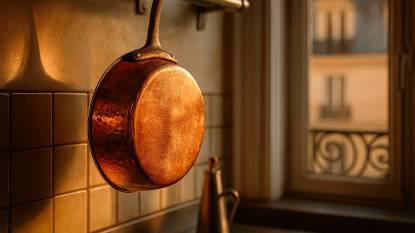
The first time I witnessed the true power of copper in a professional kitchen, I was staging at a three-Michelin-starred restaurant in Lyon. The chef de cuisine, a fourth-generation culinary master whose family had cooked for France’s gastronomic elite since the Belle Époque, handled his batterie de cuisine with the reverence of a concert violinist cradling a Stradivarius. His collection of copper pots and pans—some inherited, some commissioned from artisans in Villedieu-les-Poêles, the “City of Copper” in Normandy—gleamed against the white-tiled walls, their polished surfaces reflecting the kitchen’s frenetic choreography.
“In copper,” he told me, barely looking up as he executed a perfect beurre blanc in a pan that predated the Second World War, “there are no secrets between the chef and the flame.”
This intimate relationship between culinary artistry and metallurgical excellence isn’t a recent development. When humanity first discovered how to extract and shape copper some 9,000 years ago, we began a relationship with a material that would fundamentally transform our relationship with food. Archaeological findings from ancient Mesopotamia, Egypt, and the Indus Valley reveal copper cooking vessels that served the tables of the earliest civilizations. The Romans, with their sophisticated culinary culture, favored copper for everything from stockpots to serving vessels. By the Middle Ages, copper had become the uncontested sovereign of European kitchens, from royal courts to monastery cookhouses.
Yet copper’s culinary significance transcends mere historical footnote—it represents one of humanity’s most profound technological marriages: the union of scientific understanding with gastronomic pursuit.
The Science Behind the Shine
🔬 Technical Specifications
- Thermal Conductivity: 401 W/m·K (compared to 237 for aluminum, 80 for iron)
- Heat Capacity: 0.385 J/g·K
- Reactivity: High (requires lining for acidic foods)
- Weight: Approximately 8.96 g/cm³ (heavier than aluminum, lighter than cast iron)
The alchemy of cooking with copper begins with its exceptional thermal properties. Copper conducts heat with an efficiency that borders on the magical—nearly instantaneously responding to temperature changes and distributing that heat with unparalleled uniformity. This responsiveness creates what professional chefs call “thermal control”—the ability to execute precise temperature adjustments that can mean the difference between transcendent and ruined when working with delicate preparations.
“When I’m making caramel,” explains Dominique Ansel, the celebrated pastry chef behind the Cronut, “I need a medium that heats evenly and reacts immediately when I remove it from the flame. Copper gives me that control—it’s like having an extension of my hand.”
The science validates Ansel’s experience. Copper has a thermal conductivity rating of 401 W/m·K—approximately 60% more efficient than aluminum and five times better than stainless steel. This exceptional conductivity eliminates hot spots, those localized areas of higher temperature that can scorch sauces or create inconsistent results. When a copper pan is heated, the thermal energy distributes so uniformly that a surface temperature variation of more than a few degrees is virtually impossible.
This property makes copper particularly valuable for what French chefs call the “mother sauces”—béchamel, vélouté, espagnole, tomate, and hollandaise—where precision and consistency determine success. The gentle, responsive heat prevents the proteins in egg-based sauces from coagulating too rapidly and helps emulsifications like hollandaise achieve their characteristic silken texture.
From Mine to Masterpiece: The Craftsmanship of Copper
In Villedieu-les-Poêles, the centuries-old center of French copper cookware production, fourth-generation coppersmith Jean-Pierre Couvert hammers sheets of the ruddy metal into shape using techniques that have remained largely unchanged since the Middle Ages. The rhythmic ping of his hammer against copper creates a soundscape that has echoed through his family’s workshop since 1800.
“We begin with sheets of copper that are 2-3mm thick for the best pans,” Couvert explains, pausing to wipe his brow with a handkerchief that bears the copper-tinged stains of his life’s work. “Each piece is cut, hammered, shaped, and finished by hand. The hammering doesn’t just create the form—it work-hardens the metal, making it more durable.”
Traditional coppersmithing remains a ballet of fire and force. The metal is repeatedly heated and hammered, each strike compressing the copper’s crystalline structure and strengthening it. The process is labor-intensive—a single high-quality sauté pan might take eight hours of skilled labor to complete—but the results are both functional art and culinary tool.
The interior of copper cookware presents another layer of craftsmanship. Pure copper reacts with acidic foods, potentially creating compounds that can affect both flavor and safety. To address this, quality copper cookware is lined—traditionally with tin, though modern pieces often feature stainless steel or, in the highest-end products, silver.
“Tin lining is still the preference for many serious cooks,” notes Beth Sweeney, co-founder of Coppermill Kitchen, a company specializing in antique copper cookware. “It creates a naturally non-stick surface that conducts heat almost as well as the copper itself. The downside is that tin wears over time and must be renewed every few years with heavy use.”
This necessity for periodic maintenance represents both liability and virtue—a reminder that, like all truly exceptional things, copper cookware demands attention and care in exchange for its extraordinary performance.
The Professional’s Choice: Copper in Restaurant Kitchens
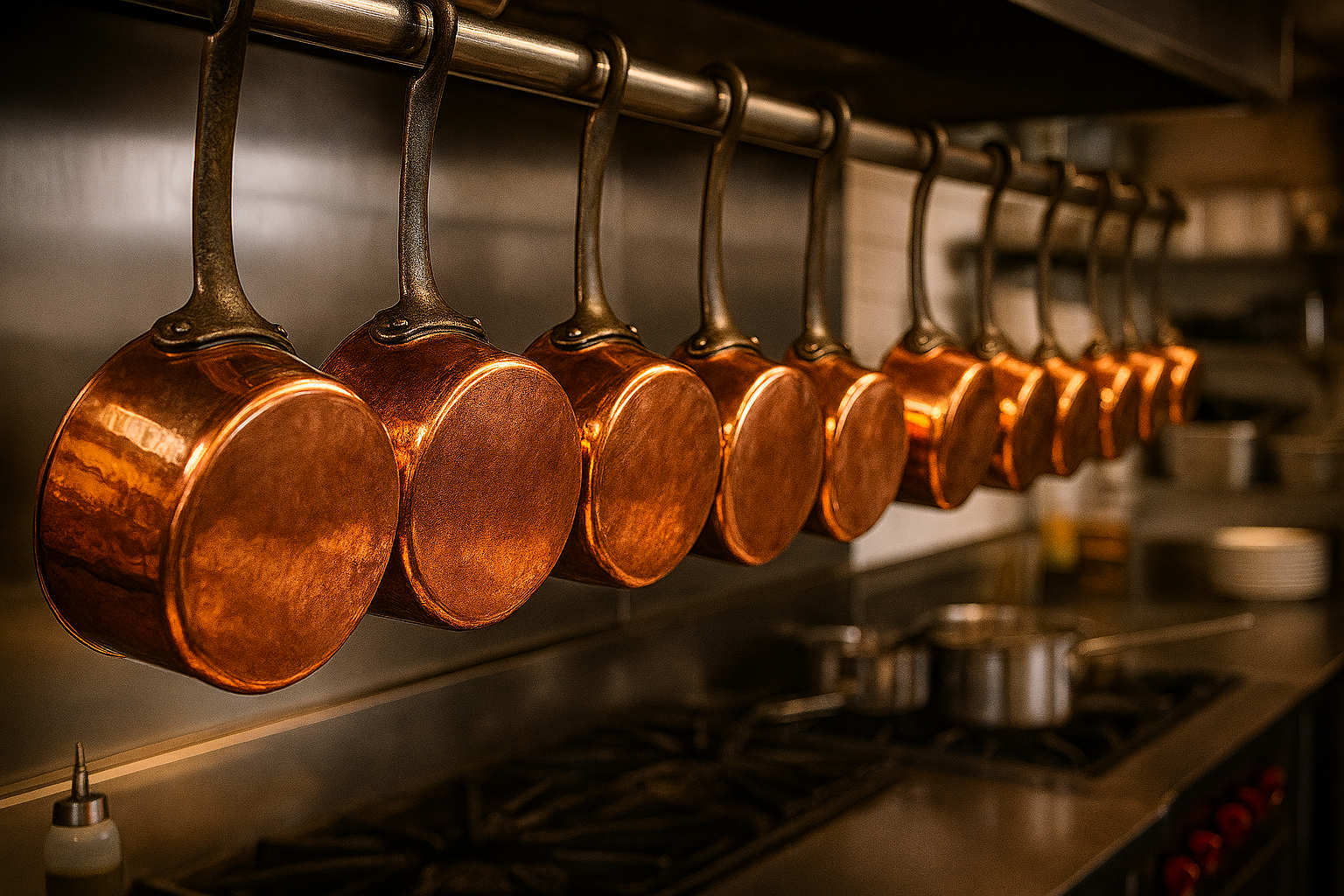
In Le Bernardin, Eric Ripert’s temple to seafood in Manhattan, the gleaming copper cookware isn’t merely decorative—it’s essential to executing the precision-dependent cuisine that has earned the restaurant three Michelin stars for consecutive decades. For fish cookery, where the difference between perfection and failure might be a matter of seconds, copper’s responsiveness provides an invaluable advantage.
“When you’re cooking at this level, your tools must be an extension of your intention,” Ripert has said. “Copper responds to the chef’s will almost without delay.”
This sentiment echoes throughout the upper echelons of the culinary world. At Alain Ducasse’s restaurants, at Thomas Keller’s French Laundry, at Joël Robuchon’s ateliers, copper remains indispensable despite its cost and maintenance requirements. What these chefs understand is that copper’s qualities address the fundamental challenges of fine cooking: maintaining precise temperatures, ensuring even heat distribution, and responding instantaneously to adjustment.
The late culinary scientist Harold McGee, in his seminal work “On Food and Cooking,” explained copper’s professional appeal: “The best conductors of heat are silver and copper, which transfer thermal energy so efficiently that they respond almost immediately to changes in heat input. This responsiveness gives the cook maximum control over the cooking process.”
In professional kitchens, this thermal control translates to consistency—the hallmark of exceptional restaurant experiences. When a diner orders the signature sauce-dependent dish for which a restaurant may be famous, the expectation is that it will taste precisely as remembered, whether it’s the first plate served that evening or the fiftieth. Copper helps make this consistency possible.
The Domestic Renaissance: Copper in Home Kitchens
While copper has never relinquished its place in professional kitchens, its presence in home cooking has waxed and waned with culinary fashions. The mid-20th century saw copper cookware largely relegated to decorative status in domestic settings, displaced by the convenience of aluminum and, later, non-stick coatings. Yet as home cooking has become more ambitious and technique-focused, copper has experienced a renaissance.
“We’ve seen a 300% increase in copper cookware sales over the past decade,” notes David Caldwell, senior buyer for a major culinary retailer. “It corresponds directly with the rise of food media, cooking shows, and social media food culture. As home cooks attempt more ambitious techniques, they discover what professionals have always known—equipment matters.”
This rediscovery has been accelerated by influential food personalities. When Julia Child displayed her wall-mounted collection of copper pots on her groundbreaking television program, she introduced millions of Americans to the idea that serious cooking required serious equipment. More recently, TV personalities like Ina Garten and Nigella Lawson have showcased copper in their home kitchens, creating aspirational images that link copper with culinary sophistication.
The home cook’s embrace of copper also reflects broader cultural currents. As with the slow food movement, artisanal bread baking, and heritage livestock breeds, the interest in traditional cookware represents a search for authenticity and connection in an increasingly digital world. A copper pan, with its tactile weight, visual warmth, and generational durability, offers something that disposable modern cookware cannot: a tangible link to culinary history.
“I inherited my grandmother’s copper jam pots,” shares Rebecca Wilcomb, James Beard Award-winning chef of Gianna in New Orleans. “When I use them each summer to preserve fruit, I’m not just making jam—I’m continuing a tradition that stretches back through my family and beyond. There’s a certain magic in using tools that have helped create memories across generations.”
The Limitations of Luxury: Copper’s Challenges
🧰 Maintenance Requirements
- Cleaning: Requires special care to maintain finish
- Polishing: Regular maintenance to preserve appearance
- Relining: Tin-lined pieces need periodic restoration
- Storage: Careful handling to prevent dents and scratches
For all its virtues, copper cookware comes with significant demands. Its reactivity with acidic foods necessitates interior lining—traditionally tin, which wears over time and requires professional renewal. The exterior, if left unattended, develops tarnish and eventually verdigris as the copper oxidizes. The material’s softness relative to steel means it dents more easily. And then there’s the price—premium copper cookware represents one of the most significant investments a cook can make in their kitchen.
“Good copper cookware requires a relationship,” observes Corey Milligan, founder of New West Knifeworks and a former professional chef. “You don’t just use it and forget it. You clean it properly, polish it periodically, store it carefully. In return, it performs in ways that no other material can match.”
This maintenance requirement has led manufacturers to develop alternatives that attempt to capture copper’s thermal properties with less demanding care needs. Copper-core stainless steel, aluminum pans with copper-infused coatings, and copper-bottom cookware all promise some fraction of copper’s performance without its full commitment.
Yet chefs and serious home cooks maintain that these compromises yield compromised results. “It’s like comparing a digital keyboard to a grand piano,” says Christopher Kimball, founder of Milk Street. “They both produce notes, but the experience and results are fundamentally different.”
The weight of copper—significantly heavier than aluminum and stainless steel—presents another practical consideration. A 10-inch copper sauté pan might weigh three pounds empty, compared to half that for an aluminum equivalent. This heft provides stability and heat retention but can be challenging for some cooks to manage, particularly when full.
Despite these limitations, many culinary professionals view copper’s demands not as drawbacks but as part of a worthy exchange—the necessary investment for unparalleled culinary control.
The Artisans Keeping Tradition Alive
In a modest workshop in Brooklyn’s Red Hook neighborhood, Mac Kohler of Brooklyn Copper Cookware represents a new generation of artisans preserving traditional craftsmanship while adapting to contemporary demands. Kohler and his team create copper cookware using methods that would be recognizable to coppersmiths from centuries past, albeit with some modern refinements.
“We’re not making museum pieces,” Kohler clarifies as he demonstrates the hammering technique that creates their signature finish. “We’re making working tools for serious cooks. The traditional methods aren’t about nostalgia—they’re about results. Hand-hammered copper simply performs better than machine-pressed.”
Across the Atlantic, in the small French town of Villedieu-les-Poêles, the Mauviel family has been producing copper cookware since 1830. Now in its seventh generation of family ownership, Mauviel 1830 navigates the balance between honoring traditional techniques and embracing innovations that improve durability and usability.
“We must respect our heritage while acknowledging that kitchens have changed,” explains Valérie Le Guern Gilbert, Mauviel’s president. “Our copper cookware is created for modern chefs, whether professional or amateur, who demand both performance and practicality.”
These artisans represent a small but vital community preserving skills that once risked extinction. The renewed interest in premium cookware has created space for specialist coppersmiths to thrive, whether creating new pieces or restoring vintage ones. This restoration market has itself become a significant niche, with specialists like Rocky Mountain Retinning providing services to maintain and renew heirloom copper pieces.
“About half our clients are professional chefs,” notes restorationist Jim Hamann. “The other half are home cooks who understand the value of investing in copper and maintaining it properly. They’re preserving not just cookware but a connection to culinary tradition.”
The Future Gleams Copper
Perhaps the most compelling aspect of copper cookware is not its storied past but its assured future. As culinary techniques continue to evolve and precision becomes ever more critical, copper’s inherent properties remain as relevant as they were centuries ago. No material yet discovered exceeds its thermal conductivity (except silver, which is prohibitively expensive for cookware), and no modern technology has rendered its performance benefits obsolete.
This enduring relevance explains why the most forward-thinking chefs still reach for the most ancient of cooking metals. Grant Achatz, whose restaurant Alinea has repeatedly been named among the world’s best for its innovative approach, maintains an extensive collection of copper cookware. “Innovation doesn’t always mean rejecting tradition,” he notes. “Sometimes it means understanding why traditions endured and building upon that foundation.”
For the home cook contemplating the significant investment that quality copper represents, the calculation extends beyond performance to longevity. While a mid-range stainless steel pan might last a decade with proper care, copper cookware routinely serves for generations. Museum collections worldwide display functional copper cooking vessels that have survived centuries, their forms still recognizable to modern cooks.
“When you purchase quality copper cookware, you’re not buying for yourself alone,” suggests culinary historian Jessica B. Harris. “You’re acquiring something that your grandchildren might use. That perspective transforms the economics of the purchase.”
As our culinary culture increasingly values providence, tradition, and sustainability, copper’s attributes align perfectly with contemporary values. Its durability defies our disposable age. Its production, particularly from traditional artisans, represents transparent craftsmanship in an era obsessed with authenticity. And its performance continues to set the standard against which all other cookware is judged.
In the final analysis, copper cookware’s appeal transcends utility, though its utility remains unmatched. It embodies a philosophy of cooking that values precision, responsiveness, and connection—to ingredients, to techniques, and to the generations of cooks who have pursued culinary excellence before us. In a copper pan, we find not just a cooking surface but a connection to culinary history itself—a living tradition that continues to evolve while honoring its ancient origins.
When that pan catches the light of the kitchen, its warm glow a distinctive counterpoint to the industrial gleam of modern appliances, it reminds us that cooking at its best has always been both science and art—a truth as elemental as copper itself.
Other Types of Cookware
While copper cookware is prized for its rapid heat conductivity and precise temperature control, it’s not the only option for serious cooks. Enameled cast iron cookware offers excellent heat retention and durability, making it ideal for slow braising, stews, and oven-to-table service where consistent warmth is key. Multi-ply Stainless steel cookware, on the other hand, provides a non-reactive surface and is often layered with aluminum or copper cores to improve heat distribution without the maintenance copper requires. For those seeking affordability and versatility, hard-anodized aluminum delivers even heating and a naturally nonstick surface. Each alternative brings its own strengths, depending on the cooking method and desired outcome.
Shop Copper Cookware 🛒
Sponsored links
| Tier | Brand | Notes |
|---|---|---|
| Budget | Gotham Steel | Hammered copper-look cookware with ceramic nonstick, induction-safe |
| Mid-range | Viking | Hammered copper exterior, stainless steel interior, induction-compatible |
| High-end | Mauviel | French-made, professional-grade copper with tin or stainless lining |
Why Copper Pans? [Video]
Featured Articles
Explore rich culinary stories, exclusive chef interviews, and expert insights from kitchens around the world. Discover cooking techniques, ingredient spotlights, and behind-the-scenes looks at the tools that shape global cuisine.

Georges Auguste Escoffier: Visionary Chef Who Revolutionized French Cuisine and Modern Cooking
Discover the life and legacy of Georges Auguste Escoffier, the legendary chef who transformed French cuisine and laid the foundation for modern culinary arts. This comprehensive historical profile …

How to Use a Knife, Fork, and Spoon
Master the basics of Western table etiquette with this guide to using a knife, fork, and spoon. Learn practical tips, cultural context, and the subtle rules that shape how we dine.
The History of Chocolate
Trace the fascinating history of chocolate—from its ancient origins with the Olmecs and Maya to its transformation into a global indulgence. Explore how cacao evolved from sacred ceremonial drink to …
Georges Auguste Escoffier: Visionary Chef Who Revolutionized French Cuisine and Modern Cooking
Discover the life and legacy of Georges Auguste Escoffier, the legendary chef who …
How to Use a Knife, Fork, and Spoon
Master the basics of Western table etiquette with this guide to using a knife, fork, and …
The History of Chocolate
Trace the fascinating history of chocolate—from its ancient origins with the Olmecs and …