The Evolution of Elegance: How Service à la Russe Revolutionized Western Dining

By: Simon
December 31, 2025 | Updated: February 17, 2026
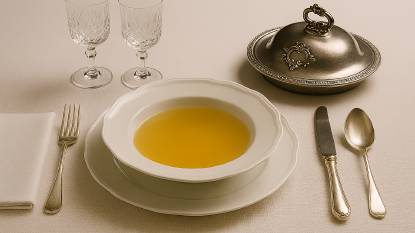


The table service that modern diners expect at events with any degree of formality—being presented with a pre-plated course, served sequentially by waitstaff—feels like a timeless standard. Yet, this is a relatively recent innovation in the long history of Western dining, a 19th-century import known as service à la russe (Russian service). Its adoption marked a dramatic shift from communal spectacle to individualized ceremony, fundamentally altering the aesthetics, etiquette, and social dynamics of formal entertaining.
The Antecedent: Service à la Française and Its Medieval Roots
To understand the revolution, one must first appreciate the tradition it displaced: service à la française. This style, dominant from the Middle Ages through the early 19th century, had its roots in the fabulous feasts of medieval courts. As historian Margaret Visser notes in The Rituals of Dinner, “The medieval dinner was a display, in the strongest sense of the word.” Each “course” or “service” was not a single dish but a vast, simultaneous presentation of up to dozens of platters—roasts, pies, fish, soups, sweetmeats—arranged across the table in a symmetrical, architectural display known as the grand couvert. The ceremony lay in the visual impact of opulent abundance.
Guests served themselves and their neighbors from platters within reach, employing shared knives and fingers before the widespread use of individual forks. As culinary historian Ivan Day describes, “The table was a landscape of food, and diners were explorers navigating its richness.” This style gave rise to enduring dining terms: the “entrée” (the entrance or first course of the service), the “relevé” (the “remove” that replaced it), and the “sorbet” (a palate cleanser between major services). While the 18th-century service à la française was more refined than its medieval forebear, it remained, in essence, a glorified buffet where “the hot things get cold, and the cold things get warm,” as the French gastronome Grimod de la Reynière famously quipped.
The Innovator: Prince Alexander Borisovich Kurakin
The catalyst for change was a Russian diplomat, Prince Alexander Borisovich Kurakin (1752-1818). While the practice existed in Russian aristocratic circles earlier, Prince Kurakin is consistently credited by contemporary sources with introducing the style to Paris during his tenure as ambassador in the 1810s, with its widespread adoption flourishing in the 1830s. His lavish embassy dinners, where dishes were presented in a precise sequence and served individually to guests from platters by a regiment of servants, created a sensation. The French, initially skeptical, came to see this new method as the height of modern, sophisticated luxury. The style quickly crossed the Channel, championed by Victorian hosts in England seeking a new mode of disciplined elegance. As Lady Charlotte Campbell observed in 1832, “The Russian style of serving dinner… is now universally adopted in all fashionable houses.”
The New Ceremony: Sequential Opulence and Social Control
Service à la russe offered a fundamentally different expression of wealth and power. Opulence was demonstrated not through simultaneous abundance but through controlled, sequential presentation and an investment in human capital—the army of servants required to execute it flawlessly.
The meal progressed through a set menu of courses—typically soup, fish, entrée, roast, dessert—each presented one at a time. An impressive pièce montée (a decorative centerpiece) or a large roasted joint might be paraded before the guests for admiration—a nod to the old display—but then whisked away to a sideboard (dressoir) or kitchen for carving. Footmen, often in matching livery, would then serve each guest in turn, proceeding around the table in a strict hierarchy, offering dishes from the left and pouring wine from the right. This required a new suite of specialized tableware: individual place settings with multiple forks, knives, and glasses for each course, which in turn spurred the glass and ceramics industries.
This shift had profound social consequences. It enforced a new decorum and passivity upon guests, who were now served rather than serving themselves. As food historian Dr. Annie Gray points out, “It turned diners into an audience for a performance directed by the host.” Furthermore, because each dish was presented individually, refusing it became a social slight. Consequently, guests were often compelled to eat far more than their ancestors at medieval feasts, who could pick and choose from the groaning board. The English author Captain R. H. Gronow remarked in his Reminiscences (1862) that under the new style, “a man dines twice as much as he used to do.”
Lasting Legacy: The Foundation of Modern Fine Dining
The triumph of service à la russe by the late Victorian era established the foundational grammar of modern Western fine dining. It created the structure of the multi-course tasting menu, elevated the role of the server, and made the individual plate—its composition, balance, and artistry—the focal point of culinary expression. The older service à la française survived only in the form of the buffet or cocktail reception.
Ultimately, the shift from à la française to à la russe reflects a broader societal move from communal, public display to individualized, disciplined experience. It replaced the banquet table as a landscape of shared plenty with the dinner party as a tightly choreographed theater of status, where luxury was measured not just by what was on the table, but by the meticulous ceremony of how it arrived there.
References & Further Reading
Sponsored links
- All Manners of Food: Eating and Taste in England and France from the Middle Ages to the Present by Stephen Mennell. University of Illinois, 1995.
- The Rituals of Dinner: The Origins, Evolution, Eccentricities, and Meaning of Table Manners by Margaret Visser. New York: Penguin Books, 1992.
- Food in History by Reay Tannahill. New York: Crown, 1995.
Featured Articles
Explore rich culinary stories, exclusive chef interviews, and expert insights from kitchens around the world. Discover cooking techniques, ingredient spotlights, and behind-the-scenes looks at the tools that shape global cuisine.
Georges Auguste Escoffier: Visionary Chef Who Revolutionized French Cuisine and Modern Cooking
Discover the life and legacy of Georges Auguste Escoffier, the legendary chef who transformed French cuisine and laid the foundation for modern culinary arts. This comprehensive historical profile …
How to Use a Knife, Fork, and Spoon
Master the basics of Western table etiquette with this guide to using a knife, fork, and spoon. Learn practical tips, cultural context, and the subtle rules that shape how we dine.

The History of Chocolate
Trace the fascinating history of chocolate—from its ancient origins with the Olmecs and Maya to its transformation into a global indulgence. Explore how cacao evolved from sacred ceremonial drink to …
Georges Auguste Escoffier: Visionary Chef Who Revolutionized French Cuisine and Modern Cooking
Discover the life and legacy of Georges Auguste Escoffier, the legendary chef who …
How to Use a Knife, Fork, and Spoon
Master the basics of Western table etiquette with this guide to using a knife, fork, and …
The History of Chocolate
Trace the fascinating history of chocolate—from its ancient origins with the Olmecs and …