🍚 Everyday Eating Customs in China

By: Simon
August 28, 2025 | Updated: February 17, 2026
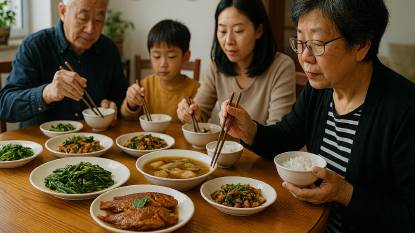


While the West has embraced Chinese cuisine through restaurants and takeout menus, the experience of dining in even the most authentic establishments rarely mirrors the rhythm and intimacy of a traditional Chinese family meal. In fact, restaurant dining—whether in Beijing or Boston—often resembles a banquet, where everyday customs are reversed, amplified, or ritualized for celebration.
To understand Chinese food culture in its truest form, one must look beyond the banquet hall and into the home, where daily meals reflect regional diversity, social etiquette, and a deep respect for the labor behind each grain of rice.
🏠 Family Meals: Structure and Rhythm
Across China, family meals are a cornerstone of daily life. Most households aim to gather for three meals a day, though in rural areas or during busy agricultural seasons, laborers may settle for two full meals supplemented by smaller snacks—often enjoyed at local tea houses.
Unlike Western conventions that associate specific foods with specific times (eggs for breakfast, sandwiches for lunch), Chinese meals are more fluid. The same types of dishes—meat, vegetables, soup, and grain—may appear at breakfast, lunch, or dinner. The emphasis is not on variety between meals, but on balance within each one. A well-planned meal offers multiple dishes, allowing diners to experience contrast and harmony in every bite.
🍚 The Core of the Meal: Fan and Ts’ai
At the heart of every Chinese meal is fan (饭)—the grain component. So central is this element that the act of eating is referred to as hsia fan, meaning “a period of grain.” In southern regions and urban centers, fan typically means rice or rice-based products. In the north, wheat takes precedence, appearing as noodles, steamed buns, or flatbreads.
For less affluent families, grains like millet, sorghum, or corn may substitute for rice or wheat. Regardless of type, fan is the foundation. The accompanying dishes—meats, vegetables, tofu—are known as ts’ai (菜), which translates loosely to “side dishes.” These are not the main event, but flavorful complements to the grain, almost akin to condiments in their supporting role.
🥢 Place Settings and Serving Etiquette
A typical place setting includes:
- A bowl of fan
- A pair of chopsticks
- A flat-bottomed soupspoon
- A small saucer (used for bones, shells, or resting oversized bites)
Napkins are uncommon; instead, diners receive a hot towel at the end of the meal to cleanse hands and mouth.
All ts’ai dishes are placed in the center of the table and served simultaneously. Diners eat directly from these communal plates using their chopsticks, and soup is shared from a common bowl. The saucer is not for portioning but for practical use—discarding inedible bits or managing unwieldy bites.
Chinese dining tables are typically round or square, promoting equal access to all dishes. Reaching across the table is perfectly acceptable and expected.
👵 Who Eats When: Hierarchy and Habits
Meals begin in order of seniority. Each diner waits for their immediate superior to start before taking their own first bite. Children are taught to eat evenly from all ts’ai dishes, avoiding favoritism or hesitation. This practice reinforces discipline and respect.
Soup is sipped while inhaling gently—a technique that cools the liquid and enhances flavor. Though it produces a slurping sound considered rude in the West, it is entirely appropriate in Chinese culture.
Fan is eaten by lifting the bowl to the lips and pushing the grains in with chopsticks. Leaving the bowl on the table while eating suggests dissatisfaction. Every grain must be finished—wasting fan is seen as disrespectful to the farmers and cooks who made the meal possible.
🍵 Accompaniments: What’s Not on the Table
Unlike Western meals, Chinese family meals rarely include beverages or dessert. Tea is consumed throughout the day but not typically served during meals. Soup acts as the primary liquid. Alcohol may appear at special occasions, but water—ubiquitous in Western dining—is notably absent.
Sweet foods are reserved for festivals, banquets, or light snacks at tea houses. Their absence from daily meals reflects a cultural preference for savory balance and functional nourishment.
📚 Recommended Reading
For deeper exploration of Chinese culinary customs and cultural context, consider reading these books (sponsored links):
- Everything You Want to Know about Chinese Cooking by Pearl Kong Chen, Tien Chi Chen, and Rose Tseng. Woodbury, New York: Barron’s, 1983.
- How to Cook and Eat in Chinese by Buwei Yang Chao. New York: The John Day Company, 1945.
- Food in Chinese Culture: Anthropological and Historical Perspectives, edited by Kwang-chih Chang. New Haven: Yale University Press, 1977.
Featured Articles
Explore rich culinary stories, exclusive chef interviews, and expert insights from kitchens around the world. Discover cooking techniques, ingredient spotlights, and behind-the-scenes looks at the tools that shape global cuisine.
Georges Auguste Escoffier: Visionary Chef Who Revolutionized French Cuisine and Modern Cooking
Discover the life and legacy of Georges Auguste Escoffier, the legendary chef who transformed French cuisine and laid the foundation for modern culinary arts. This comprehensive historical profile …
How to Use a Knife, Fork, and Spoon
Master the basics of Western table etiquette with this guide to using a knife, fork, and spoon. Learn practical tips, cultural context, and the subtle rules that shape how we dine.
The History of Chocolate
Trace the fascinating history of chocolate—from its ancient origins with the Olmecs and Maya to its transformation into a global indulgence. Explore how cacao evolved from sacred ceremonial drink to …
Georges Auguste Escoffier: Visionary Chef Who Revolutionized French Cuisine and Modern Cooking
Discover the life and legacy of Georges Auguste Escoffier, the legendary chef who …
How to Use a Knife, Fork, and Spoon
Master the basics of Western table etiquette with this guide to using a knife, fork, and …
The History of Chocolate
Trace the fascinating history of chocolate—from its ancient origins with the Olmecs and …